
Why in Brazil Your Telecom Holding Is Forced to Unblock Spam Callers
Anatel has ordered New York-listed carrier TIM S.A. to suspend its anti-spam tool, escalating regulatory risks and reviving a feud with Vivo.

Investors holding shares of New York-listed telecom operator TIM S.A. are facing a sudden regulatory intervention that forces the company to dismantle its automated anti-spam systems. On November 13, 2026, the carrier was ordered to suspend its "TIM Anti Spam" tool and unblock all restricted phone numbers within 24 hours. The decision exposes the company to immediate operational disruptions and reignites a sharp commercial feud with its main market competitor, Telefônica Brasil.
The order was issued by Brazil’s National Telecommunications Agency, Anatel, which serves as the federal telecom regulator. According to the official Anatel notification, the regulatory body stepped in because TIM S.A. failed to provide transparent blocking criteria, lacked adequate channels for users to contest blocked numbers, and blocked essential public services. A compliance review reported by Telesíntese revealed that the automated tool had erroneously silenced emergency lines, military police terminals, and major municipal hospitals.
An Escalating Battle Over Mass Calling
This regulatory crackdown stems from a corporate conflict that began escalating in September 2026. Rival carrier Telefônica Brasil, operating under the brand Vivo, accused TIM S.A. of selectively blocking its commercial and administrative calls. In its official filings, Vivo detailed that the automated blocking swept up legitimate public entities like the São Paulo Military Police, the Presidential Palace, and the Central Bank. Anatel had previously ordered emergency unblockings in September 2026, but the regulator decided to halt TIM’s entire system after the carrier missed a final November 9, 2026, deadline to submit audit data.
TIM S.A. has stated it will appeal the regulator's decision. The telecom operator argues that unilateral mandates are counterproductive and has advocated for anti-spam standards to be established collectively through an industry-wide regulatory working group. Under Anatel's telecom guidelines enacted in August 2026, carriers are encouraged to combat abusive robocalls, but the agency mandates that any such system must remain fully audit-ready and user-friendly, as explained in a report by Tecnoblog.
In your brokerage app
American retail investors holding TIM S.A., listed in New York as TIMB, or Telefônica Brasil, listed in New York as VIV, are directly exposed to the regulatory compliance costs of this telecom dispute. These New York-listed ADRs are also major components of broad-market Brazil ETFs, meaning any prolonged regulatory penalties or increased spam compliance burdens could impact their regional performance.
Analysis · NWX analysis desk
Which Brazil assets this touches
- TIMB, VIV, TIMS3, VIVT3, USDBRL — Named in this story.
Fundamentals · TIMS3 (TIMS3)
TIMS3 (TIMS3) trades at 12.5x its yearly earnings and 2.0x its book value. Its return on equity is 16.3%. Its dividend yield is 6.8%. The market values the company at R$51.1 billion. Its financial health score is 66 out of 100 (stable), based on profitability, liquidity, debt and growth. Latest: Q2 2026 results, published Jul 27, 2026.
| Price / earnings (P/E) | 12.5x | How many years of the current yearly profit the share price adds up to. |
|---|---|---|
| Price / book (P/B) | 2.0x | The share price compared with the accounting value of what the company owns, per share. |
| Return on equity (ROE) | 16.3% | Yearly profit for every R$100 that shareholders have put into the company. |
| Net margin | 14.9% | The part of every R$100 in sales that is left as profit. |
| Dividend yield | 6.8% | Cash paid to shareholders over the past year, as a share of today's price. |
| Market value | R$51.1 billion | What the whole company is worth at today's share price. |
Technical picture · TIMS3 (TIMS3)
TIMS3 (TIMS3) closed at R$21.55 on Nov 13, 2026, up 8.4% from five sessions earlier. The last close is above its 20-day average of R$19.75 and above its 50-day average of R$19.27. Since May 19, 2026 it has traded between R$16.00 (low, Oct 26, 2026) and R$23.17 (high, Jul 15, 2026).
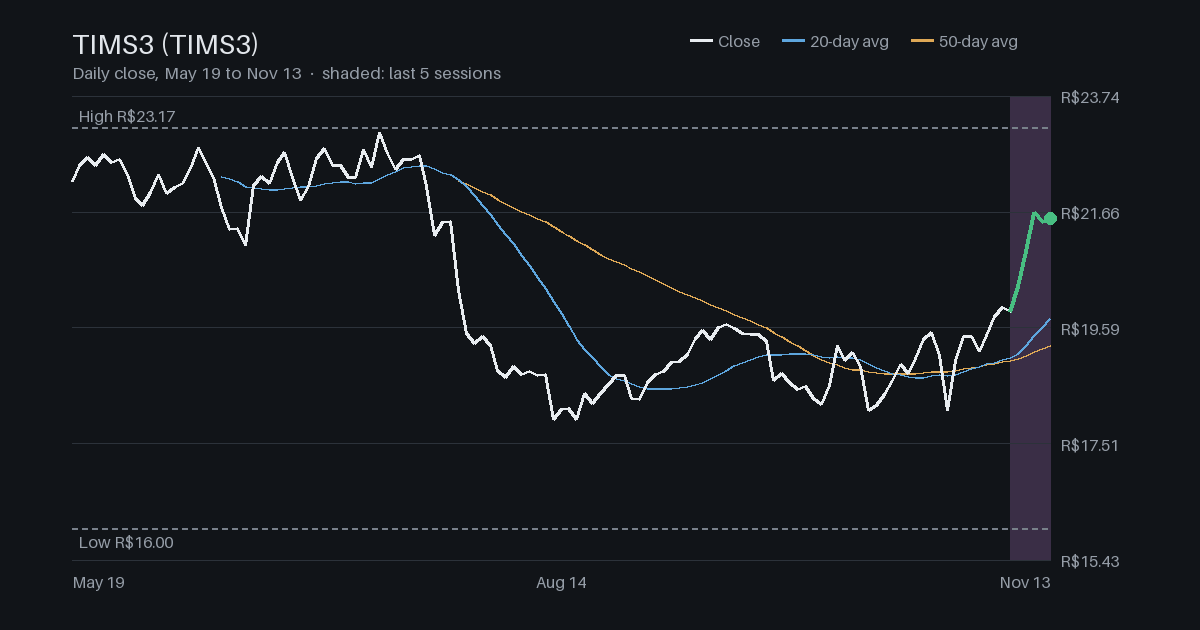
| Last close | R$21.55 | Closing price on Nov 13, 2026. |
|---|---|---|
| 5-session move | +8.4% | Change in the closing price over the last five trading days. |
| 20-day average | R$19.75 | The average closing price of the last 20 trading days. |
| 50-day average | R$19.27 | The average closing price of the last 50 trading days. |
| Period high | R$23.17 | Highest price since May 19, 2026. |
| Period low | R$16.00 | Lowest price since May 19, 2026. |
Latest articles
 How Grain Futures Shift Past Brazil Stock Market Holidays in 2026Large speculators trimmed their net-long soybean positions as of November 3, 2026, navigating a record-breaking South American export crop.
 How a Major Brazil Holding Company Is Swapping CEOs to Slash DebtBrazilian conglomerate Cosan announced CEO Marcelo Martins is stepping down in January 2027 as the company shifts from expansion to aggressive deleveraging.
 Court Delay on Brazil Shorter Workweek Eases Corporate PressuresSupreme Court Justice Luiz Fux halts a virtual trial on Brazil's 6x1 to 5x2 workweek transition, resetting votes but leaving a temporary December start date active.