
How Grain Futures Shift Past Brazil Stock Market Holidays in 2026
Large speculators trimmed their net-long soybean positions as of November 3, 2026, navigating a record-breaking South American export crop.
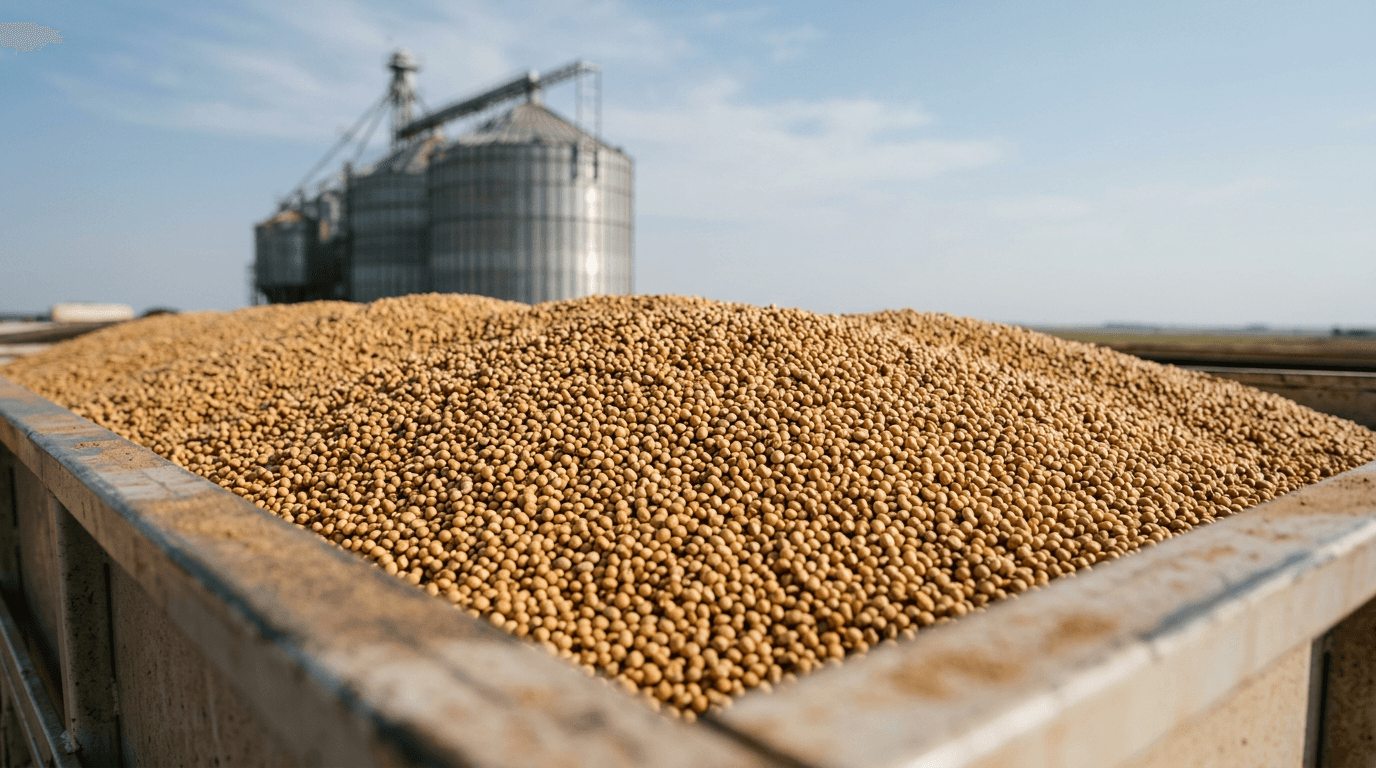
American retail investors tracking agricultural exchange-traded funds or monitoring the grocery bills that shape the Federal Reserve's inflation decisions are witnessing a subtle cooling in speculative bets on the physical ingredients of the global food supply. According to the U.S. Commodity Futures Trading Commission (CFTC) commitments of traders report published for the November 3, 2026 observation date, large speculators pared back their bullish exposure, holding a net-long position of 163,618 contracts on Chicago Board of Trade soybeans. This net-long position represented a drop of 40,501 contracts from the previous week's net-long position of 204,119 contracts on October 27, 2026, according to CFTC historical records.
While American trade desks processed these position changes, the underlying force on global grain prices remains concentrated in South America, where Brazil's agricultural engine is producing a historic wall of supply. Even as local financial trading paused for All Souls' Day on November 2, 2026—one of the scheduled brazil stock market holidays 2026 when the B3 exchange in São Paulo closed its doors—physical grain corridors remained active. According to official Brazilian customs data released through October 2026, Brazil exported a record 106.5 million metric tons of soybeans in the first ten months of 2026, which represents a 5.9% increase compared to the same period in 2025. This ten-month export volume has already surpassed the country's full-year shipments for the entirety of 2025.
The trimming of speculative long positions on Chicago futures contracts reflects this physical reality. Because global grain prices are highly sensitive to South American weather and export flows, the massive volume coming out of Brazil has acted as a natural cap on speculative fervor. According to the U.S. Department of Agriculture (USDA) forecast from November 2026, Brazil is on track to harvest a record 186 million metric tons of soybeans for the 2026/27 cycle, with exports projected to reach 118 million metric tons. Meanwhile, Brazil's national crop agency, Conab, issued a slightly more conservative but still historic harvest projection of 181.6 million metric tons on November 13, 2026.
The CFTC data for November 3, 2026, showed that non-commercial traders held 239,253 long contracts compared to 75,635 short contracts, out of a total market open interest of 959,576 contracts. These figures illustrate why weekly commitments data functions as context rather than a direct price forecast. While speculators are pulling back their exposure, they still retain a substantial net-long stance, suggesting that the market is far from capitulating to a bearish outlook. Global grain traders will continue to watch weather patterns in key Brazilian agricultural states like Mato Grosso, where planting progress over the coming weeks will determine whether the 2026/27 harvest actually hits these record-breaking institutional forecasts.
In your brokerage app
For US retail investors, shifts in global soybean fundamentals directly impact several major holdings available in standard brokerage accounts. For direct exposure to South American farmland and agricultural production, investors often track Adecoagro S.A., a Luxembourg-incorporated company listed in New York that owns and operates massive crop operations in South America. Additionally, global meat processing giant JBS N.V., which is listed in New York and relies heavily on soybean meal as a primary feed input, is highly sensitive to the global pricing pressures reflected in Chicago futures markets. Alternatively, those seeking direct commodity price tracking without trading futures contracts often look to the Teucrium Soybean Fund, a US-listed exchange-traded product designed to track the performance of soybean futures.
Analysis · NWX analysis desk
Which Brazil assets this touches
- SOYBEAN — Named in this story.
- EWZ, USDBRL, IBOV — Higher U.S. interest rates tend to pull money out of emerging markets such as Brazil, which weighs on the real and on Brazilian stocks; lower rates tend to do the opposite.
Technical picture · iShares MSCI Brazil ETF (EWZ)
iShares MSCI Brazil ETF (EWZ) closed at $32.22 on Nov 13, 2026, up 0.8% from five sessions earlier. The last close is below its 20-day average of $35.03 and below its 50-day average of $37.59. Since May 12, 2026 it has traded between $31.73 (low, Nov 3, 2026) and $43.54 (high, Oct 9, 2026).
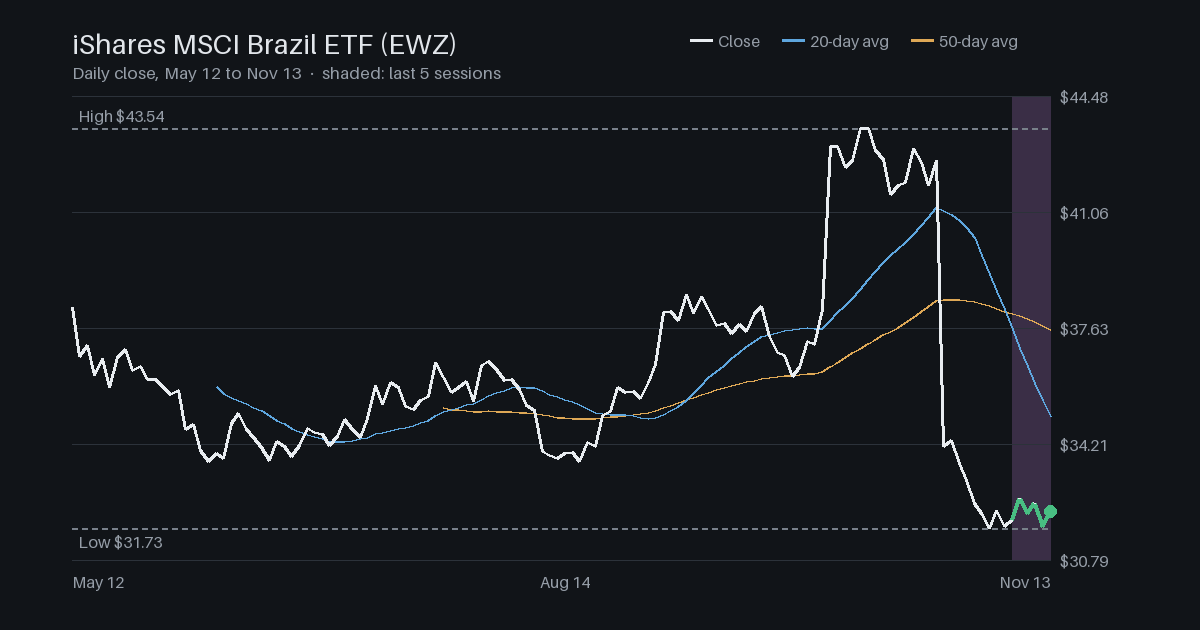
| Last close | $32.22 | Closing price on Nov 13, 2026. |
|---|---|---|
| 5-session move | +0.8% | Change in the closing price over the last five trading days. |
| 20-day average | $35.03 | The average closing price of the last 20 trading days. |
| 50-day average | $37.59 | The average closing price of the last 50 trading days. |
| Period high | $43.54 | Highest price since May 12, 2026. |
| Period low | $31.73 | Lowest price since May 12, 2026. |
Related coverage
 How a Major Brazil Holding Company Is Swapping CEOs to Slash DebtBrazilian conglomerate Cosan announced CEO Marcelo Martins is stepping down in January 2027 as the company shifts from expansion to aggressive deleveraging.
 Why Corporate Headwinds in Brazil Today Match Wall Street ExpectationsBrazil’s Senate backs a $10.8B spending-cut bill as high interest rates, new labor rules, and a temporary Philippine pork ban squeeze corporate margins.
 Philippines Pork Ban on Brazil, the Food Giant, Impacts Meat StocksA temporary 60-day safeguard on pork by the Philippines, Brazil’s top export market, raises the risk of domestic oversupply and price pressures.