
Direct Nasdaq listing INTR gains attention among Brazilian financial stocks
Inter & Co reports record 3Q26 earnings with net income up 26% year-over-year, drawing market interest to its Nasdaq-listed structure.

U.S. retail investors can trade shares of digital banking group Inter & Co. directly on the Nasdaq without having to manage the fees and transaction hurdles of American Depositary Receipts (ADRs). The Miami-headquartered firm saw its Class A common stock rise 4.67% to close at $4.15 on Friday, November 13, 2026, according to Nasdaq market data, drawing attention to the digital lender's performance and direct listing structure.
While most major Latin American financial institutions trade in New York through depositary receipts, Inter & Co. migrated its primary listing to the United States in 2022 to attract direct foreign capital. The company controls Banco Inter, one of Brazil's largest digital-only lenders, which grew its customer base to 46.8 million total clients and 27.1 million active users, according to the bank’s third-quarter earnings report on November 12, 2026. This digital super-app model integrates checking accounts, wealth management, insurance, and e-commerce into a single platform designed to compete with traditional brick-and-mortar financial institutions across Brazil.
The stock's recent upward movement follows the release of Inter & Co.'s third-quarter 2026 financial results on November 12, 2026, which posted a record consolidated net income of $76.1 million (425 million Brazilian reais), representing a 26% year-over-year increase, as detailed in the company's SEC Form 6-K filing. This performance is particularly noteworthy given Brazil's high-interest-rate environment, where the central bank's benchmark Selic rate stands at 13.75% as of November 15, 2026. Despite these macro headwinds, Inter & Co. expanded its credit book by 25% year-over-year to $10.39 billion, outpacing the broader Brazilian credit market’s expansion of 8.6% during the same period.
Another key catalyst for international trading liquidity is the company's recent completion of its exit from the Brazilian Depositary Receipt (BDR) program. On November 10, 2026, Inter & Co. filed an update with the SEC confirming it had finalized the sale of 12.28 million Class A shares under its BDR wind-down facility. By centralizing its equity on the Nasdaq, the company has consolidated trading volume in New York, giving direct shareholders undivided ownership. This structure also helps control administrative costs, helping push the bank's efficiency ratio down to 41.9% in the third quarter of 2026, down 322 basis points from the prior year, as reported in the company's November 12, 2026, disclosures.
Looking forward, investors will track whether the digital lender can sustain its credit growth while managing asset quality as consumer portfolios expand. The company’s non-performing loan ratio for credit overdue by 90 days or more edged up to 5.3% in the third quarter of 2026, up from earlier quarters due to expansion in private payroll loans and credit cards, according to company earnings disclosures on November 12, 2026. Investors will closely watch the next major earnings release in early February 2027 to see if management's target of 20% to 25% annual credit growth remains sustainable.
In your brokerage app
Inter & Co. Inc. trades on the Nasdaq under the symbol INTR. Unlike traditional foreign bank stocks that require specialized depositary agreements, shares of this Miami-headquartered digital bank are held as direct common equity, making them accessible to standard U.S. brokerage accounts at major institutions like Fidelity, Schwab, and Robinhood.
Analysis · NWX analysis desk
Which Brazil assets this touches
- INTR — Named in this story.
- EWZ, NU, STNE, PAGS, IBOV — Big swings in U.S. tech stocks tend to spill into Brazil's fintechs listed in New York and into the broad Brazil fund, as global investors change how much risk they hold.
Technical picture · Inter&Co (INTR)
Inter&Co (INTR) closed at $4.15 on Nov 13, 2026, up 7.5% from five sessions earlier. The last close is below its 20-day average of $4.81 and below its 50-day average of $5.52. Since May 12, 2026 it has traded between $3.78 (low, Nov 5, 2026) and $7.74 (high, Oct 12, 2026).
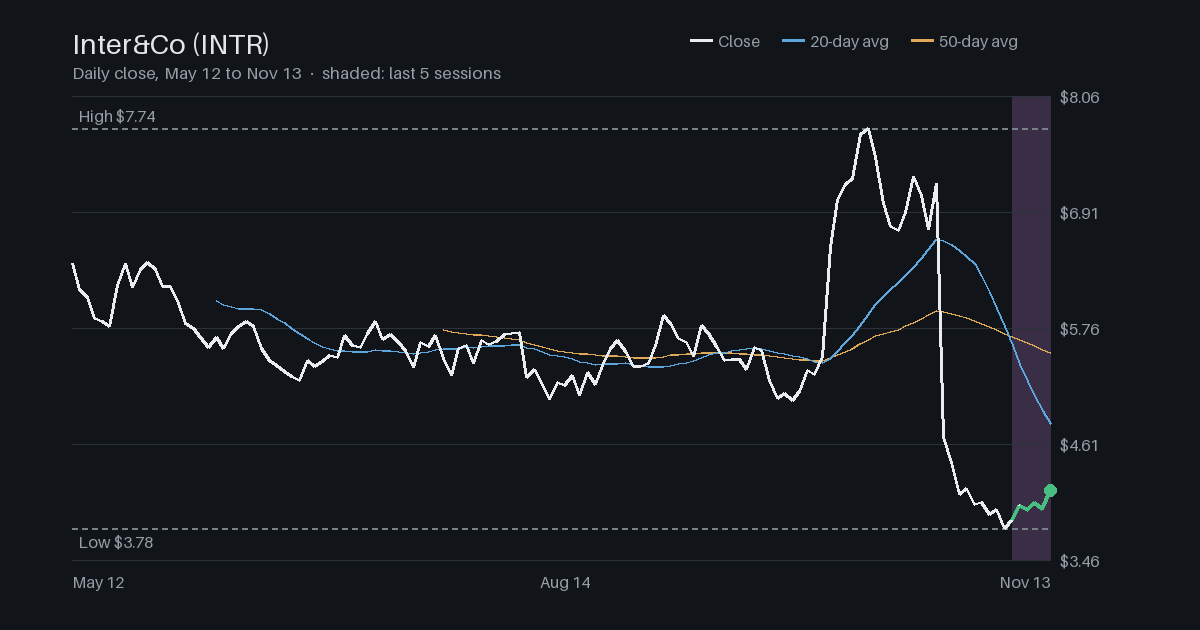
| Last close | $4.15 | Closing price on Nov 13, 2026. |
|---|---|---|
| 5-session move | +7.5% | Change in the closing price over the last five trading days. |
| 20-day average | $4.81 | The average closing price of the last 20 trading days. |
| 50-day average | $5.52 | The average closing price of the last 50 trading days. |
| Period high | $7.74 | Highest price since May 12, 2026. |
| Period low | $3.78 | Lowest price since May 12, 2026. |
Related coverage
 To US Investors in Brazil, Your Welcome Means XP Excess CapitalXP Inc. prepares to report its Q3 2026 earnings on November 16, with investors watching for potential capital distributions from its 20.3% BIS ratio.
 Why INTR is one of the few Brazil stocks trading without ADR feesInter & Co reported record Q3 2026 profits of R$ 425 million and cleared its Nasdaq-based BDR sales facility, lifting technical pressure on its shares.
 StoneCo Cuts Growth Targets, Cooling Your Welcome Brazil Fintech BetBrazilian fintech StoneCo slashed its 2026 adjusted gross profit outlook and withdrew its 2027 targets on November 12, 2026, citing soaring interest rates.