
How Shifting Policies in Brazil Today Match the Needs of US Investors
Brazil passes a major $10 billion fiscal package, tightens rules on strategic rare earth mining, and cracks down on systemic judicial debt fraud.
Key takeaways
- The Brazilian Senate approved the PLP 299/2026 fiscal package to yield up to R$ 56.1 billion ($10 billion) in savings, per official Senate reports on November 12, 2026
- The National Justice Council canceled R$ 4.7 billion in fraudulent court-ordered precatório debts, per a Supreme Court request on September 29, 2026
- Braskem S.A. defaulted on its R$ 1.2 billion debenture payment due November 9, 2026, per B3 exchange disclosures on November 12, 2026
- XP Inc. announced plans to distribute excess capital after its BIS ratio hit 20.7%, per company records on October 16, 2026
If you hold shares of Latin American tech giants or broad emerging market ETFs in a US brokerage account, a quiet but structural policy pivot is underway in South America’s largest economy brznews.com. For investors who do not follow the daily noise out of Brasília, a series of sweeping legislative, regulatory, and corporate restructuring decisions have begun to align behind a single, coherent narrative. Brazil is trading immediate corporate tax perks for longer-term fiscal and judicial discipline, while systematically restructuring its critical mineral and financial sectors brznews.com.
The most immediate evidence of this shift came on November 12, 2026, when the Brazilian Senate passed the base text of Complementary Bill (PLP) 299/2026 by a vote of 45 to 31, according to BRZ News. The fiscal adjustment package is designed to yield up to R$ 56.1 billion (approximately $10 billion USD) in budget savings for 2027 by lowering the real annual spending growth cap from 2.5% to 2.0% during periods of fiscal stress, as reported by Reuters. To reinforce these savings, the judiciary is cracking down on systemic leakage. Following the cancellation of R$ 4.7 billion in fraudulent court-ordered government debts (precatórios) on September 23, 2026, Supreme Court Justice Gilmar Mendes initiated a sweeping audit of federal regional courts, per BRZ News on October 3, 2026. To shut down future exploitation, a real-time national tracking system was launched jointly by the Supreme Court and the Central Bank to log all government debt transfers youtube.com.
Brasília is matching this domestic cleanup with an increasingly protective stance on strategic resources. On November 5, 2026, the National Council for Industrialization of Critical and Strategic Minerals approved a select list of 27 critical minerals, including lithium and rare earths, to qualify for local federal support, according to Mining.com. Crucially, the government intends to implement new regulations that prioritize domestic processing and refining of Brazil’s 21 million tonnes of rare earth reserves, rather than permitting direct raw ore exports globaltimes.cn mining.com. As the risk of future U.S. tariffs looms, Brazil is accelerating this mineral and agricultural export pivot toward Asian trade blocs, transforming itself into a sovereign processing hub rather than a simple raw material exporter.
For retail equity portfolios, this macro matrix is landing directly on corporate balance sheets. Petrochemical titan Braskem S.A. failed to settle a R$ 1.2 billion (roughly $210 million USD) debenture payment due November 9, 2026, confirming in a B3 exchange filing on November 12, 2026, that the liabilities are covered under its ongoing $10.9 billion extrajudicial restructuring, as reported by Stock Titan. Meanwhile, digital-first operators are using Brazil's advanced financial infrastructure to capture the upside. MercadoLibre’s financial arm, Mercado Pago, recently rolled out new small-enterprise credit lines of up to BRL 700,000, running proprietary risk algorithms over Open Finance data representing 138 million unique consents, per reports on El Fondo on October 14, 2026.
At the same time, traditional financial giants are returning capital pulse2.com. Retail brokerage pioneer XP Inc. is actively drawing down its capital adequacy (BIS) ratio from an overly conservative 20.7% toward its 16% to 19% target, committing to return the excess capital to shareholders via buybacks and dividends by the end of 2026, according to Walnut Invest on October 16, 2026.
The next major milestone for investors to watch is January 5, 2027, when re-elected President Luiz Inácio Lula da Silva gains the executive authority to fill 73 director-level appointments across federal regulatory agencies and the Central Bank, per BRZ News. Resolving an administrative bottleneck that has left 21 of these seats vacant or occupied by interim heads will clear up delayed infrastructure and energy licenses, but the upcoming Senate confirmation hearings will test how much policy control Lula must yield to the centrist legislative coalition brznews.com.
In your brokerage app
For US retail investors, these regulatory and fiscal shifts are directly visible through several New York-traded assets. MercadoLibre (listed in New York as MELI) continues to leverage Brazil's Open Finance network to expand its high-margin credit book levelheadedinvesting.com. Meanwhile, investors in retail brokerage giant XP Inc. (XP) are positioned to capture upcoming excess capital distributions [pulse2.com](https://vertexaisearch.cloud.google.com/grounding-api-redirect/AUZIYQFjGXZQ5-4NgLazH4hzllxH7sY3cpbabMp1jRlde48comi4A3eclneT0OOPAv_Ode0H-DkKyPfUzp6dR-MHS8uzhHfseYmOJQ4hN6Vu9mlZJYWvtia_Vk6M1BHgnw_kVpWCdgn0GyDQ1i2_kn6HnmyCu0vc-4iB8k47ZwgXFwWUbqk0hl2EiR5pNMxnV4JQTg8Q_IjcDh3HlGUp], whereas those exposed to the petrochemical sector via Braskem (BAK) must navigate ongoing bankruptcy proceedings securitasglobal.com. For those seeking digital banking exposure, Inter & Co (INTR) stands out as one of the few Brazilian financial institutions listed directly as common shares on Nasdaq, completely bypassing traditional ADR custodian pass-through fees robinhood.com.
Analysis · NWX analysis desk
Which Brazil assets this touches
- EWZ, NU, STNE, PAGS, IBOV — Big swings in U.S. tech stocks tend to spill into Brazil's fintechs listed in New York and into the broad Brazil fund, as global investors change how much risk they hold.
Technical picture · iShares MSCI Brazil ETF (EWZ)
iShares MSCI Brazil ETF (EWZ) closed at $32.22 on Nov 13, 2026, up 0.8% from five sessions earlier. The last close is below its 20-day average of $35.03 and below its 50-day average of $37.59. Since May 12, 2026 it has traded between $31.73 (low, Nov 3, 2026) and $43.54 (high, Oct 9, 2026).
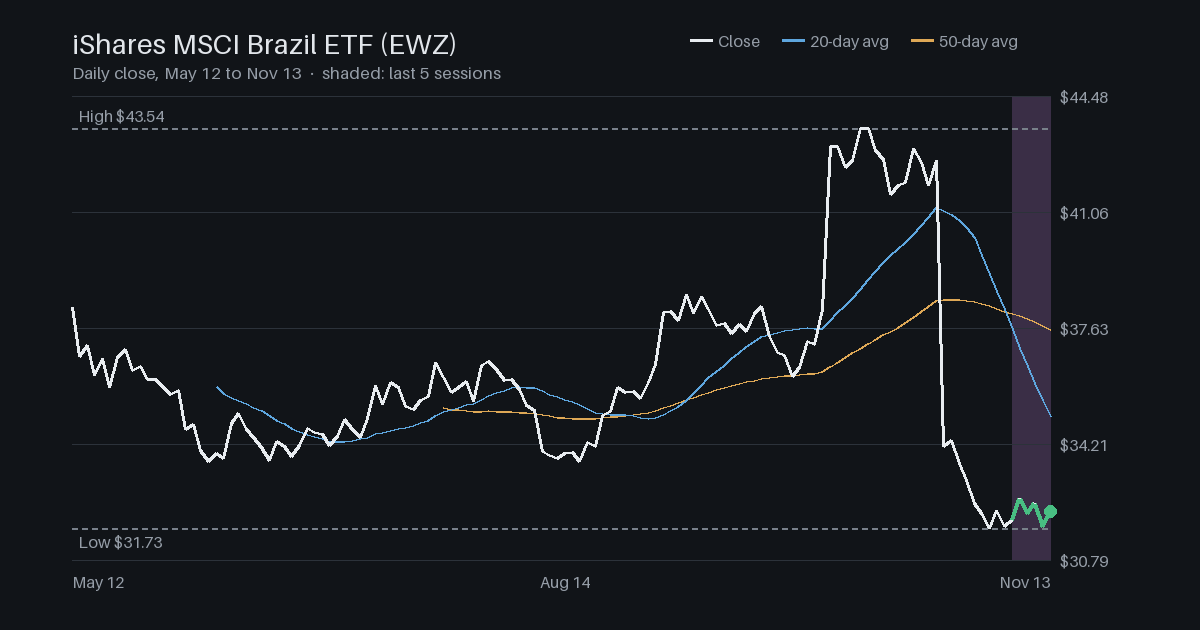
| Last close | $32.22 | Closing price on Nov 13, 2026. |
|---|---|---|
| 5-session move | +0.8% | Change in the closing price over the last five trading days. |
| 20-day average | $35.03 | The average closing price of the last 20 trading days. |
| 50-day average | $37.59 | The average closing price of the last 50 trading days. |
| Period high | $43.54 | Highest price since May 12, 2026. |
| Period low | $31.73 | Lowest price since May 12, 2026. |
Related coverage
 How Brazil ground beef is filling U.S. shelves as China quotas shift exportsMinerva Foods redirects exports to the U.S. to bypass China tariffs as U.S. cattle herds hit a 75-year low, driving ground beef prices higher.
 How Cosan's New CEO Impacts Brazil, Your Infrastructure HoldingCosan's Board of Directors appointed Guilherme Penin as interim CEO to lead a shift toward asset sales and deleverage its R$ 9.5 billion net debt.
 Why the Brazil Tuesday Vote Matters for Your Emerging Market ETFBrazil's Senate approved its R$60 billion fiscal package, but a Tuesday vote on four key amendments will decide if its actual spending cuts survive.