
How Cosan's New CEO Impacts Brazil, Your Infrastructure Holding
Cosan's Board of Directors appointed Guilherme Penin as interim CEO to lead a shift toward asset sales and deleverage its R$ 9.5 billion net debt.

Key takeaways
- Cosan approved the CEO transition from Marcelo Martins to interim CEO Guilherme Penin on January 4, 2027, per its CVM regulatory filing on November 13, 2026
- Cosan reported Q3 2026 net income of R$ 190 million, reversing its prior loss while net debt reached R$ 9.5 billion, per company financial disclosures on November 13, 2026
- Cosan completed the sale of Radar agricultural properties for R$ 808 million in early November 2026 to address a tight 0.3x debt-service coverage ratio, per its Q3 earnings release on November 13, 202
For global infrastructure investors holding diversified emerging-market assets, the corporate maneuvering inside major holding companies often dictates fund performance. On November 13, 2026, Brazilian infrastructure giant Cosan announced that its board of directors approved the retirement of its 20-year veteran chief executive officer, Marcelo Martins, effective January 4, 2027. In a CVM regulatory filing reported by C-Level Folha on November 13, 2026, the company appointed Vice President of Strategy Guilherme Penin as interim CEO to steer the heavily indebted conglomerate.
Cosan is one of Brazil’s largest conglomerates, controlling major players in energy, logistics, and agriculture including railway operator Rumo, natural gas distributor Compass, lubricants producer Moove, and sugar-and-ethanol giant Raízen. While the company's third-quarter earnings report released on November 13, 2026, showed a return to profitability with a consolidated net income of R$ 190 million—reversing a massive R$ 1.185 billion loss from the third quarter of 2025—it is still battling critical debt pressure. According to the company's financial disclosures on November 13, 2026, its expanded net debt rose 3% sequentially to R$ 9.5 billion, keeping its leverage at a high 8.54 times net debt to EBITDA over the last twelve months.
Pivoting to Divestments and Deleveraging
The strategic shift under Penin's incoming leadership signals an urgent transition from aggressive, acquisition-driven growth to a strict deleveraging campaign. Cosan’s immediate financial bottleneck is highlighted by its Debt Service Coverage Ratio, which stood at an acute 0.3x in the third quarter of 2026, far below its full-year target range of 0.8x to 1.2x. To generate cash and bridge this gap, Cosan is actively negotiating asset sales. These include selling a portion of its stake in the railway operator Rumo and the early November 2026 sale of its Radar agricultural properties for R$ 808 million.
Marcelo Martins, who has been with the group for two decades and helped manage the 2025 capitalization and Raízen's extrajudicial restructuring, will not leave the company entirely. He is set to retain his seats on the board of directors of Cosan, Rumo, Compass, and Moove to assist with the ongoing strategic handover and mergers and acquisitions. This orderly transition gives Penin—a federal infrastructure veteran and BNDES alumnus who has spent 10 years inside the Cosan group, as reported by CNN Brasil on November 13, 2026—the operational runway to execute these complex divestments.
What to watch next is how quickly Penin can convert preliminary divestment talks into signed contracts to ease Cosan's debt burden before his interim appointment is made permanent or a new chief executive is named. Infrastructure investors will be monitoring whether the holding company can upstream sufficient dividends from subsidiaries or successfully close the Rumo stake sale without disrupting long-term operations.
In your brokerage app
For retail investors holding global infrastructure exchange-traded funds or direct emerging-market equities, Cosan is accessible on U.S. exchanges as an American Depositary Receipt under the ticker CSAN. Changes in its corporate structure and leverage directly influence its market valuation and the underlying value of holdings in broader Latin American or global infrastructure funds.
Analysis · NWX analysis desk
Which Brazil assets this touches
- CSAN, CSAN3, USDBRL — Named in this story.
Technical picture · CSAN3 (CSAN3)
CSAN3 (CSAN3) closed at R$3.10 on Nov 13, 2026, up 11.9% from five sessions earlier. The last close is below its 20-day average of R$3.37 and below its 50-day average of R$3.83. Since May 20, 2026 it has traded between R$2.16 (low, Oct 30, 2026) and R$5.47 (high, Oct 9, 2026).
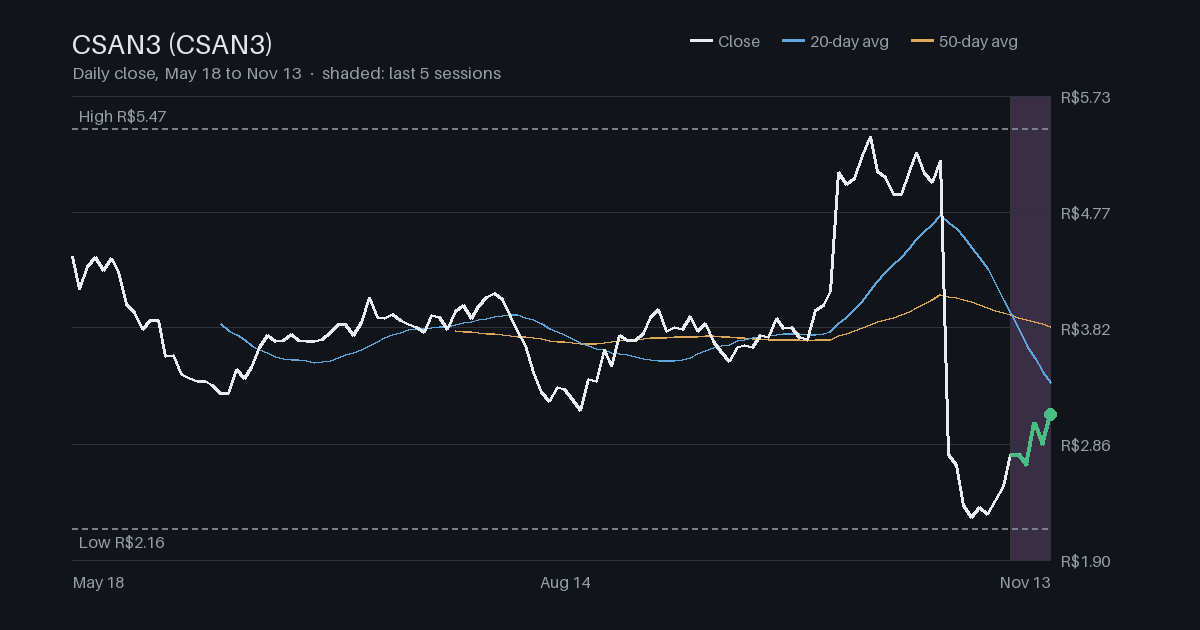
| Last close | R$3.10 | Closing price on Nov 13, 2026. |
|---|---|---|
| 5-session move | +11.9% | Change in the closing price over the last five trading days. |
| 20-day average | R$3.37 | The average closing price of the last 20 trading days. |
| 50-day average | R$3.83 | The average closing price of the last 50 trading days. |
| Period high | R$5.47 | Highest price since May 20, 2026. |
| Period low | R$2.16 | Lowest price since May 20, 2026. |
Related coverage
 How Shifting Policies in Brazil Today Match the Needs of US InvestorsBrazil passes a major $10 billion fiscal package, tightens rules on strategic rare earth mining, and cracks down on systemic judicial debt fraud.
 How Brazil ground beef is filling U.S. shelves as China quotas shift exportsMinerva Foods redirects exports to the U.S. to bypass China tariffs as U.S. cattle herds hit a 75-year low, driving ground beef prices higher.
 Why the Brazil Tuesday Vote Matters for Your Emerging Market ETFBrazil's Senate approved its R$60 billion fiscal package, but a Tuesday vote on four key amendments will decide if its actual spending cuts survive.