Beyond Brazilian meat at The Grove, JBS and BRF face pork import ban
The Philippines implemented a 60-day safeguard ban on pork imports from Brazil starting November 24, squeezing margins for US-listed giants JBS and BRF.
Key takeaways
- The Philippines announced a 60-day safeguard ban on pork imports from Brazil on November 9, 2026, set to take effect November 24, per Philippine Department of Agriculture Order No. 33.
- The Philippines represents 25% of Brazil's pork exports, totaling US$ 600 million from January to September 2026, per the Brazilian Association of Animal Protein (ABPA).
- JBS CEO Gilberto Tomazoni stated on November 10, 2026, that the restriction will pressure profit margins by forcing sales into lower-priced alternative markets.
- Brazilian Agriculture Minister André de Paula is meeting with Philippine Agriculture Secretary Francisco Tiu Laurel Jr. in Manila on November 16, 2026, to seek a revision.
American retail investors who associate South American agriculture giants with local dining options like Brazilian meat at The Grove should look further downstream to Southeast Asia, where a major trade bottleneck is taking shape. On November 9, 2026, the Philippines announced a provisional 60-day safeguard restriction on pork imports from Brazil, scheduled to take effect on November 24, 2026, according to Department of Agriculture Order No. 33. This emergency trade barrier targets the single largest destination for Brazil's pork in natura exports, directly threatening the profit margins of major New York-listed food giants JBS and BRF.
The Philippines is Brazil's top destination for pork in natura, representing 25% of all Brazilian pork exports, with total shipments reaching US$ 600 million from January to September 2026, according to data from the Brazilian Association of Animal Protein (ABPA). Furthermore, Brazil supplies approximately 46% of the Philippines' total pork imports, creating significant revenue exposure for major exporters JBS and BRF, per data from the Brazilian Ministry of Agriculture in November 2026. Under Department Order No. 33, signed on November 7, 2026, by Philippine Agriculture Secretary Francisco Tiu Laurel Jr., the ban covers fresh, chilled, and frozen pork cuts to protect local hog raisers from cheap foreign competition. The move follows a preliminary investigation showing that surging imports caused domestic producer prices to tumble, creating an estimated 28 billion Philippine pesos (US$ 480 million) in losses for the local industry from January to July 2026, according to the Philippine Department of Agriculture.
Is Brazilian meat safe?
The current 60-day trade barrier is purely a safeguard measure designed to protect domestic producers, not a sanitary ban, indicating there are no safety or health concerns regarding Brazil's export quality, according to Department Order No. 33 issued on November 7, 2026. The Philippine Department of Agriculture implemented the restriction under its Safeguard Measures Act to help local farms recover from depressed domestic prices rather than in response to disease outbreaks, as detailed by the agency's November 9, 2026, announcement. Brazilian exporters continue to maintain strict sanitary compliance across global markets, though they now face the task of redirecting large volumes of meat, per statements from the Brazilian Association of Animal Protein (ABPA) on November 9, 2026.
During a third-quarter earnings call on November 10, 2026, JBS global CEO Gilberto Tomazoni acknowledged that the Manila ban would pressure export profit margins. While Tomazoni noted that the company can redirect excess pork volume to other international markets, he warned that alternative destinations will likely yield lower sales prices. However, the executive downplayed the overall impact on JBS's massive consolidated balance sheet, pointing out that the live hog division under its Seara brand remains the company’s least exposed business line compared to its dominant poultry and beef divisions, per the company's November 10, 2026, presentation.
Efforts to resolve the dispute are already underway at the highest diplomatic levels. On November 16, 2026, Brazilian Agriculture Minister André de Paula—who assumed office on April 1, 2026, following the departure of Carlos Fávaro—is scheduled to hold emergency face-to-face meetings in Manila with Secretary Francisco Tiu Laurel Jr., according to a Ministry of Agriculture schedule. Accompanying a presidential delegation led by Luiz Inácio Lula da Silva, de Paula expressed optimism on November 14, 2026, that the two governments could negotiate a revision or an early end to the 60-day temporary ban, relying on their 80-year history of diplomatic and commercial relations, as reported by Agência Brasil.
In your brokerage app
Investors holding JBS S.A. (which trades as American Depositary Receipts under JBSAY in New York) or BRF S.A. (trading as BRFS in New York) should monitor whether the 60-day suspension is extended beyond January 2027. If the diplomatic mission fails, the redirection of excess pork to Brazil’s domestic market could depress local pork prices and further compress profit margins for both food producers in the final quarter of 2026, according to projections by Safras & Mercado on November 9, 2026.
Analysis · NWX analysis desk
Which Brazil assets this touches
- JBS, BRFS, JBSS3, BRFS3, CORN, SOYBEAN — Named in this story.
Technical picture · JBSS3 (JBSS3)
JBSS3 (JBSS3) closed at R$69.16 on Nov 13, 2026, up 1.4% from five sessions earlier. The last close is above its 20-day average of R$66.57 and above its 50-day average of R$64.22. Since May 20, 2026 it has traded between R$55.44 (low, Oct 1, 2026) and R$73.85 (high, Aug 19, 2026).
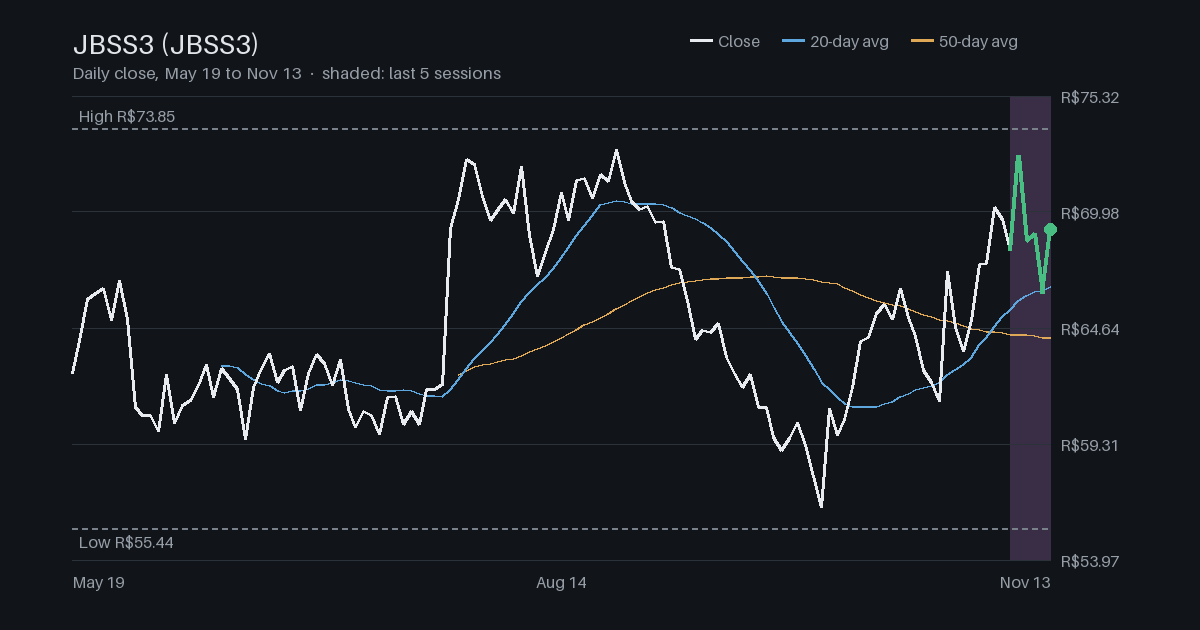
| Last close | R$69.16 | Closing price on Nov 13, 2026. |
|---|---|---|
| 5-session move | +1.4% | Change in the closing price over the last five trading days. |
| 20-day average | R$66.57 | The average closing price of the last 20 trading days. |
| 50-day average | R$64.22 | The average closing price of the last 50 trading days. |
| Period high | R$73.85 | Highest price since May 20, 2026. |
| Period low | R$55.44 | Lowest price since May 20, 2026. |