
Why INTR is one of the few Brazil stocks trading without ADR fees
Inter & Co reported record Q3 2026 profits of R$ 425 million and cleared its Nasdaq-based BDR sales facility, lifting technical pressure on its shares.

Shares of Brazilian digital banking group Inter & Co rose 4.67% to close at $4.15 on Nasdaq on Friday, November 13, 2026, driven by its record third-quarter earnings report and the formal completion of its share-liquidation program. The Nasdaq-listed lender (ticker: INTR) reported a 26% year-over-year jump in net income to R$ 425 million ($76.1 million) in its November 12, 2026 financial release. By listing its Class A common shares directly in New York rather than via depositary receipts, Inter & Co operates as one of the few Brazil stocks that American retail investors can trade without paying recurring ADR custody fees.
Headquartered in Belo Horizonte, Brazil, Inter & Co operates a digital financial platform integrating banking, credit, insurance, and investments for 46.8 million clients, of which 27.1 million are active users. Traditional Brazilian financial institutions typically list in New York through American Depositary Receipts (ADRs), which are subject to annual pass-through custody fees from depository banks. In contrast, Inter & Co migrated its corporate structure to list Class A common shares directly on Nasdaq, allowing investors using standard brokerage accounts to trade without these foreign administrative charges.
The company's positive quarterly numbers helped stabilize its stock following a period of intense technical selling. According to Inter & Co's regulatory SEC filing on November 10, 2026, the bank successfully completed a sales facility that liquidated 12,281,668 Class A common shares to wind down its Level II Brazilian Depositary Receipt (BDR) program on Sao Paulo's B3 exchange. This forced liquidation process, managed by custodian Banco Bradesco S.A. on a best-efforts basis from October 19 to November 17, 2026, had previously hammered the stock, causing a 34.9% single-session plunge on October 26, 2026.
Operationally, the third-quarter earnings showed robust growth alongside improving financial efficiency. The bank's net revenue rose 26% year-over-year to R$ 2.7 billion ($483 million), while its annualized return on equity rose to 15.8% from 14.2% a year prior, per its earnings release. Its efficiency ratio improved by 322 basis points to 41.9%, and its net interest margin expanded to 9.96%.
However, Inter & Co faces credit headwind challenges as Brazil's central bank held its benchmark Selic rate steady at 13.75% on November 4, 2026, to combat persistent inflation, per the Banco Central do Brasil monetary policy decision. High domestic interest rates contributed to a slight rise in Inter & Co's 90-day non-performing loans, which ticked up to 5.3%. To protect asset quality, the bank has focused heavily on collateralized credit lines, which now make up approximately 70% of its R$ 58.1 billion loan book. During the November 13, 2026 earnings webcast, Chief Executive Officer João Vitor Menin stated that the bank remains comfortable expanding its credit portfolio by 20% to 25% annually into 2027 by leaning on low-risk collateralized portfolios.
In your brokerage app
Inter & Co. Inc. trades on the Nasdaq exchange under the ticker symbol INTR. Unlike traditional ADRs of foreign companies, this direct Nasdaq listing allows US-based retail investors to buy and sell its Class A shares with no foreign depositary fees or specialized cross-border surcharges. Passive investors can also gain diversified exposure to the stock, as it is held in fintech-focused exchange-traded funds, such as the ARK Fintech Innovation ETF (ARKF).
Analysis · NWX analysis desk
Which Brazil assets this touches
- INTR — Named in this story.
- EWZ, NU, STNE, PAGS, IBOV — Big swings in U.S. tech stocks tend to spill into Brazil's fintechs listed in New York and into the broad Brazil fund, as global investors change how much risk they hold.
Technical picture · Inter&Co (INTR)
Inter&Co (INTR) closed at $4.15 on Nov 13, 2026, up 7.5% from five sessions earlier. The last close is below its 20-day average of $4.81 and below its 50-day average of $5.52. Since May 12, 2026 it has traded between $3.78 (low, Nov 5, 2026) and $7.74 (high, Oct 12, 2026).
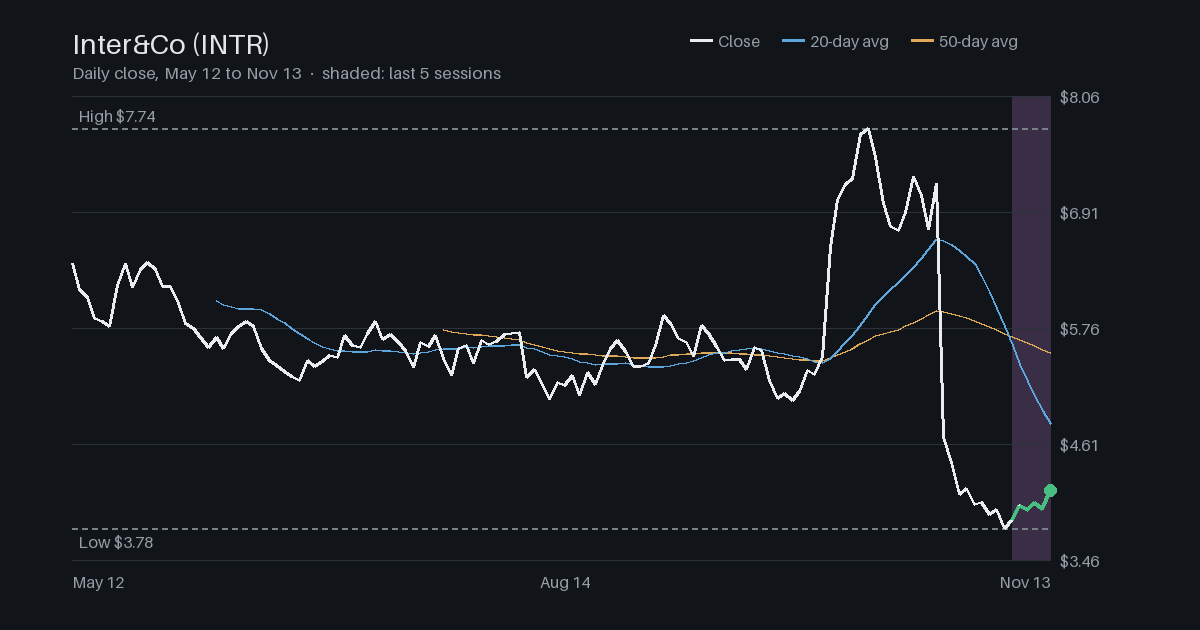
| Last close | $4.15 | Closing price on Nov 13, 2026. |
|---|---|---|
| 5-session move | +7.5% | Change in the closing price over the last five trading days. |
| 20-day average | $4.81 | The average closing price of the last 20 trading days. |
| 50-day average | $5.52 | The average closing price of the last 50 trading days. |
| Period high | $7.74 | Highest price since May 12, 2026. |
| Period low | $3.78 | Lowest price since May 12, 2026. |
Related coverage
 To US Investors in Brazil, Your Welcome Means XP Excess CapitalXP Inc. prepares to report its Q3 2026 earnings on November 16, with investors watching for potential capital distributions from its 20.3% BIS ratio.
 StoneCo Cuts Growth Targets, Cooling Your Welcome Brazil Fintech BetBrazilian fintech StoneCo slashed its 2026 adjusted gross profit outlook and withdrew its 2027 targets on November 12, 2026, citing soaring interest rates.