
Why the Brazil Tuesday Vote Matters for Your Emerging Market ETF
Brazil's Senate approved its R$60 billion fiscal package, but a Tuesday vote on four key amendments will decide if its actual spending cuts survive.

Key takeaways
- Brazil's Senate approved the main text of fiscal package PLP 299/2026 by a vote of 45 to 31, per Senado Federal on November 12, 2026
- The reform targets 2027 fiscal savings between R$ 45.1 billion and R$ 56.1 billion, per Poder360 on November 13, 2026
- Four critical amendments face a final Senate vote on Tuesday, November 17, 2026, per Congresso em Foco on November 13, 2026
- The package reduces the federal spending growth ceiling from 2.5% to 2.0% during fiscal containment, per InfoMoney on November 13, 2026
If you hold a broad-based emerging market fund in your brokerage account, a pivotal legislative showdown in Latin America's largest economy is about to test your portfolio’s resilience. Global investors tracking international equities are watching a high-stakes decision in Brasília, where lawmakers are trying to rein in a persistent budget deficit that has historically fueled currency volatility and dragged down dollar-denominated returns. On November 12, 2026, the Brazilian Senate took a major step toward addressing these concerns by approving the core framework of a key fiscal adjustment package, setting up a final, high-consequence vote on Tuesday, November 17, 2026.
The bill, officially known as PLP 299/2026, passed its initial hurdle in the upper house by a vote of 45 to 31, according to the official Senado Federal portal on November 12, 2026. Sponsored by Senator Jaques Wagner and amended by rapporteur Senator Eduardo Braga, the legislation targets an improvement in Brazil's 2027 primary budget balance of between R$ 45.1 billion and R$ 56.1 billion (up to $10.7 billion), as reported by Poder360 on November 13, 2026. To achieve these savings, the bill introduces structural spending triggers, cutting the ceiling on federal spending growth above inflation from 2.5% to 2.0% during periods of fiscal containment, alongside a linear 10% reduction in corporate tax benefits.
However, the ultimate success of this deficit-reduction plan depends on the upcoming vote on Tuesday, November 17, 2026, when senators will vote on four crucial amendments, known locally as destaques. According to political and legislative analyses compiled by Congresso em Foco on November 13, 2026, these amendments could significantly dilute the bill's impact. Key proposals up for debate include rolling back restrictions on how corporations use tax credits to offset federal liabilities and stripping out a provision that delays R$ 12 billion in transfers to states and municipalities under the Lei Kandir export tax law. If these opposition-backed amendments pass, they could strip billions from the projected savings, leaving the government with fewer tools to stabilize its public debt.
Should the fiscal package survive the Tuesday vote with its core measures intact, the bill will immediately head to the Chamber of Deputies, the lower house of Congress, where leaders are already coordinating to fast-track its final approval before the 2027 budget is finalized. If the lower house makes modifications, the text will return to the Senate, creating a tight legislative timeline as the year draws to a close. Global rating agencies and the Central Bank of Brazil are monitoring the progress closely; failure to pass a robust adjustment could keep local interest rates elevated at their current 13.75% benchmark and continue to pressure the Brazilian real, which hit its weakest level since mid-2025 following the initial Senate debate.
In your brokerage app
For retail investors holding the iShares MSCI Brazil ETF, which is listed in New York and tracks the performance of the largest publicly traded Brazilian companies, the outcome of this fiscal reform is highly consequential. A successful passage of PLP 299/2026 with its spending limits intact would likely ease sovereign yield pressures and support the Brazilian currency, directly benefiting dollar-denominated emerging market funds. Conversely, if the core fiscal triggers are diluted in the Tuesday vote, continued fiscal uncertainty is expected to weigh heavily on major Brazilian equities like state-run oil firm Petrobras and financial giant Itaú Unibanco.
Analysis · NWX analysis desk
Which Brazil assets this touches
- EWZ, IBOV, USDBRL, DI1 — Named in this story.
Technical picture · iShares MSCI Brazil ETF (EWZ)
iShares MSCI Brazil ETF (EWZ) closed at $32.22 on Nov 13, 2026, up 0.8% from five sessions earlier. The last close is below its 20-day average of $35.03 and below its 50-day average of $37.59. Since May 12, 2026 it has traded between $31.73 (low, Nov 3, 2026) and $43.54 (high, Oct 9, 2026).
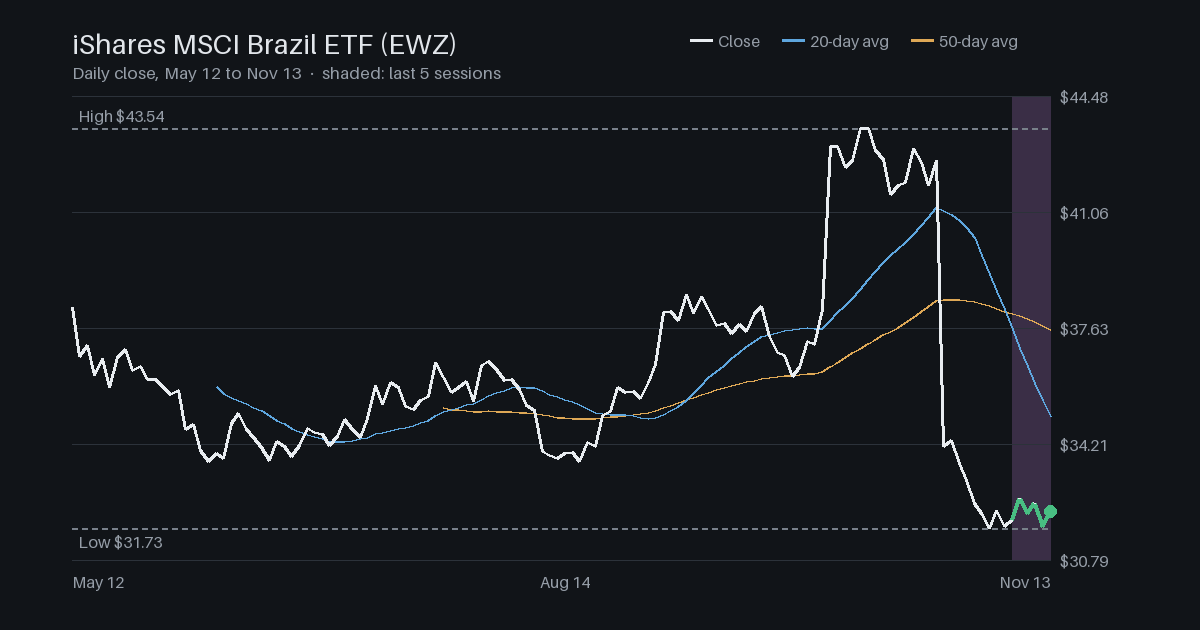
| Last close | $32.22 | Closing price on Nov 13, 2026. |
|---|---|---|
| 5-session move | +0.8% | Change in the closing price over the last five trading days. |
| 20-day average | $35.03 | The average closing price of the last 20 trading days. |
| 50-day average | $37.59 | The average closing price of the last 50 trading days. |
| Period high | $43.54 | Highest price since May 12, 2026. |
| Period low | $31.73 | Lowest price since May 12, 2026. |
Related coverage
 How Shifting Policies in Brazil Today Match the Needs of US InvestorsBrazil passes a major $10 billion fiscal package, tightens rules on strategic rare earth mining, and cracks down on systemic judicial debt fraud.
 How Brazil ground beef is filling U.S. shelves as China quotas shift exportsMinerva Foods redirects exports to the U.S. to bypass China tariffs as U.S. cattle herds hit a 75-year low, driving ground beef prices higher.
 How Cosan's New CEO Impacts Brazil, Your Infrastructure HoldingCosan's Board of Directors appointed Guilherme Penin as interim CEO to lead a shift toward asset sales and deleverage its R$ 9.5 billion net debt.