
In Brazil, Your Welcome to Agribusiness Bank Profits Cuts in Half
A wave of deliberate farm loan defaults forces state-controlled Banco do Brasil to halve its 2026 net income guidance and slash dividend payouts.
Key takeaways
- Banco do Brasil reported Q3 2026 adjusted net profit of R$ 1.27 billion, plunging 66.5% year-over-year, per the bank's earnings release on November 12, 2026.
- The bank halved its full-year 2026 adjusted net income guidance to R$ 9 billion to R$ 11 billion, per the bank's earnings release on November 12, 2026.
- CEO Tarciana Medeiros cited deliberate defaults and moral hazard among Center-West producers, per her remarks on November 12, 2026.
- The lender slashed its dividend payout ratio to the 25% statutory minimum and canceled 2027 interim payouts, per the bank's material fact on November 11, 2026.
If your emerging-market mutual funds or global dividend exchange-traded funds hold exposure to South American financial giants, a sudden 50% profit forecast cut from Brazil’s top agricultural lender has just altered your portfolio’s return trajectory. On November 12, 2026, state-controlled financial giant Banco do Brasil reported in its third-quarter earnings release that its adjusted net profit plummeted 66.5% year-over-year to R$ 1.27 billion, down from R$ 3.79 billion in the same period of 2025. In a simultaneous announcement, the bank slashed its full-year 2026 adjusted net income guidance in half, dropping its forecast range to R$ 9 billion to R$ 11 billion from its previous projection of R$ 18 billion to R$ 22 billion.
To understand this sudden reversal, global investors must look to the powerhouse of South American agribusiness. The bank’s troubles do not stem from a broad economic recession, but from a quiet rebellion in the grain belts of Brazil’s Center-West region.
What's your name in Brazil?
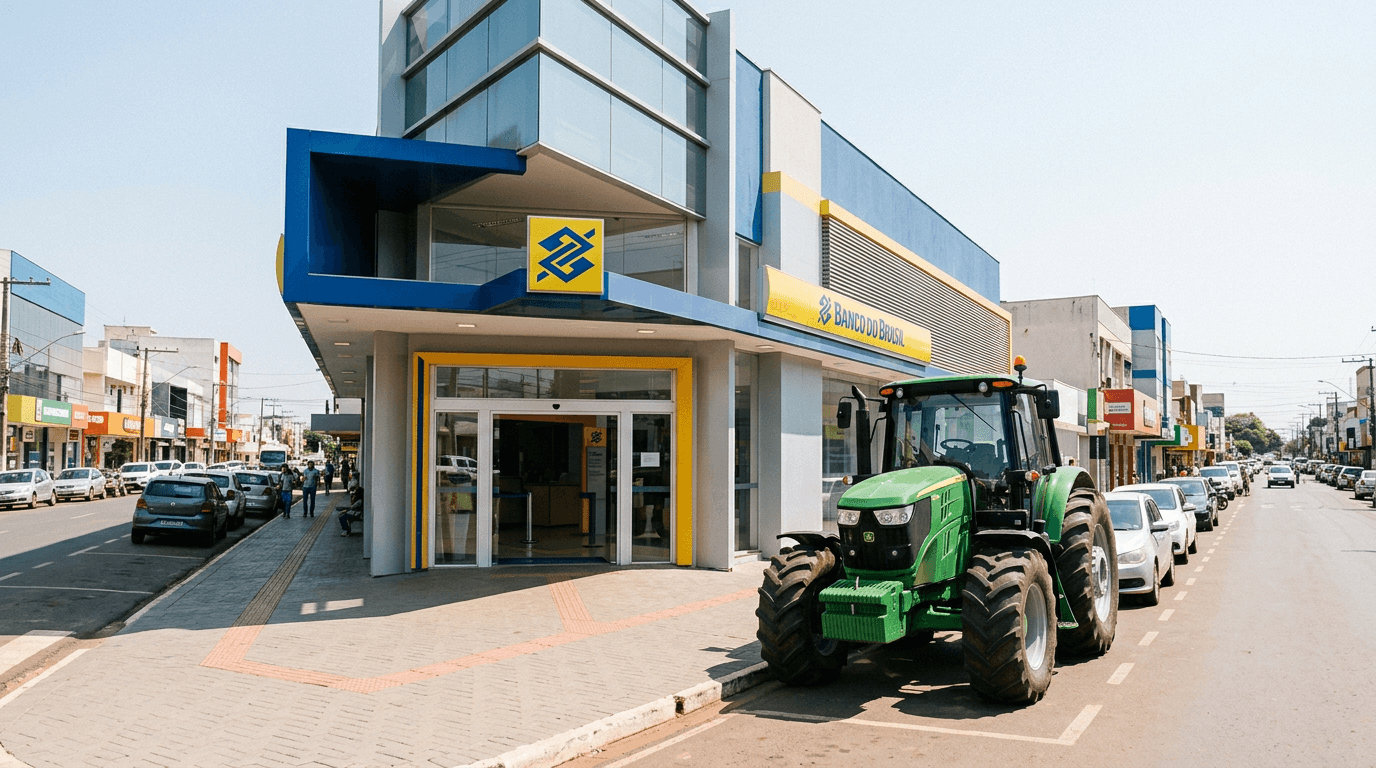
In the world's leading food-exporting nation, the primary name for agricultural financing is Banco do Brasil, which manages a R$ 403.6 billion crop portfolio representing roughly half of the country’s rural credit, according to bank disclosures on November 12, 2026. Yet, large-scale farmers who cultivate soybeans, corn, and raise livestock are deliberately withholding payments, choosing to wait out the bank for softer debt-relief terms from the government.
Banco do Brasil's Chief Executive Officer, Tarciana Medeiros, directly attributed the poor performance to what she termed a persistent and intentional "moral hazard". Medeiros explained during the bank's November 12, 2026 earnings call that wealthy producers in the Center-West region with full financial capacity to pay have chosen to default or delay renegotiations in hopes that the federal government will intervene with a more generous, subsidized debt-forgiveness package under legislative programs such as Provisional Measure 1,376.
The gridlock has forced the bank to dramatically expand its safety net, driving credit costs—largely consisting of provisions to absorb bad loans—up 18.4% year-over-year to R$ 21.2 billion in the third quarter of 2026, according to the bank's earnings report. Consequently, the bank's 90-day agricultural delinquency rate jumped to 6.92% in September 2026 from 4.84% a year prior, while on-time loan payments collapsed from 85% in June 2026 to just 66% in October 2026, per bank presentation data.
For international retail investors, the immediate casualty of this standoff is the bank's once-dependable capital distribution. To preserve capital as its common equity tier 1 ratio dipped below 11% in Q3 2026, Banco do Brasil reduced its planned dividend payout ratio for both 2026 and 2027 to the statutory minimum of 25%, down from 30%, per its November 11, 2026 material fact. The bank also canceled scheduled interim payouts for the remainder of 2026 and announced that no interim dividends will be paid in 2027, forcing management to shift to aggressive litigation, out-of-court notifications, and selling off loss-bearing agricultural portfolios to private distressed-debt market firms.
In your brokerage app
For US retail investors, Banco do Brasil's American Depositary Receipts trade over-the-counter under the ticker BDORY, while its primary shares trade on the B3 exchange in São Paulo as BBAS3. Both assets fell sharply following the November 12, 2026 announcement, and their values remain heavily tied to whether these wealthy Center-West producers break their holdout and resume payments as the bank increases aggressive legal collections.
Analysis · NWX analysis desk
Which Brazil assets this touches
- BBAS3, SOYBEAN, CORN, CATTLE, USDBRL — Named in this story.
Fundamentals · Banco do Brasil (BBAS3)
Banco do Brasil (BBAS3) trades at 7.8x its yearly earnings and 0.5x its book value. Its return on equity is 6.8%. Its dividend yield is 4.6%. The market values the company at R$86.4 billion. Its financial health score is 47 out of 100 (stable), based on profitability, liquidity, debt and growth. Latest: Q3 2026 results, published Nov 11, 2026.
| Price / earnings (P/E) | 7.8x | How many years of the current yearly profit the share price adds up to. |
|---|---|---|
| Price / book (P/B) | 0.5x | The share price compared with the accounting value of what the company owns, per share. |
| Return on equity (ROE) | 6.8% | Yearly profit for every R$100 that shareholders have put into the company. |
| Net margin | 4.3% | The part of every R$100 in sales that is left as profit. |
| Dividend yield | 4.6% | Cash paid to shareholders over the past year, as a share of today's price. |
| Market value | R$86.4 billion | What the whole company is worth at today's share price. |
Technical picture · Banco do Brasil (BBAS3)
Banco do Brasil (BBAS3) closed at R$15.10 on Nov 13, 2026, down 11.9% from five sessions earlier. The last close is below its 20-day average of R$18.85 and below its 50-day average of R$21.35. Since May 20, 2026 it has traded between R$14.72 (low, Nov 12, 2026) and R$27.19 (high, Oct 5, 2026).
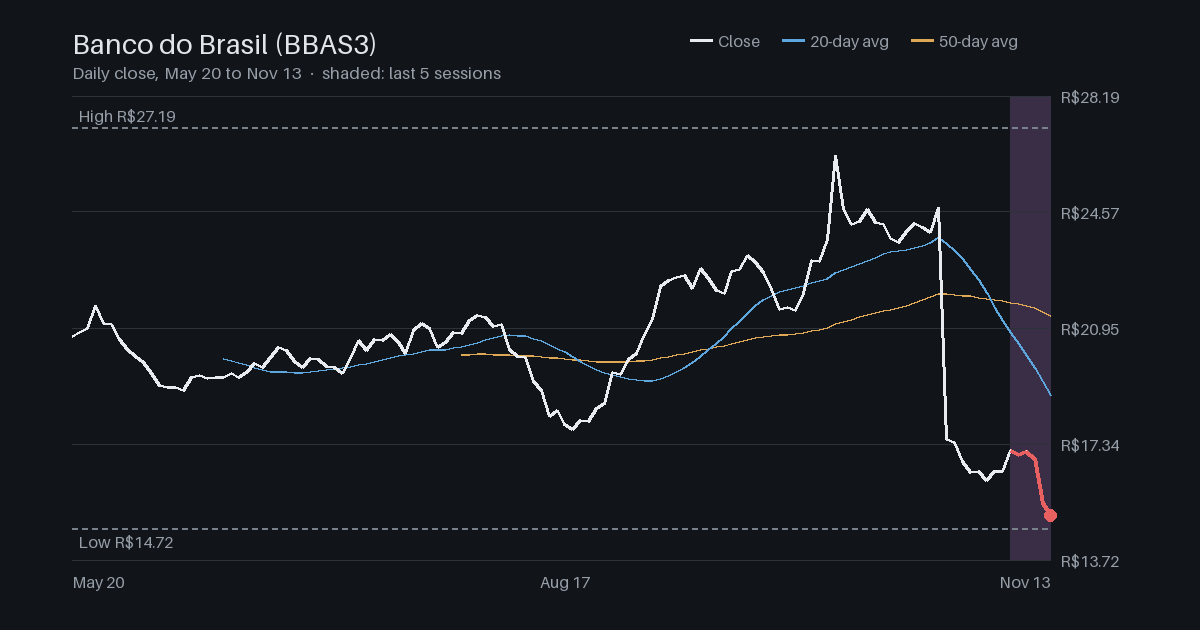
| Last close | R$15.10 | Closing price on Nov 13, 2026. |
|---|---|---|
| 5-session move | -11.9% | Change in the closing price over the last five trading days. |
| 20-day average | R$18.85 | The average closing price of the last 20 trading days. |
| 50-day average | R$21.35 | The average closing price of the last 50 trading days. |
| Period high | R$27.19 | Highest price since May 20, 2026. |
| Period low | R$14.72 | Lowest price since May 20, 2026. |
Related coverage
 Why a Popular Brazil Nasdaq Fintech Slashed Its Profit ForecastsStoneCo reported a 15.5% drop in Q3 2026 adjusted net income, slashed its 2026 earnings guidance, and scrapped its 2027 targets due to high interest rates and defaults.
 Braskem, titan of Brazil petrochemical sector, misses $210M paymentBraskem missed a R$ 1.2 billion ($210M) debenture payment, citing a judicial shield during its ongoing $10.9 billion extrajudicial restructuring.