
Wealthy farmers withholding debt payments hit Banco do Brasil profit
Banco do Brasil's Q3 2026 profit plummeted 66.5% as wealthy farmers deliberately withheld debt payments, creating what the CEO called a moral hazard.
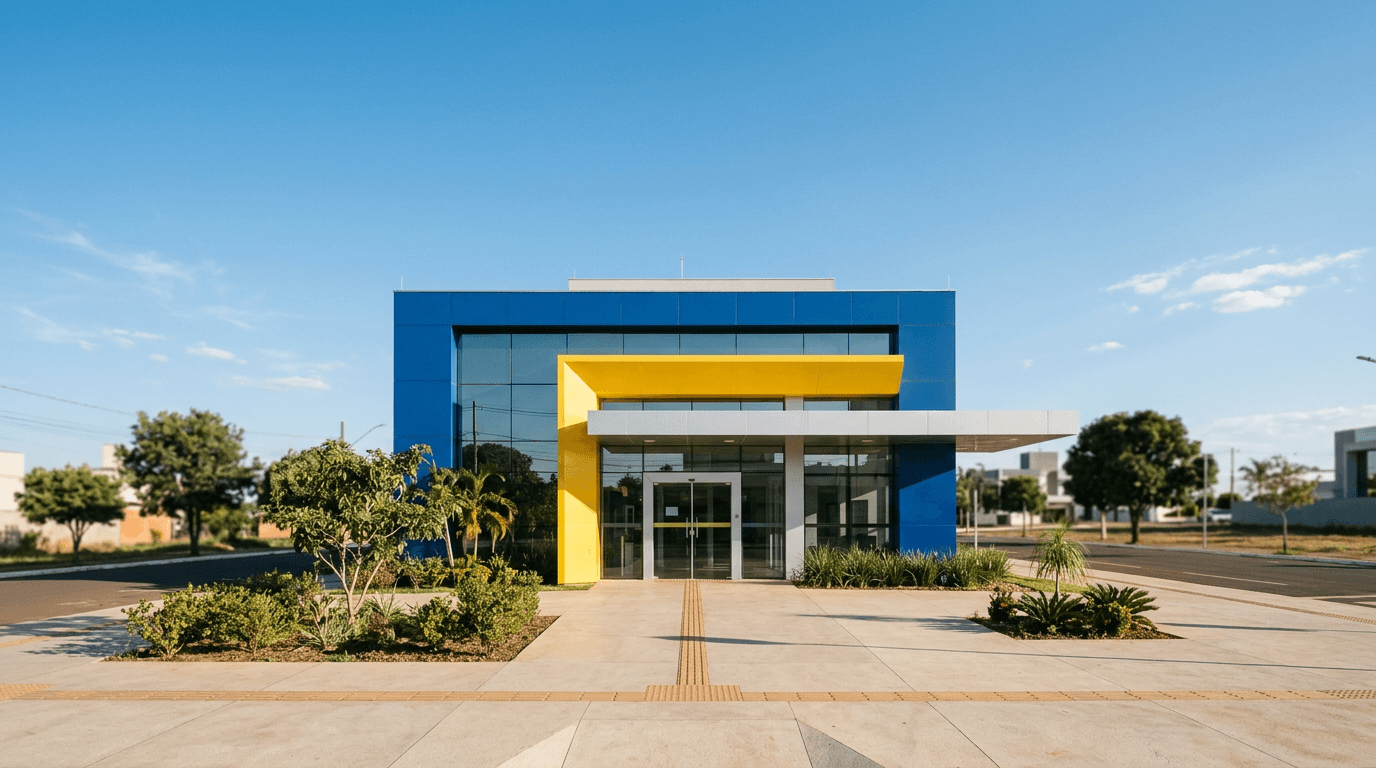
If you hold global agricultural funds or emerging market bank stocks, a quiet rebellion in the heart of South America’s grain belt just hit your portfolio’s underlying assets. A standoff between Brazil’s largest agricultural lender and its wealthiest farmers over debt renegotiations has triggered a sharp drop in quarterly earnings, exposing the unique political risks of state-backed banking in the world's leading food exporter.
On November 12, 2026, state-controlled Banco do Brasil reported that its adjusted net income for the third quarter of 2026 plummeted 66.5% year-on-year to R$ 1.27 billion (approximately $235 million), down from the R$ 3.47 billion expected by analysts. The bank’s CEO, Tarciana Medeiros, directly blamed the collapse on a deliberate "wait-and-see" strategy by medium and large-scale agricultural producers who are refusing to pay or renegotiate their debts. Medeiros labeled the behavior a classic case of "moral hazard," where wealthy borrowers with the capacity to pay choose default because they expect the government to bail them out with even better terms.
The "Wait-and-See" Rebellion
The friction centers on Brazil’s Center-West region, the powerhouse of global soybean, corn, and livestock production. Despite enjoying highly productive harvests in 2025 and 2026, many of these large-scale growers have chosen to withhold payments. According to Banco do Brasil, the on-time payment rate for its agricultural portfolio fell from 85% in June 2026 to just 66% in October 2026.
This payment strike was fueled by the federal government's Provisional Measure (MP) 1.376/26, a relief program designed to help farmers affected by climate and market adversity. While the bank successfully restructured R$ 13.4 billion in rural debts for 7,700 eligible clients under the program, only 15% of those renegotiations were with actually delinquent borrowers. The remaining 85% of delinquent farmers chose to stay in default, betting that Congress—which was actively debating the final bill—would yield to political pressure and mandate even cheaper, subsidized interest rates.
Reining in the Risk
To protect its balance sheet, Banco do Brasil has been forced to set aside massive provisions for bad loans. The bank's credit costs—which include provisions for defaults—surged to R$ 21.2 billion for the third quarter of 2026, an 18.4% increase compared to the same period last year. Consequently, the bank slashed its full-year 2026 adjusted net income guidance from an initial range of R$ 18 billion–R$ 22 billion down to just R$ 9 billion–R$ 11 billion.
To bypass the political gridlock, Medeiros announced that the bank is shifting its strategy. Banco do Brasil will begin selling off its delinquent agricultural loan portfolios to private asset management firms to accelerate recoveries, a process that has already drawn interest from more than 40 private companies. Additionally, the bank is tightening credit standards, requiring stronger collateral—such as fiduciary sales of future harvests—before issuing new loans.
In your brokerage app
For retail investors holding the iShares MSCI Brazil ETF (EWZ), which heavily weights state-controlled giants, this standoff highlights the regulatory and political risks unique to Brazilian banking. While private competitors like Itaú Unibanco and Banco Bradesco have limited exposure to subsidized federal farm programs, Banco do Brasil remains the primary vehicle for the government's R$ 610 billion Plano Safra agricultural credit program. The bank's decision to cut its dividend payout ratio to the statutory minimum of 25% to preserve capital will directly depress the yield of broad Brazil-focused funds in the coming quarters.
Analysis · NWX analysis desk
Which Brazil assets this touches
- EWZ, BBAS3, SOYBEAN, CORN, USDBRL — Named in this story.
Fundamentals · Banco do Brasil (BBAS3)
Banco do Brasil (BBAS3) trades at 7.8x its yearly earnings and 0.5x its book value. Its return on equity is 6.8%. Its dividend yield is 4.6%. The market values the company at R$88.5 billion. Its financial health score is 48 out of 100 (stable), based on profitability, liquidity, debt and growth. Latest: Q2 2026 results, published Aug 12, 2026.
| Price / earnings (P/E) | 7.8x | How many years of the current yearly profit the share price adds up to. |
|---|---|---|
| Price / book (P/B) | 0.5x | The share price compared with the accounting value of what the company owns, per share. |
| Return on equity (ROE) | 6.8% | Yearly profit for every R$100 that shareholders have put into the company. |
| Net margin | 4.3% | The part of every R$100 in sales that is left as profit. |
| Dividend yield | 4.6% | Cash paid to shareholders over the past year, as a share of today's price. |
| Market value | R$88.5 billion | What the whole company is worth at today's share price. |
Technical picture · iShares MSCI Brazil ETF (EWZ)
iShares MSCI Brazil ETF (EWZ) closed at $32.22 on Nov 13, 2026, up 0.8% from five sessions earlier. The last close is below its 20-day average of $35.03 and below its 50-day average of $37.59. Since May 12, 2026 it has traded between $31.73 (low, Nov 3, 2026) and $43.54 (high, Oct 9, 2026).
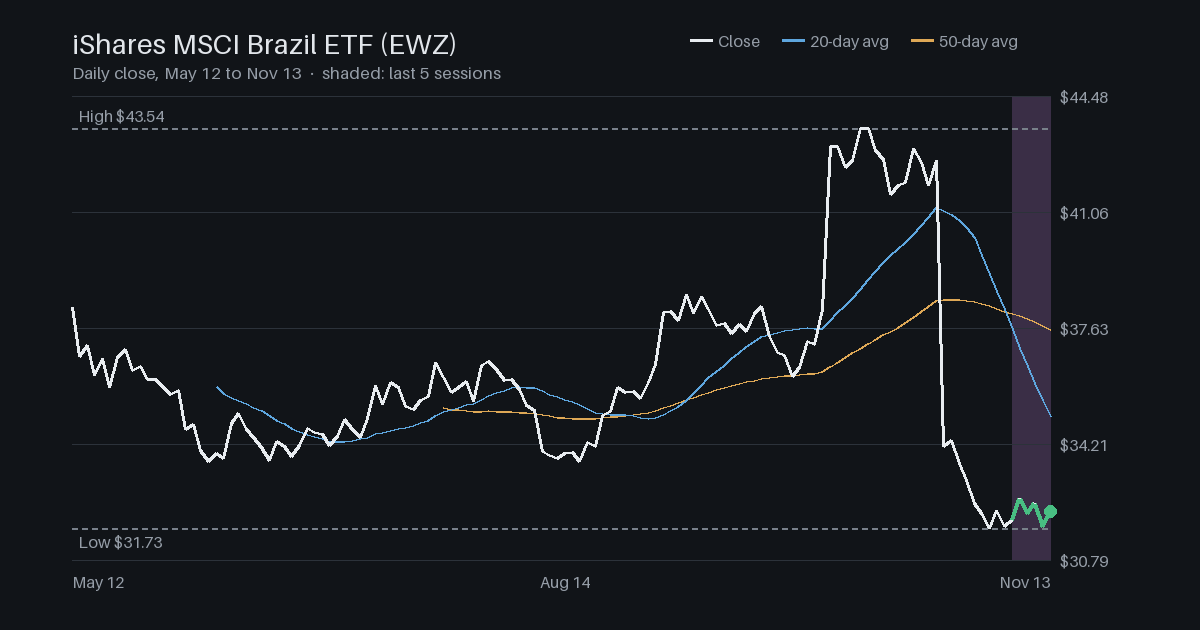
| Last close | $32.22 | Closing price on Nov 13, 2026. |
|---|---|---|
| 5-session move | +0.8% | Change in the closing price over the last five trading days. |
| 20-day average | $35.03 | The average closing price of the last 20 trading days. |
| 50-day average | $37.59 | The average closing price of the last 50 trading days. |
| Period high | $43.54 | Highest price since May 12, 2026. |
| Period low | $31.73 | Lowest price since May 12, 2026. |
Related coverage
 How Grain Futures Shift Past Brazil Stock Market Holidays in 2026Large speculators trimmed their net-long soybean positions as of November 3, 2026, navigating a record-breaking South American export crop.
 How a Major Brazil Holding Company Is Swapping CEOs to Slash DebtBrazilian conglomerate Cosan announced CEO Marcelo Martins is stepping down in January 2027 as the company shifts from expansion to aggressive deleveraging.
 Why Corporate Headwinds in Brazil Today Match Wall Street ExpectationsBrazil’s Senate backs a $10.8B spending-cut bill as high interest rates, new labor rules, and a temporary Philippine pork ban squeeze corporate margins.