
Retailer CBD Settles 17-Year Dispute, Lifting Brazil Stock Market
Retailer Companhia Brasileira de Distribuição settled a 17-year dispute with Casas Bahia, reversing R$ 174 million in provisions in Q4 2026.

American investors who track international retail or hold shares of New York-listed Companhia Brasileira de Distribuição (NYSE: CBD) have a clean balance sheet update to look forward to in their portfolios. On November 13, 2026, the Brazilian supermarket chain, widely known as GPA, announced a comprehensive legal settlement in São Paulo ending a historic 17-year feud with retail group Casas Bahia, according to a regulatory filing with the Securities and Exchange Commission of Brazil (CVM). The deal will allow GPA to release R$ 174 million back to its balance sheet as reversed provisions in the fourth quarter of 2026, according to the same November 13, 2026, CVM filing.
To understand why this matter is significant, one must look back to 2009 when GPA and the Klein family, founders of the massive appliance retailer Casas Bahia, agreed to combine their operations into a retail powerhouse called Via Varejo, as documented in historical merger filings. The partnership quickly soured, leading to a corporate split in 2019 and leaving a trail of high-stakes lawsuits over tax indemnities, arbitration decisions, and financial liabilities, according to subsequent corporate records. For years, this legacy legal baggage acted as an anchor for both companies, which are currently undergoing intense debt reorganization programs.
Under the terms of the settlement announced on November 13, 2026, GPA is officially freed from a R$ 424 million obligation to reimburse Casas Bahia for historical tax contingencies, as reported in the CVM filing. Since GPA had already set aside R$ 174 million in provisions to cover those potential losses, it will now reverse that entire provision in the fourth quarter of 2026, adding a positive non-recurring boost to its Q4 earnings, per the November 13, 2026, CVM filing. In return, GPA agreed to forfeit its rights to R$ 708 million in tax credits stemming from a long-running dispute over ICMS tax calculations, which would only have started paying out in 2036, according to the November 13, 2026, disclosure.
Giving up those R$ 708 million in tax credits does not represent a new blow to GPA’s current earnings. Because Casas Bahia is currently undergoing its own court-supervised judicial reorganization, GPA’s board had already classified those tax credits as highly unlikely to be recovered, recording a full impairment write-down of the entire R$ 708 million asset during the third quarter of 2026, according to GPA's Q3 2026 earnings statement published on November 4, 2026. By trading away a written-down asset for concrete relief from R$ 424 million in active liabilities, GPA’s management successfully cleaned up a structural liability that had clouded the retailer's outlook for nearly two decades.
As part of the broader settlement on November 13, 2026, GPA will still honor a separate R$ 231.8 million arbitration debt owed to Casas Bahia, which will be settled under the terms of GPA’s ongoing extrajudicial debt restructuring plan, according to the CVM filing. Even with this pre-existing payment of R$ 231.8 million remaining on the books, the formal end of the legal hostilities removes a major long-term drain on managerial focus and legal expenses for both retail groups.
Looking forward, investors should watch GPA’s upcoming fourth-quarter 2026 earnings release to verify the R$ 174 million provision reversal, as outlined in the November 13, 2026, CVM filing. This transaction represents a crucial step in GPA's broader effort to simplify its corporate structure, settle legacy debts, and focus entirely on its core supermarket banner, Pão de Açúcar. Moving past these legacy disputes from the 2009 merger allows both GPA and Casas Bahia to dedicate their limited capital toward operational recoveries rather than courtroom battles.
In your brokerage app
Companhia Brasileira de Distribuição is listed in New York, meaning investors can buy its American Depositary Receipts directly. It is also represented in the iShares MSCI Brazil ETF, which offers diversified exposure to the broader Brazilian equity market.
Analysis · NWX analysis desk
Which Brazil assets this touches
- EWZ — Named in this story.
Technical picture · iShares MSCI Brazil ETF (EWZ)
iShares MSCI Brazil ETF (EWZ) closed at $32.22 on Nov 13, 2026, up 0.8% from five sessions earlier. The last close is below its 20-day average of $35.03 and below its 50-day average of $37.59. Since May 12, 2026 it has traded between $31.73 (low, Nov 3, 2026) and $43.54 (high, Oct 9, 2026).
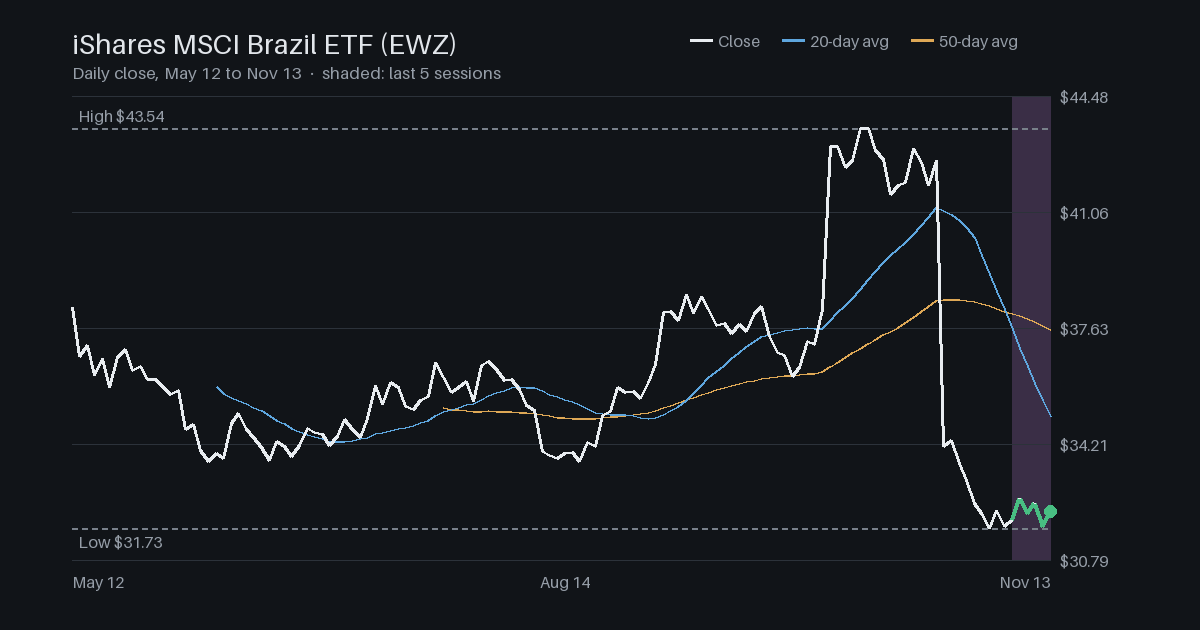
| Last close | $32.22 | Closing price on Nov 13, 2026. |
|---|---|---|
| 5-session move | +0.8% | Change in the closing price over the last five trading days. |
| 20-day average | $35.03 | The average closing price of the last 20 trading days. |
| 50-day average | $37.59 | The average closing price of the last 50 trading days. |
| Period high | $43.54 | Highest price since May 12, 2026. |
| Period low | $31.73 | Lowest price since May 12, 2026. |
Related coverage
 How Shifting Policies in Brazil Today Match the Needs of US InvestorsBrazil passes a major $10 billion fiscal package, tightens rules on strategic rare earth mining, and cracks down on systemic judicial debt fraud.
 How Brazil ground beef is filling U.S. shelves as China quotas shift exportsMinerva Foods redirects exports to the U.S. to bypass China tariffs as U.S. cattle herds hit a 75-year low, driving ground beef prices higher.
 How Cosan's New CEO Impacts Brazil, Your Infrastructure HoldingCosan's Board of Directors appointed Guilherme Penin as interim CEO to lead a shift toward asset sales and deleverage its R$ 9.5 billion net debt.