
Philippines Halts Pork Imports, Shaking Global Meatpackers
A sudden 60-day import suspension by the Philippines, Brazil's top pork export market, threatens over 23% of Brazilian shipments and could depress domestic meat prices.

Global agricultural trade is facing a sudden disruption as one of the world's fastest-growing meat import markets abruptly shuts its doors to protect local farmers. On November 9, 2026, the Department of Agriculture of the Philippines announced a provisional 60-day safeguard restriction suspending imports of fresh, chilled, and frozen pork. The emergency measure, signed by Philippine Agriculture Secretary Francisco Tiu Laurel Jr. under the country's Safeguard Measures Act, aims to shield domestic hog raisers who have suffered an estimated $441 million in losses during the first seven months of 2026.
The decision strikes a direct blow to Brazil, which has quietly become the primary foreign supplier of pork to the Southeast Asian nation. The Philippines represents Brazil's largest pork export destination, accounting for 23.36% of total Brazilian pork export volume and nearly 22% of its export revenue. According to data from Brazil's Ministry of Development, Industry, Trade and Services, Brazilian meatpackers shipped 271,000 metric tons of pork to the Philippines from January through September 2026, valued at $595 million.
The sudden suspension has triggered immediate pushback from trade groups on both sides of the Pacific. The Brazilian Animal Protein Association (ABPA) and the Philippine Meat Importers and Traders Association (MITA) both argue that the surge in imports was not a predatory move, but a necessary response to local supply shortages caused by persistent outbreaks of African swine fever (ASF). ABPA warned that cutting off Brazilian shipments, which make up nearly half of the Philippines' total pork imports, will trigger severe retail shortages and stoke food inflation for Filipino consumers.
For Brazilian meatpackers, the timing of the suspension threatens to depress domestic pork prices as excess supply is redirected back into the local market. Over the past three years, the Southeast Asian market had become a vital alternative for Brazilian exporters looking to offset declining demand from China. While the immediate impact may be softened by strong year-end holiday demand, the broader concern is that the Philippine Tariff Commission could extend the restrictions beyond the initial 60 days or permanently raise import tariffs once its formal investigation concludes.
In your brokerage app
For retail investors, this trade friction directly impacts major global protein producers. JBS N.V., which is listed in New York and operates extensive global poultry, beef, and pork processing networks, is highly sensitive to shifts in international meat trade flows and domestic pricing pressures in South America.
Analysis · NWX analysis desk
Which Brazil assets this touches
- EWZ, CATTLE, USDBRL — Named in this story.
Technical picture · iShares MSCI Brazil ETF (EWZ)
iShares MSCI Brazil ETF (EWZ) closed at $32.22 on Nov 13, 2026, up 0.8% from five sessions earlier. The last close is below its 20-day average of $35.03 and below its 50-day average of $37.59. Since May 12, 2026 it has traded between $31.73 (low, Nov 3, 2026) and $43.54 (high, Oct 9, 2026).
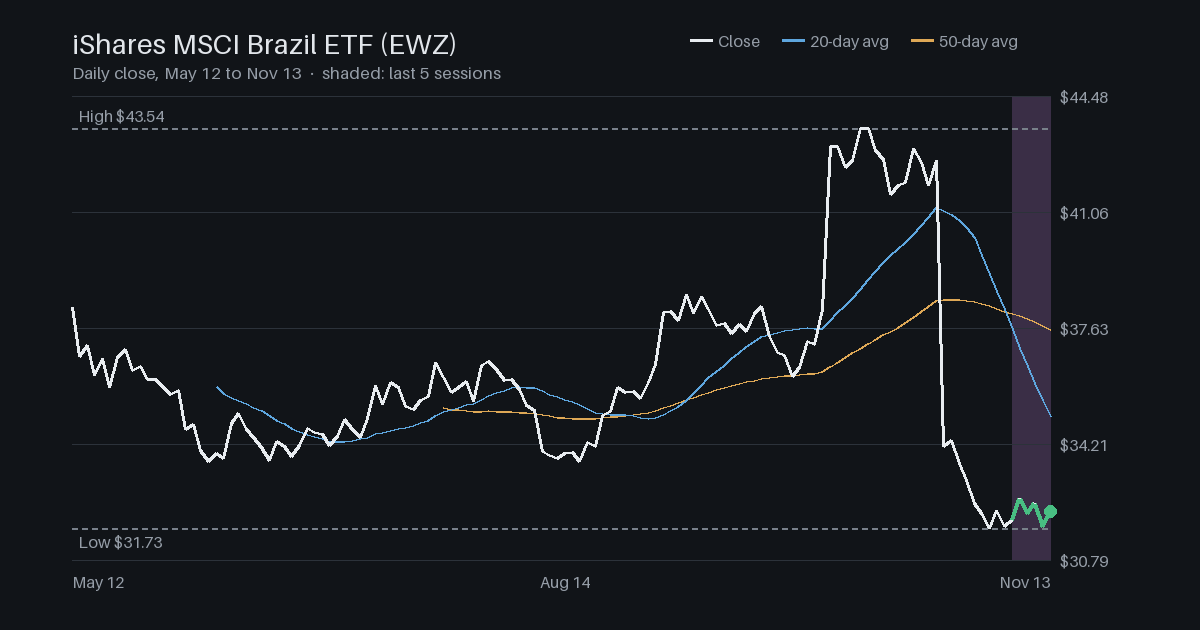
| Last close | $32.22 | Closing price on Nov 13, 2026. |
|---|---|---|
| 5-session move | +0.8% | Change in the closing price over the last five trading days. |
| 20-day average | $35.03 | The average closing price of the last 20 trading days. |
| 50-day average | $37.59 | The average closing price of the last 50 trading days. |
| Period high | $43.54 | Highest price since May 12, 2026. |
| Period low | $31.73 | Lowest price since May 12, 2026. |
Related coverage
 How Grain Futures Shift Past Brazil Stock Market Holidays in 2026Large speculators trimmed their net-long soybean positions as of November 3, 2026, navigating a record-breaking South American export crop.
 How a Major Brazil Holding Company Is Swapping CEOs to Slash DebtBrazilian conglomerate Cosan announced CEO Marcelo Martins is stepping down in January 2027 as the company shifts from expansion to aggressive deleveraging.
 Why Corporate Headwinds in Brazil Today Match Wall Street ExpectationsBrazil’s Senate backs a $10.8B spending-cut bill as high interest rates, new labor rules, and a temporary Philippine pork ban squeeze corporate margins.