
NYSE Steel Stock SID Plunges 11% After Weak Brazil Earnings
Companhia Siderúrgica Nacional shares plunged 10.94% on November 13, 2026, after reporting a R$ 1.25 billion third-quarter net loss amid rising leverage.

American retail investors holding shares of Brazilian industrial giant Companhia Siderúrgica Nacional woke up to a steep decline as its New York-listed shares plunged 10.94% on November 13, 2026, following the release of a devastating third-quarter earnings report. The steel and mining giant's American Depositary Receipts, trading on the NYSE under the ticker SID, fell to $0.6878, closing near its 52-week low of $0.6823 on November 13, 2026, according to stock exchange records.
The sharp drop on Friday came after CSN reported a consolidated net loss of R$ 1.25 billion ($222 million) late on November 12, 2026, representing a painful reversal from the R$ 76 million profit recorded in the third quarter of 2025, according to company filings. The financial squeeze was driven by high logistics costs and a collapse in international iron ore prices during the third quarter of 2026, according to CSN's operations report. Operating profitability also deteriorated significantly, as CSN’s adjusted EBITDA fell 32% quarter-over-quarter to R$ 1.88 billion, missing the R$ 1.94 billion analyst consensus tracked by Bloomberg on November 12, 2026.
With its adjusted net debt standing at R$ 44.92 billion ($7.75 billion) at the end of September 2026, the company's leverage ratio escalated to a strained 4.23x from 3.49x in June 2026, according to company financial statements. The mounting debt burden and weak cash flow had already prompted S&P Global Ratings to downgrade CSN's credit rating to 'B-' on October 20, 2026, warning that high freight costs would continue to pressure mining margins. In response to the crisis, newly appointed CEO Fabio Schvartsman, who took the helm in September 2026, announced an aggressive deleveraging campaign alongside CFO Pedro Oliva.
To relieve the balance sheet pressure, Schvartsman is prioritizing major asset divestments. On November 8, 2026, CSN announced a definitive agreement to sell its cement division, CSN Cimentos, to China's Huaxin Building Materials Group for an enterprise value of R$ 12.7 billion ($2.3 billion), per regulatory disclosures. The company also signed a binding term sheet in October 2026 to sell its German steel subsidiary, Stahlwerk Thüringen (SWT), for €550 million, aiming for a combined debt reduction of R$ 16.1 billion from the two deals. Although these transactions will materially reduce net debt once they close, the market remains divided on whether the valuation is sufficient to fully resolve CSN's leverage concerns.
What to watch next
Investors will be watching whether CSN can successfully close the cement sale, which remains subject to approvals from Brazil's antitrust regulator Cade, power regulator Aneel, and Chinese authorities. Additionally, CSN has implemented steel price increases of 14% to 16% in November 2026, with an additional 5% to 7.5% hike planned for December 2026 to shore up domestic steel margins, according to management reports. Credit markets will also monitor CSN's actively traded dollar bonds, which slid along the curve on November 13, 2026, with the 2031 notes declining 3.38 cents to trade at 48 cents on the dollar, according to Trace bond pricing data.
In your brokerage app
American retail investors can track these developments directly through Companhia Siderúrgica Nacional's American Depositary Receipts, which trade on the New York Stock Exchange under the ticker SID, or via exchange-traded funds like the iShares MSCI Brazil ETF (EWZ), which holds exposure to Brazil's major industrial and mining exporters.
Analysis · NWX analysis desk
Which Brazil assets this touches
- SID, CSNA3, IRONORE, USDBRL — Named in this story.
- VALE, VALE3 — Iron ore is Vale's main product and China is its biggest buyer, so the ore price feeds straight into Vale's revenue.
Fundamentals · CSNA3 (CSNA3)
CSNA3 (CSNA3) trades at 0.5x its book value. Its return on equity is -33.5%. The market values the company at R$5.6 billion. Its financial health score is 34 out of 100 (weak), based on profitability, liquidity, debt and growth. Latest: Q2 2026 results, published Aug 12, 2026.
| Price / book (P/B) | 0.5x | The share price compared with the accounting value of what the company owns, per share. |
|---|---|---|
| Return on equity (ROE) | -33.5% | Yearly profit for every R$100 that shareholders have put into the company. |
| Net margin | -7.5% | The part of every R$100 in sales that is left as profit. |
| Market value | R$5.6 billion | What the whole company is worth at today's share price. |
Technical picture · CSNA3 (CSNA3)
CSNA3 (CSNA3) closed at R$3.72 on Nov 13, 2026, down 15.6% from five sessions earlier. The last close is below its 20-day average of R$4.75 and below its 50-day average of R$5.66. Since May 18, 2026 it has traded between R$3.71 (low, Nov 13, 2026) and R$7.30 (high, Jun 2, 2026).
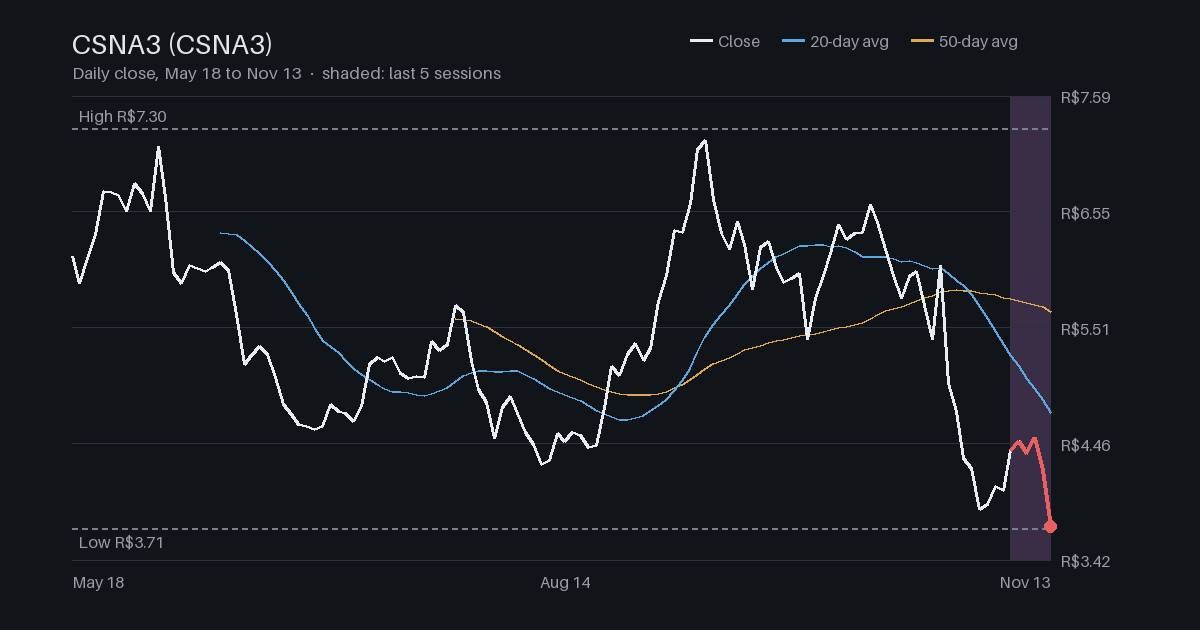
| Last close | R$3.72 | Closing price on Nov 13, 2026. |
|---|---|---|
| 5-session move | -15.6% | Change in the closing price over the last five trading days. |
| 20-day average | R$4.75 | The average closing price of the last 20 trading days. |
| 50-day average | R$5.66 | The average closing price of the last 50 trading days. |
| Period high | R$7.30 | Highest price since May 18, 2026. |
| Period low | R$3.71 | Lowest price since May 18, 2026. |
Related coverage
 How Grain Futures Shift Past Brazil Stock Market Holidays in 2026Large speculators trimmed their net-long soybean positions as of November 3, 2026, navigating a record-breaking South American export crop.
 How a Major Brazil Holding Company Is Swapping CEOs to Slash DebtBrazilian conglomerate Cosan announced CEO Marcelo Martins is stepping down in January 2027 as the company shifts from expansion to aggressive deleveraging.
 Why Corporate Headwinds in Brazil Today Match Wall Street ExpectationsBrazil’s Senate backs a $10.8B spending-cut bill as high interest rates, new labor rules, and a temporary Philippine pork ban squeeze corporate margins.