
Global meat supply chains face disruption as Philippines curbs pork
The Philippines is imposing a 60-day restriction on pork imports, threatening to divert Brazilian supply back home and depress domestic meat prices.

Global food supply chains are bracing for sudden shifts as the Philippines, one of the world's fastest-growing meat consumers, prepares to restrict pork imports. The move threatens to redirect hundreds of thousands of tons of protein back onto global and domestic markets, potentially altering what consumers pay at grocery counters and how major multinational meatpackers allocate their global production.
The Philippines Department of Agriculture issued Departmental Order No. 33/2026, establishing a temporary 60-day import restriction on pork starting November 24, 2026. The safeguard measure, aimed at protecting local pig farmers from a collapse in domestic prices, targets fresh, chilled, and frozen pork cuts. While the policy applies to all foreign suppliers, it hits Brazil the hardest. The South American agricultural powerhouse has become the top supplier of pork to the Philippines, shipping 222,700 metric tons worth US$ 530.9 million to the archipelago between January and September 2026 alone, according to Brazil's Ministry of Agriculture. That volume represents roughly 21% to 22% of Brazil's total pork export value during that period.
With the 60-day clock ticking, Brazilian officials and corporate executives are scrambling to prevent a supply glut. On November 14, 2026, Brazilian Agriculture Minister André de Paula met with pork industry representatives in Manila to coordinate an emergency response. The high-stakes meeting is part of a broader state visit led by President Luiz Inácio Lula da Silva, who is leveraging a pre-scheduled trip to the Association of Southeast Asian Nations (ASEAN) summit to seek a bilateral resolution. Brazilian negotiators are arguing that their exports are vital to keeping food affordable for Filipino consumers, especially after local herds were decimated by African swine fever in recent years.
If diplomatic efforts fail, the immediate consequence will be felt inside Brazil, where local meat prices could face downward pressure. Because Brazil exports only about 27% of its total pork production, domestic markets are highly sensitive to any sudden backflow of meat originally destined for overseas ports. A prolonged ban would force meatpackers to dump excess supply into the Brazilian market, driving down local wholesale prices and squeezing profit margins for domestic producers.
The dispute is strictly commercial and protectionist rather than a health crisis; there are no active concerns regarding whether pork from Brazil is safe. However, the temporary closure of Brazil's top pork export avenue highlights the geopolitical risks that global food conglomerates face when navigating international trade barriers.
In your brokerage app
For retail investors, the primary exposure to this trade dispute lies in JBS N.V., the world's largest protein producer, which is listed in New York. While JBS operates a highly diversified global footprint across beef, poultry, and pork, its Brazilian pork division, Seara, is directly exposed to the Filipino market. Investors holding JBS or broad agribusiness exchange-traded funds (ETFs) that track global food supply chains will want to monitor whether the Manila negotiations yield a swift resolution before the November 24, 2026 deadline.
Analysis · NWX analysis desk
Which Brazil assets this touches
- EWZ, EEM, CATTLE, USDBRL — Named in this story.
Technical picture · iShares MSCI Brazil ETF (EWZ)
iShares MSCI Brazil ETF (EWZ) closed at $32.22 on Nov 13, 2026, up 0.8% from five sessions earlier. The last close is below its 20-day average of $35.03 and below its 50-day average of $37.59. Since May 12, 2026 it has traded between $31.73 (low, Nov 3, 2026) and $43.54 (high, Oct 9, 2026).
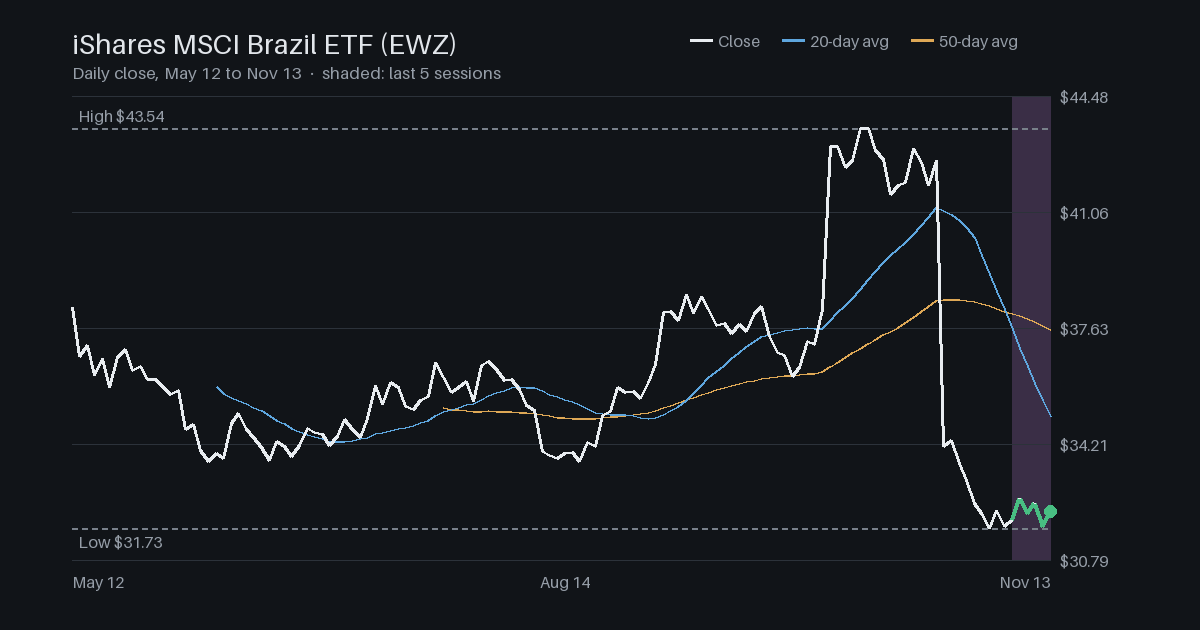
| Last close | $32.22 | Closing price on Nov 13, 2026. |
|---|---|---|
| 5-session move | +0.8% | Change in the closing price over the last five trading days. |
| 20-day average | $35.03 | The average closing price of the last 20 trading days. |
| 50-day average | $37.59 | The average closing price of the last 50 trading days. |
| Period high | $43.54 | Highest price since May 12, 2026. |
| Period low | $31.73 | Lowest price since May 12, 2026. |
Related coverage
 How Grain Futures Shift Past Brazil Stock Market Holidays in 2026Large speculators trimmed their net-long soybean positions as of November 3, 2026, navigating a record-breaking South American export crop.
 How a Major Brazil Holding Company Is Swapping CEOs to Slash DebtBrazilian conglomerate Cosan announced CEO Marcelo Martins is stepping down in January 2027 as the company shifts from expansion to aggressive deleveraging.
 Why Corporate Headwinds in Brazil Today Match Wall Street ExpectationsBrazil’s Senate backs a $10.8B spending-cut bill as high interest rates, new labor rules, and a temporary Philippine pork ban squeeze corporate margins.