
Fiscal Reform Vote Set to Impact the Brazil Currency to USD
Brazil's Senate prepares for a final vote on fiscal package PLP 299/2026, which is set to impact the real's exchange rate volatility against the U.S. dollar.

For U.S. retail investors holding diversified emerging-market assets, the relative value of overseas portfolios hinges heavily on upcoming legislative decisions in South America's largest economy. On Tuesday, November 17, 2026, the Brazilian Senate is scheduled to vote on final amendments to a sweeping fiscal reform bill designed to curb public deficits and stabilize the country's sovereign debt. If successfully enacted, the supplementary law project (PLP 299/2026) will trigger automatic spending cuts and scale back tax exemptions, a step expected to heavily influence the volatility of the brazil currency to usd exchange rate.
On Sunday, November 15, 2026, Vice President Geraldo Alckmin defended the newly proposed fiscal package during a press briefing in Brasília, asserting that balancing the federal budget is the government's primary mechanism for lowering local interest rates. Alckmin, acting as president while Luiz Inácio Lula da Silva returned from international negotiations, emphasized that the reform is designed to secure a zero deficit and a primary budget surplus without rolling back social safety nets. By implementing strict fiscal controls, the government hopes to curb public expenditure and restore investor confidence, which eroded earlier in the quarter as public debt escalated.
The legislative package aims to deliver up to R$ 60 billion ($10.75 billion USD) in total spending adjustments and revenue containment for the 2027 primary budget, according to data from the Planning Ministry released on November 11, 2026. Structurally, PLP 299/2026 enforces mechanisms including a linear cut in corporate tax incentives and an automatic tightening of the federal spending growth ceiling. If the government fails to achieve its primary balance target, real expenditure growth will contract from 2.5% to 2.0% above inflation, freeing up critical budgetary resources and reducing long-term sovereign default risk.
The bill cleared a major hurdle on Thursday, November 12, 2026, when the Senate approved its core text by a 45-to-31 vote. The upcoming session on Tuesday, November 17, 2026, represents the final stage of Senate review, where lawmakers will decide on four separate amendments—known locally as destaques—that could potentially dilute or strengthen the proposed spending caps. Once these amendments are finalized, the legislation will immediately proceed to the Chamber of Deputies, Brazil's lower congressional house, where the government will seek to fast-track a final floor vote.
Even if the legislative package passes cleanly, market analysts warn that the modest scope of the adjustment—amounting to roughly 0.5% of gross domestic product—may not be sufficient to fully stabilize the mounting public debt. Consequently, the real could remain highly volatile against the greenback. The International Monetary Fund projects that Brazil’s gross public debt will rise from 97% of GDP in 2026 to 104.5% by 2030, highlighting the persistent structural depreciation pressures facing the local currency over the medium term.
In your brokerage app
The outcome of this legislative sprint directly impacts global exchange-traded funds and sovereign debt instruments. Investors with exposure to the iShares MSCI Brazil ETF, which aggregates the country's largest publicly traded equities, should monitor the volatility of the Brazilian real, which traded at 5.65 Real per U.S. dollar on November 15, 2026. A dilution of the fiscal cuts in the final congressional votes could trigger further currency depreciation and weigh on ADRs listed in New York, while a clean passage is expected to ease premium pressures on local interest rate futures, though substantial depreciation risks remain if broader structural issues are left unaddressed.
Analysis · NWX analysis desk
Which Brazil assets this touches
- EWZ, IBOV, USDBRL, DI1 — Named in this story.
Technical picture · iShares MSCI Brazil ETF (EWZ)
iShares MSCI Brazil ETF (EWZ) closed at $32.22 on Nov 13, 2026, up 0.8% from five sessions earlier. The last close is below its 20-day average of $35.03 and below its 50-day average of $37.59. Since May 12, 2026 it has traded between $31.73 (low, Nov 3, 2026) and $43.54 (high, Oct 9, 2026).
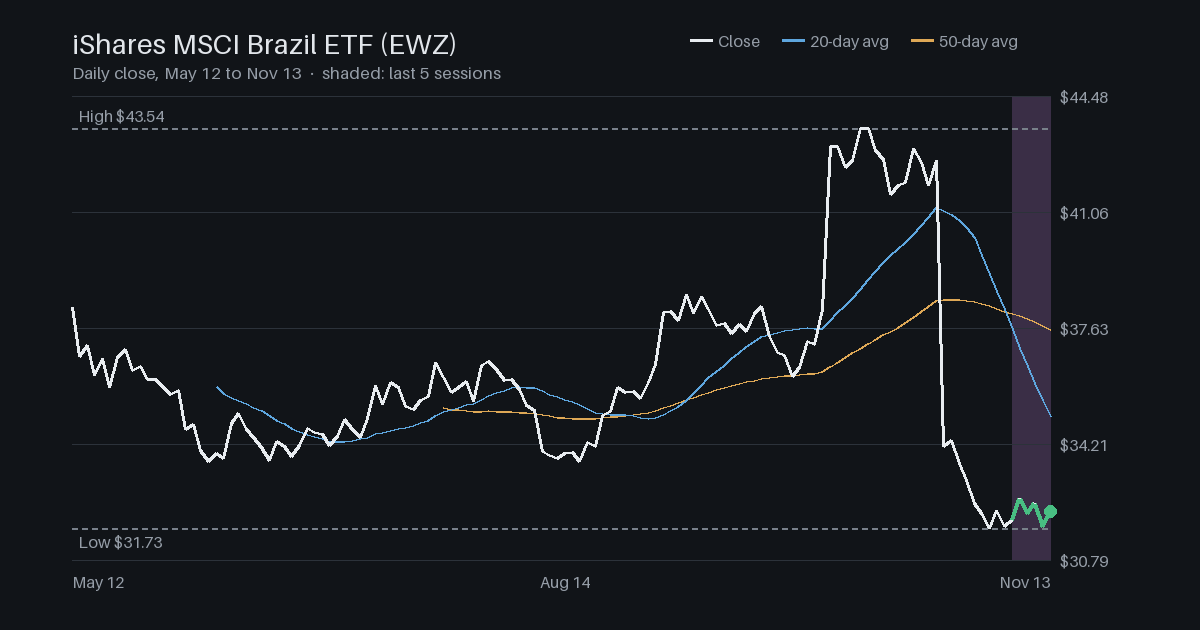
| Last close | $32.22 | Closing price on Nov 13, 2026. |
|---|---|---|
| 5-session move | +0.8% | Change in the closing price over the last five trading days. |
| 20-day average | $35.03 | The average closing price of the last 20 trading days. |
| 50-day average | $37.59 | The average closing price of the last 50 trading days. |
| Period high | $43.54 | Highest price since May 12, 2026. |
| Period low | $31.73 | Lowest price since May 12, 2026. |
Related coverage
 How Shifting Policies in Brazil Today Match the Needs of US InvestorsBrazil passes a major $10 billion fiscal package, tightens rules on strategic rare earth mining, and cracks down on systemic judicial debt fraud.
 How Brazil ground beef is filling U.S. shelves as China quotas shift exportsMinerva Foods redirects exports to the U.S. to bypass China tariffs as U.S. cattle herds hit a 75-year low, driving ground beef prices higher.
 How Cosan's New CEO Impacts Brazil, Your Infrastructure HoldingCosan's Board of Directors appointed Guilherme Penin as interim CEO to lead a shift toward asset sales and deleverage its R$ 9.5 billion net debt.