
A Giant of Brazil Energy Sources Is Replacing Its CEO to Focus on Debt Sales
Cosan replaces its long-time CEO Marcelo Martins with Guilherme Penin to focus on asset sales and pay down its R$9.5 billion debt load.
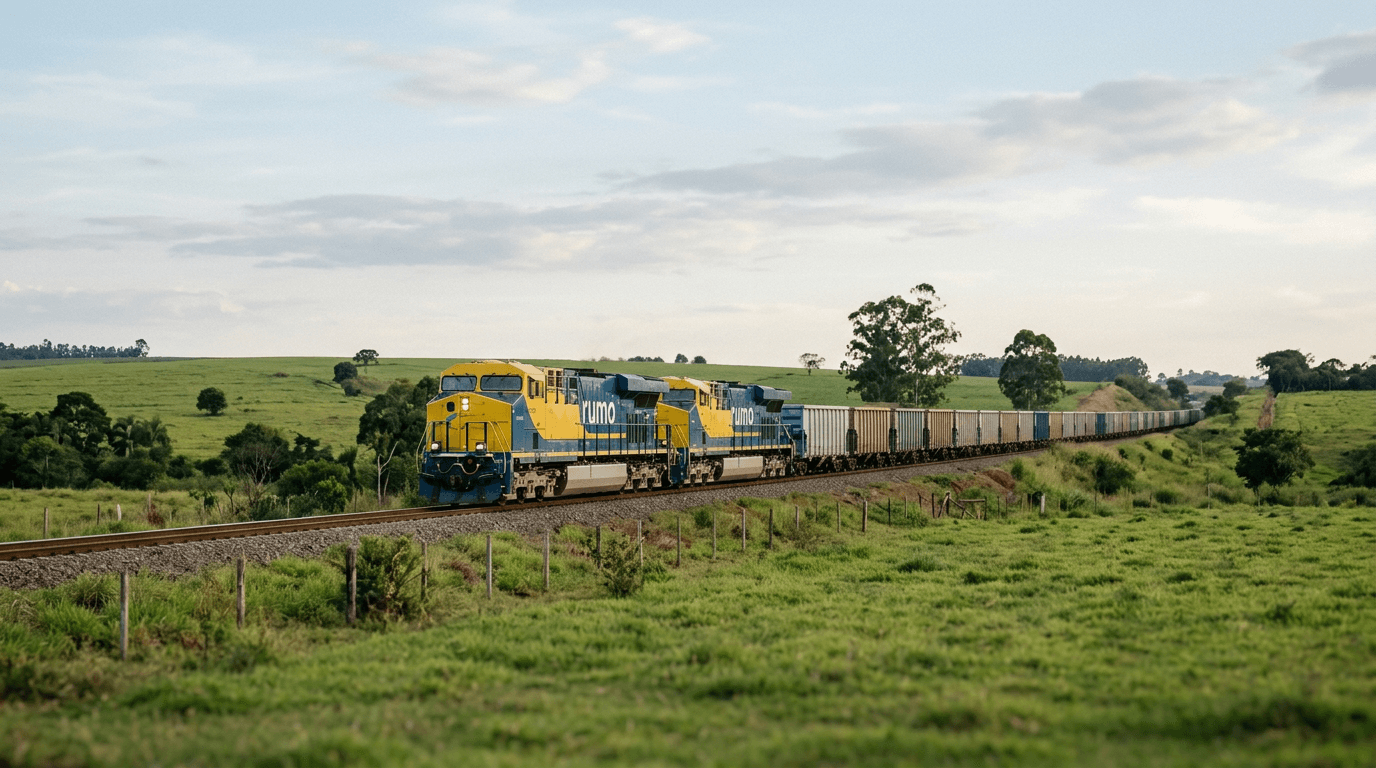
Investors holding international energy or infrastructure assets in their US brokerage accounts are seeing their exposure to South America's largest economy shift from aggressive growth to a strict debt-cutting diet. On November 13, 2026, Brazilian energy and rail conglomerate Cosan S.A. (NYSE: CSAN) announced that its long-time Chief Executive Officer Marcelo Martins will step down on January 4, 2027, with Vice President of Strategy Guilherme Penin taking over on an interim basis. The executive shuffle signals a complete strategic pivot: Cosan is halting its decades-long, multi-billion-dollar acquisition spree to focus entirely on selling down assets and paying off a heavy corporate debt load.
The transition, approved by Cosan's board of directors during a regular meeting on November 13, 2026, marks the end of an era for the $7 billion holding company. Over the past two decades, Martins spearheaded more than R$40 billion ($7 billion) in mergers and acquisitions, transforming Cosan from a regional sugar producer into a sprawling empire that controls rail operator Rumo, gas distributor Compass, and lubricant manufacturer Moove, and co-controls fuel distributor Raízen alongside Shell. According to a source close to the company's shareholders who spoke to Brazil Journal on November 13, 2026, Cosan's era of expansion is over: "It is not on the agenda to do M&As to grow, but rather to divest and eliminate the company's debt."
A Shift From Growth to Deleveraging
This leadership shake-up arrived alongside Cosan's third-quarter financial results, which highlighted the urgency of the new strategy. The company reported a net income of R$190 million for the third quarter of 2026, successfully reversing a massive net loss of R$1.185 billion recorded in the same period of 2025, according to filings submitted to Brazil's securities regulator, the CVM, on November 13, 2026. However, the positive bottom line did not mask the severe debt pressure on the holding company's balance sheet. Cosan's expanded net debt reached R$9.5 billion at the end of September 2026, representing a 3% increase from the previous quarter, while its critical debt-service coverage ratio (DSCR) sat at a tight 0.3x—well below the 0.8x to 1.2x range management had targeted for the end of the year.
To narrow this financial gap, Cosan is actively swapping out capital expenditures for asset sales. In early November 2026, the company completed the divestment of its Radar agricultural land portfolio for R$808 million and is currently in active talks to sell a portion of its stake in rail operator Rumo. Penin, a 44-year-old executive who has spent a decade at Cosan and previously served as an infrastructure coordinator in Brazil's federal government, is seen as a regulatory expert uniquely suited to navigate these complex, highly regulated asset sales while reassuring creditors.
Looking forward, the market will closely monitor whether Cosan can finalize the sale of its Rumo stake without being forced to accept deep valuation discounts from buyers. Additionally, investors will watch whether the holding company can improve its debt-service coverage metric when it reports its end-of-year figures in December 2026, which will serve as the first major test of Penin's interim leadership before a permanent successor is named.
In your brokerage app
US retail investors can monitor this financial turnaround through Cosan S.A., which trades in New York as American Depositary Receipts. However, the company has recently initiated a process to delist its New York receipts as part of its broader cost-cutting initiatives. This means that long-term holders should watch for corporate communications regarding whether their holdings will eventually need to be transitioned to the B3 exchange in São Paulo.
Analysis · NWX analysis desk
Which Brazil assets this touches
- CSAN, CSAN3, USDBRL — Named in this story.
Technical picture · CSAN3 (CSAN3)
CSAN3 (CSAN3) closed at R$3.10 on Nov 13, 2026, up 11.9% from five sessions earlier. The last close is below its 20-day average of R$3.37 and below its 50-day average of R$3.83. Since May 18, 2026 it has traded between R$2.16 (low, Oct 30, 2026) and R$5.47 (high, Oct 9, 2026).
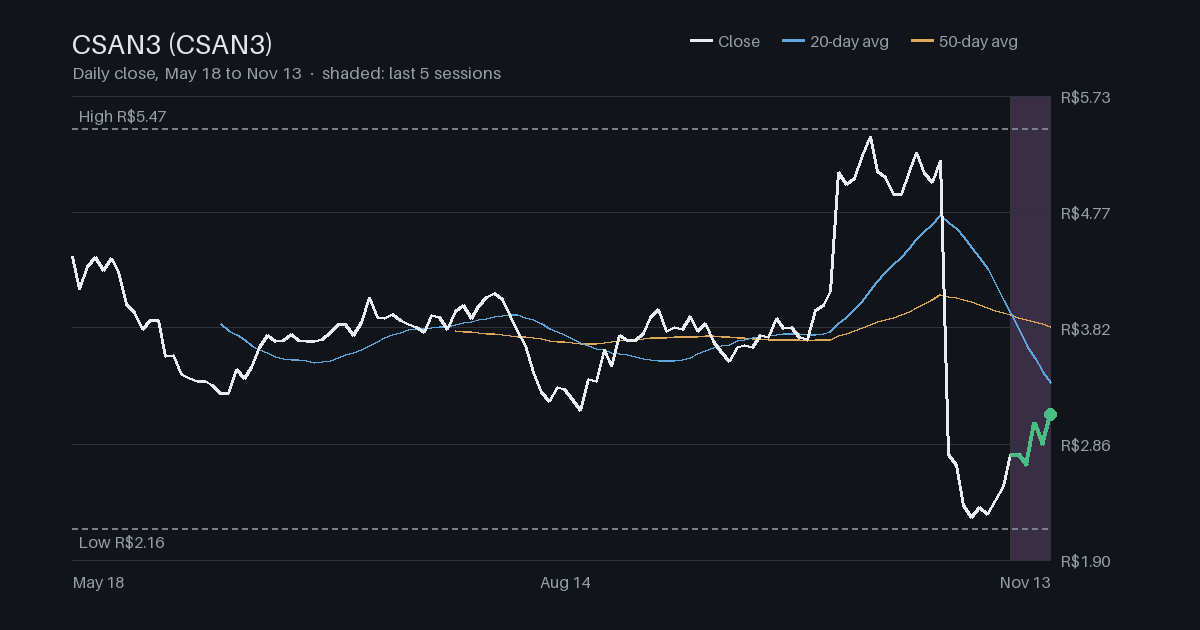
| Last close | R$3.10 | Closing price on Nov 13, 2026. |
|---|---|---|
| 5-session move | +11.9% | Change in the closing price over the last five trading days. |
| 20-day average | R$3.37 | The average closing price of the last 20 trading days. |
| 50-day average | R$3.83 | The average closing price of the last 50 trading days. |
| Period high | R$5.47 | Highest price since May 18, 2026. |
| Period low | R$2.16 | Lowest price since May 18, 2026. |
Related coverage
 How Grain Futures Shift Past Brazil Stock Market Holidays in 2026Large speculators trimmed their net-long soybean positions as of November 3, 2026, navigating a record-breaking South American export crop.
 How a Major Brazil Holding Company Is Swapping CEOs to Slash DebtBrazilian conglomerate Cosan announced CEO Marcelo Martins is stepping down in January 2027 as the company shifts from expansion to aggressive deleveraging.
 Why Corporate Headwinds in Brazil Today Match Wall Street ExpectationsBrazil’s Senate backs a $10.8B spending-cut bill as high interest rates, new labor rules, and a temporary Philippine pork ban squeeze corporate margins.