
Nasdaq-Listed Brazil Payment App StoneCo Slashes Financial Targets
On November 12, 2026, StoneCo withdrew its 2027 financial targets and lowered its 2026 guidance, citing high interest rates and credit headwinds in Brazil.

Global retail investors holding shares of New York-listed payment companies got a stark reminder of emerging-market volatility on November 12, 2026, when Brazilian payment processor StoneCo Ltd. slashed its full-year earnings outlook and completely withdrew its 2027 targets. The company, which provides payment and banking services to millions of small businesses across South America's largest economy, revealed in its third-quarter 2026 earnings report that highly volatile domestic interest rates have forced a strategic retreat from its long-term growth goals.
According to its official earnings release on November 12, 2026, StoneCo revised its 2026 adjusted gross profit guidance down to a range of BRL 6.1 billion to BRL 6.2 billion, from a prior projection of BRL 6.6 billion to BRL 7.0 billion. The company also lowered its expected 2026 basic earnings per share to BRL 9.1–9.5, down from its earlier BRL 10.8–11.4 forecast, according to the same November 12, 2026 report. During the accompanying earnings call on November 12, 2026, CEO Mateus Scherer explained that the decision to scrap the 2027 targets entirely was driven by extreme volatility in the Brazilian yield curve, which spiked by roughly 250 basis points after recent elections.
Does Brazil use Cash App?
American retail investors looking for high-growth fintech opportunities abroad often wonder: does brazil use cash app? The short answer is no; Cash App does not operate in Brazil, where the mobile payment market is dominated by Pix—a free, instant government-run payment system—and contested by local players. StoneCo acts as a primary Brazil payment app ecosystem, serving over 5.1 million active merchants with card processing, banking, and business credit as of its November 12, 2026 report. However, because StoneCo finances its merchant credit portfolio using local debt, it remains highly sensitive to Brazil's central bank, which has kept the benchmark Selic rate at a highly restrictive 13.75% as of November 14, 2026.
The operational mechanism behind StoneCo's profit squeeze lies in the mismatch between high local interest rates and rising credit delinquencies. While the company's credit portfolio expanded by 78% year-over-year to BRL 4.1 billion as of September 30, 2026, this rapid growth triggered a sharp rise in non-performing loans over 90 days, which jumped to 9.92% in the third quarter of 2026 from 5.03% in the third quarter of 2025, per the company's November 12, 2026 report. Consequently, StoneCo increased its third-quarter loan-loss provisions by 128.6% year-over-year to BRL 197.4 million, dragging down its quarterly adjusted gross profit by 8.0% year-over-year to BRL 1.48 billion, per its November 12, 2026 report.
To support its stock, the company spent over BRL 200 million on share buybacks in the third quarter of 2026, per its November 12, 2026 report. CFO Diego Salgado clarified on November 12, 2026, that the temporary slowdown in buybacks from prior quarters was due to short-term liquidity needs for restructuring European holding entities to reduce exposure to Brazilian tax disputes. Management reaffirmed its commitment on November 12, 2026, to distribute BRL 2 billion in excess capital through the end of 2026 and stated they would reassess whether to issue new long-term targets when reporting full-year 2026 results in early 2027.
In your brokerage app
For US retail investors, StoneCo Ltd. trades on the Nasdaq under the ticker STNE. While the business faces significant near-term headwinds from Brazil's restrictive interest rate environment, the company maintained a healthy adjusted return on equity of 23.5% and a strong capital ratio of 27.0% as of September 30, 2026, well above its internal hurdle of 17.0%, per the company's November 12, 2026 earnings report.
Analysis · NWX analysis desk
Which Brazil assets this touches
- STNE, USDBRL — Named in this story.
- EWZ, NU, PAGS, IBOV — Big swings in U.S. tech stocks tend to spill into Brazil's fintechs listed in New York and into the broad Brazil fund, as global investors change how much risk they hold.
Technical picture · StoneCo (STNE)
StoneCo (STNE) closed at $7.92 on Nov 13, 2026, up 5.5% from five sessions earlier. The last close is below its 20-day average of $8.73 and below its 50-day average of $9.70. Since May 12, 2026 it has traded between $7.39 (low, Nov 3, 2026) and $12.46 (high, Oct 9, 2026).
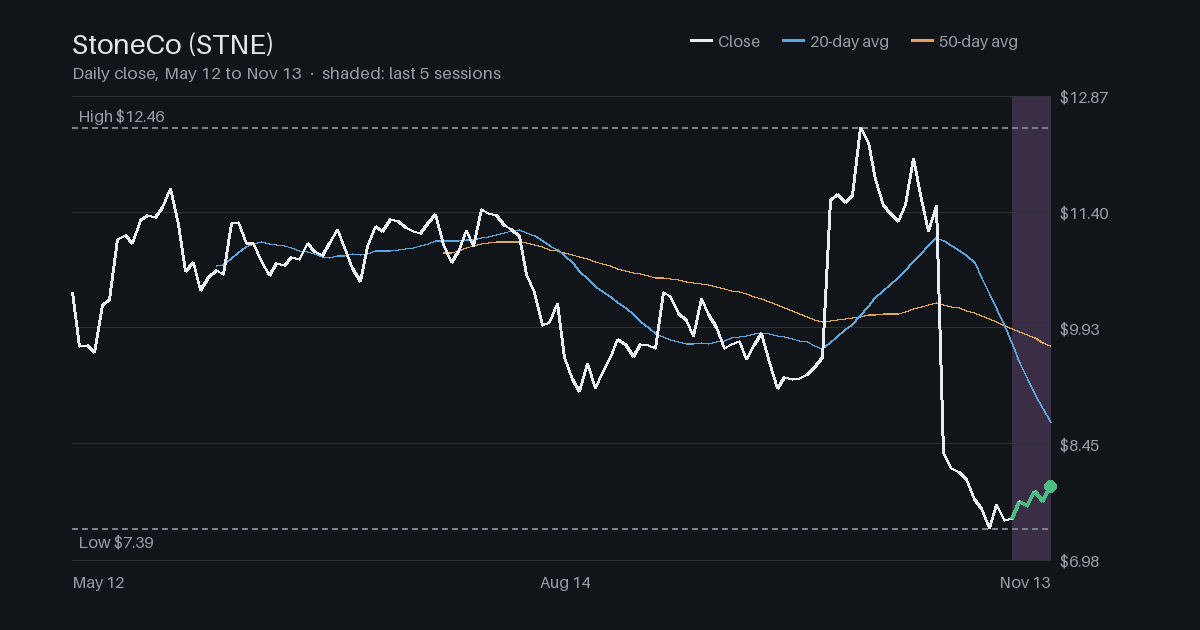
| Last close | $7.92 | Closing price on Nov 13, 2026. |
|---|---|---|
| 5-session move | +5.5% | Change in the closing price over the last five trading days. |
| 20-day average | $8.73 | The average closing price of the last 20 trading days. |
| 50-day average | $9.70 | The average closing price of the last 50 trading days. |
| Period high | $12.46 | Highest price since May 12, 2026. |
| Period low | $7.39 | Lowest price since May 12, 2026. |
Related coverage
 Inter Nasdaq Listing Offers Direct Path to Invest in BrazilInter&Co reports record R$425 million Q3 profit as the digital bank consolidates trading on the Nasdaq, bypassing traditional ADR custody fees.
 Squeezed in Brazil, Your Welcome to Free Shipping Sinks MercadoLibreMercadoLibre shares tumbled on Q3 2026 margin compression as heavy investments in Brazil e-commerce logistics and marketing offset a 45% revenue surge.
 For EM Funds in Brazil, Your Welcome to Rate Cuts Just ExpiredBrazil's central bank held interest rates at 13.75% while the government proposed 50 to 60 billion reais in spending cuts to protect the sliding real.