
For EM Funds in Brazil, Your Welcome to Rate Cuts Just Expired
Brazil's central bank held interest rates at 13.75% while the government proposed 50 to 60 billion reais in spending cuts to protect the sliding real.

American retail investors checking their brokerage accounts this month may notice some unexpected pressure on their broad emerging market funds holding the iShares MSCI Brazil ETF. In Latin America's largest economy, the Central Bank of Brazil's Monetary Policy Committee (Copom) voted unanimously on November 4, 2026, to hold its benchmark Selic interest rate at a high 13.75%, halting a sequence of five consecutive rate cuts that had begun in March. This sudden halt, designed to defend a sliding Brazil real against the dollar (USDBRL), complicates the return expectations for those who invest in Brazil.
The policy freeze ended a streak of quarter-point cuts that had previously lowered the benchmark rate from a peak of 15%. Policymakers were forced to act following a sharp post-election depreciation of the Brazil real, which sent domestic inflation expectations climbing and hit the Ibovespa index on the local B3 exchange. According to the Central Bank's weekly Focus survey published around the decision, market analysts' inflation projections for 2026 drifted to 5.2%, landing well above the official target ceiling of 4.5%. The central bank's statement noted that a combination of domestic fiscal uncertainties, currency volatility, and global pressures—including rising oil prices driven by Middle East conflicts—demanded a halt to monetary easing.
To combat the resulting market sell-off and soothe fears over rising public debt, the government rushed a new legislative defense. On November 11, 2026, Planning Minister Bruno Moretti presented a fiscal spending-cut package to Congress worth 50 to 60 billion reais (approximately $10.8 billion) for next year. The proposed measures include a mechanism to limit real spending growth to 2%—below the 2.5% ceiling of the country's existing fiscal framework—and new rules to exclude certain extraordinary oil revenues from mandatory social spending calculations. While intended to stabilize the plunging real, the plan faces political resistance within the governing coalition, keeping markets on edge.
Investors should keep a close eye on the Chamber of Deputies and the Senate, where Congress will debate and vote on Minister Moretti's fiscal package before the legislative recess in December. The Central Bank's monetary policy committee is scheduled to meet again on December 8 and 9, 2026, to reassess whether the currency has stabilized enough to consider future rate adjustments. Until the spending cuts are formally approved and inflation expectations begin to cool, the baseline for Latin American debt portfolios is a high-for-longer interest rate regime.
In your brokerage app
For retail investors, this monetary and fiscal friction directly impacts the iShares MSCI Brazil ETF, a popular fund listed in New York that tracks the country's largest equities. As high local interest rates raise the cost of credit and weigh on corporate earnings in São Paulo, the fund's underlying assets face near-term headwinds from both currency depreciation and local debt repricing.
Analysis · NWX analysis desk
Which Brazil assets this touches
- EWZ, IBOV, USDBRL, DI1 — Named in this story.
- PBR, PETR4 — Crude oil is the main product of Petrobras and PRIO, so their revenue moves with the price of oil.
Fundamentals · Petrobras (PETR4)
Petrobras (PETR4) trades at 4.2x its yearly earnings and 1.2x its book value. Its return on equity is 27.8%. Its dividend yield is 8.1%. The market values the company at R$617.3 billion. Its financial health score is 81 out of 100 (strong), based on profitability, liquidity, debt and growth. Latest: Q2 2026 results, published Aug 6, 2026.
| Price / earnings (P/E) | 4.2x | How many years of the current yearly profit the share price adds up to. |
|---|---|---|
| Price / book (P/B) | 1.2x | The share price compared with the accounting value of what the company owns, per share. |
| Return on equity (ROE) | 27.8% | Yearly profit for every R$100 that shareholders have put into the company. |
| Net margin | 23.8% | The part of every R$100 in sales that is left as profit. |
| Dividend yield | 8.1% | Cash paid to shareholders over the past year, as a share of today's price. |
| Market value | R$617.3 billion | What the whole company is worth at today's share price. |
Technical picture · iShares MSCI Brazil ETF (EWZ)
iShares MSCI Brazil ETF (EWZ) closed at $32.22 on Nov 13, 2026, up 0.8% from five sessions earlier. The last close is below its 20-day average of $35.03 and below its 50-day average of $37.59. Since May 12, 2026 it has traded between $31.73 (low, Nov 3, 2026) and $43.54 (high, Oct 9, 2026).
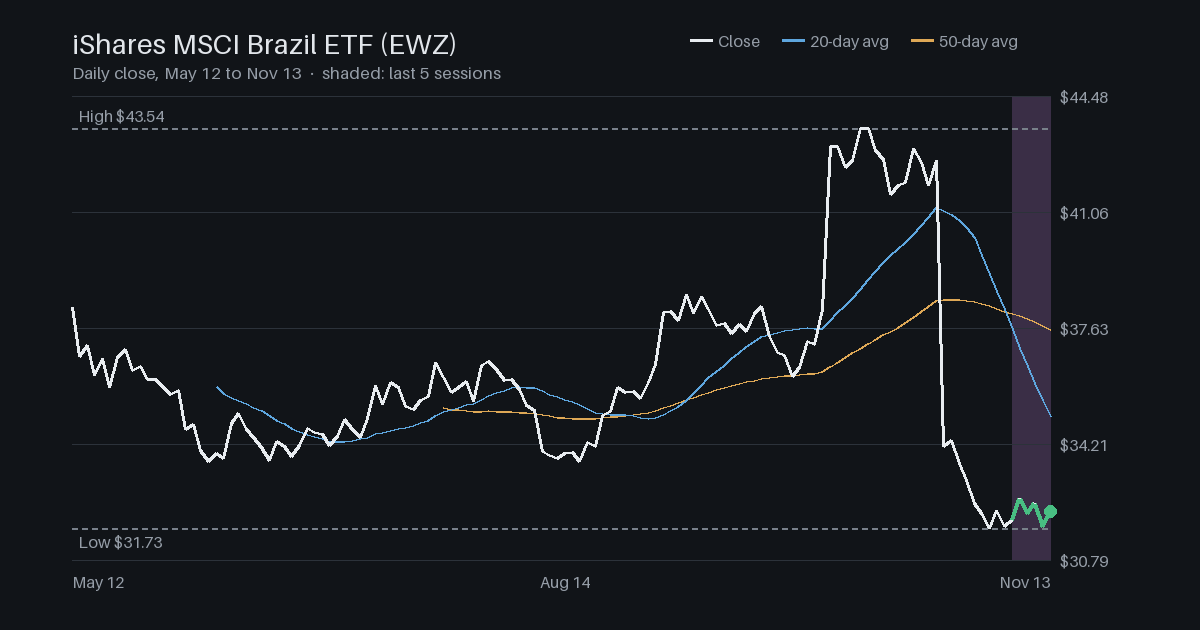
| Last close | $32.22 | Closing price on Nov 13, 2026. |
|---|---|---|
| 5-session move | +0.8% | Change in the closing price over the last five trading days. |
| 20-day average | $35.03 | The average closing price of the last 20 trading days. |
| 50-day average | $37.59 | The average closing price of the last 50 trading days. |
| Period high | $43.54 | Highest price since May 12, 2026. |
| Period low | $31.73 | Lowest price since May 12, 2026. |
Related coverage
 Inter Nasdaq Listing Offers Direct Path to Invest in BrazilInter&Co reports record R$425 million Q3 profit as the digital bank consolidates trading on the Nasdaq, bypassing traditional ADR custody fees.
 Squeezed in Brazil, Your Welcome to Free Shipping Sinks MercadoLibreMercadoLibre shares tumbled on Q3 2026 margin compression as heavy investments in Brazil e-commerce logistics and marketing offset a 45% revenue surge.