

Why a New Brazil Wall Street Downgrade Warns of Stock Market Declines
Morgan Stanley downgraded Brazilian equities to underweight on November 16, 2026, forecasting a 7.2% decline in the Ibovespa index by late 2027.

Key takeaways
- Morgan Stanley downgraded Brazilian equities to underweight, predicting a 7.2% drop by late 2027, per its strategy report on November 16, 2026
- Corporate earnings face a 10% to 20% downside risk due to high interest rates, per Morgan Stanley on November 16, 2026
- Strategists advise shifting from domestic-focused companies to export giants like Petrobras, per its asset recommendation on November 16, 2026
American retail investors holding broad emerging market mutual funds or Brazil-focused exchange-traded funds received a stark warning from New York on Monday, as one of Wall Street's largest investment banks recommended slashing exposure to Latin America’s largest economy. On November 16, 2026, Morgan Stanley downgraded Brazilian equities to underweight—the equivalent of a sell recommendation—predicting that the country's benchmark stock index, the Ibovespa, will drop 7.2% to 160,000 points by the end of 2027. This projected decline is measured against the index’s closing level of 172,457.77 on Friday, November 13, 2026, according to a Morgan Stanley strategy report released on November 16, 2026.
For global investors, the key structural driver behind this downgrade is an economic phenomenon known as "crowding out". Brazil's central bank has aggressively maintained its benchmark Selic interest rate in double-digit territory, which makes local government bonds highly lucrative and virtually risk-free for domestic capital. Morgan Stanley’s strategists noted that these persistent double-digit rates act as a massive vacuum, pulling domestic investment out of riskier corporate equities and steering them into high-yielding fixed income. This dynamic starves local businesses of stock market liquidity and drags down equity valuations.
Beyond high borrowing costs, Wall Street remains deeply skeptical of Brazil’s fiscal path. Morgan Stanley highlighted the government's continued lack of a credible fiscal framework capable of stabilizing the country's rising public debt. Paired with a decelerating domestic economy, the bank warned that Brazilian corporate earnings face a 10% to 20% downside risk. Consequently, international capital is actively migrating to other emerging markets, with Morgan Stanley expressing a clear preference for equities in Chile, India, and South Korea, which offer a more favorable combination of growth and return.
This move represents the second time Morgan Stanley has cut its outlook on Brazil in less than a month. Following the country's late October 2026 presidential runoff, the bank initially trimmed the nation's equities from overweight to a neutral "equalweight" rating. By moving all the way to underweight on November 16, 2026, the bank is signaling that even its previous defensive strategy—relying on massive local financial institutions and basic materials companies to anchor portfolios—is no longer sufficient to protect investor returns.
Going forward, the primary catalyst for any market recovery will be whether the government can deliver concrete spending cuts to stabilize public debt. Until a credible fiscal response is legislated, high interest rates are expected to keep local equities depressed and maintain upward pressure on the U.S. dollar against the Brazilian real.
In your brokerage app
For retail investors holding the iShares MSCI Brazil ETF, this downgrade points to a challenging environment for the fund's net asset value. However, the bank's strategy report did not recommend a complete exit from the country. Instead, Morgan Stanley advised shifting capital away from domestic-focused retailers and builders toward large, New York-listed export giants that earn their revenues in foreign currencies. The bank preserved its preference for several major multinational players listed in New York, including state-controlled oil producer Petrobras, aerospace firm Embraer, paper and pulp manufacturer Suzano, and meatpacking multinational JBS.
Analysis · NWX analysis desk
Which Brazil assets this touches
- EWZ, PBR, EMBJ, SUZ, ITUB, USDBRL — Named in this story.
Fundamentals · Petrobras (PETR4)
Petrobras (PETR4) trades at 4.1x its yearly earnings and 1.1x its book value. Its return on equity is 27.8%. Its dividend yield is 8.3%. The market values the company at R$626.6 billion. Its financial health score is 81 out of 100 (strong), based on profitability, liquidity, debt and growth. Latest: Q3 2026 results, published Nov 10, 2026.
| Price / earnings (P/E) | 4.1x | How many years of the current yearly profit the share price adds up to. |
|---|---|---|
| Price / book (P/B) | 1.1x | The share price compared with the accounting value of what the company owns, per share. |
| Return on equity (ROE) | 27.8% | Yearly profit for every R$100 that shareholders have put into the company. |
| Net margin | 23.8% | The part of every R$100 in sales that is left as profit. |
| Dividend yield | 8.3% | Cash paid to shareholders over the past year, as a share of today's price. |
| Market value | R$626.6 billion | What the whole company is worth at today's share price. |
Technical picture · iShares MSCI Brazil ETF (EWZ)
iShares MSCI Brazil ETF (EWZ) closed at $32.22 on Nov 13, 2026, up 0.8% from five sessions earlier. The last close is below its 20-day average of $35.03 and below its 50-day average of $37.59. Since May 13, 2026 it has traded between $31.73 (low, Nov 3, 2026) and $43.54 (high, Oct 9, 2026).
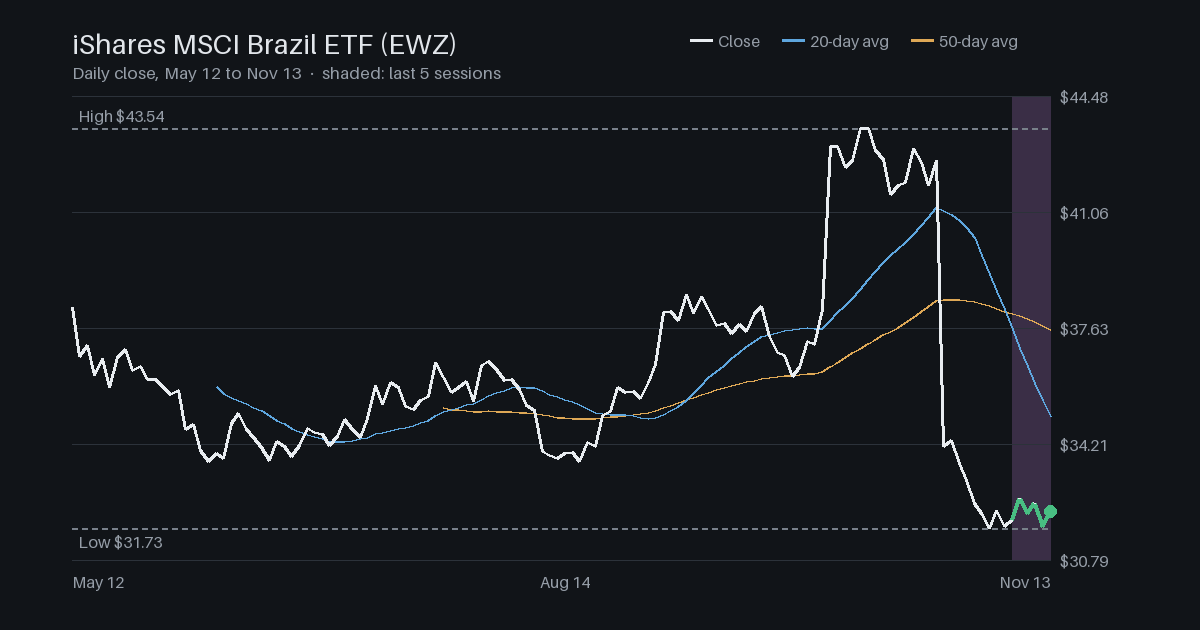
| Last close | $32.22 | Closing price on Nov 13, 2026. |
|---|---|---|
| 5-session move | +0.8% | Change in the closing price over the last five trading days. |
| 20-day average | $35.03 | The average closing price of the last 20 trading days. |
| 50-day average | $37.59 | The average closing price of the last 50 trading days. |
| Period high | $43.54 | Highest price since May 13, 2026. |
| Period low | $31.73 | Lowest price since May 13, 2026. |
Related coverage
 Brazil Policy Shifts and Tax Overhaul Pressure Stock MarketBrazil's dual VAT proposals, tech regulations, and utility license reviews are creating headwinds for international investors.
 Senate's R$18B Tax Credit Cap Threatens Corporate Cash FlowThe Brazilian Senate is debating PLP 299/2026, a fiscal package that limits companies from offsetting federal taxes with accumulated tax credits.
 Citi Cuts Petrobras ADR Target to $18.50 on Capital Spending RisksCitigroup lowered its Petrobras ADR target to $18.50 on capital expenditure concerns, ahead of the oil company's strategic plan release on November 23.