

Brazil Policy Shifts and Tax Overhaul Pressure Stock Market
Brazil's dual VAT proposals, tech regulations, and utility license reviews are creating headwinds for international investors.

Key takeaways
- Court proposes 11.3% federal VAT reference rate for 2027, threatening profit margins for foreign holdings
- Electricity regulator Aneel recommends canceling Enel SpA's São Paulo power concession
- Lawmakers push antitrust and digital tax proposals targeting global tech platforms
- Senate debates anticipated spending cuts as investors seek fiscal clarity
Policymakers in Brasília are advancing a multi-front economic transition, combining anticipated spending cuts to stabilize the local currency with aggressive regulatory actions in the digital and utility sectors. Brazil's electricity regulator, Aneel, recently recommended the early termination of Italian utility firm Enel SpA’s massive São Paulo power distribution concession following repeated service failures. At the same time, a federal court has proposed an 11.3% reference rate for the country's new federal value-added tax (VAT). These coordinated policy and tax resets are reshaping corporate risks across the brazil stock market, forcing international investors to recalibrate their emerging market portfolios.
Tech and Telecom Regulation
In the digital arena, lawmakers are pursuing tighter oversight of global technology platforms and digital service providers. The Chamber of Deputies is advancing a landmark antitrust bill targeting tech gatekeepers to establish ex-ante regulatory authority over dominant platforms. These proposals coincide with a proposed 3% Brazilian digital tax designed to target major U.S. technology giants. While international digital trade groups have warned that these measures will impose significant compliance burdens, supporters of the legislative push argue that fair-competition rules are necessary to safeguard domestic economic interests.
Spending Cuts and Tax Overhauls
For investors monitoring the brazil stock market spending cuts debate, these regulatory actions are unfolding alongside a major transition in the nation's fiscal architecture. The proposed 11.3% federal VAT reference rate—which is being defended in the Senate—has sparked concern among foreign asset managers. Under this new consumption tax model, a rate of this level could significantly pressure operating margins for foreign holdings, making it harder to invest in Brazil profitably. To mitigate these risks, market participants are closely watching the executive branch and Congress as they negotiate a broader fiscal package designed to curb public expenditures and support the real.
Power Outages and Concession Resets
Meanwhile, traditional utility concessions face unprecedented regulatory pressure from federal agencies. Aneel's board recommended stripping Enel São Paulo of its distribution license before its scheduled 2028 expiration, citing systemic power outages between 2023 and 2025 that left millions of metropolitan consumers in the dark. The final decision on the historic contract forfeiture now rests with the Ministry of Mines and Energy. Highlighting the broader regulatory friction in the infrastructure space, Aneel also postponed its voting on new joint rules for sharing utility poles with telecommunications operators, pausing the regulatory process ahead of a key Senate vote.
These sweeping policy shifts are occurring as Brazil's primary export giants contend with volatile international commodity demand. Shares of mining heavyweight Vale S.A. have traded under pressure due to fluctuating Chinese iron ore inventories, while state-backed oil company Petrobras continues to manage capital allocation risks. In contrast, defensive telecom operators continue to return cash to shareholders. Telefônica Brasil, operating under the Vivo brand, continues to prioritize shareholder remuneration, confirming its commitment to ongoing dividend payments and interest on capital payouts despite the shifting tax backdrop.
For retail investors tracking the Brazil ETF (EWZ) and other local assets, the primary focus remains on the implementation timeline of these fiscal and tax overhauls. The Senate must review the federal VAT reference rate by mid-December, while the proposed spending cuts package remains subject to fast-tracked legislative reviews. How successfully the federal government executes these fiscal targets in the coming weeks will determine whether the country can stabilize its debt trajectory and reverse the recent depreciation of the real.
In your brokerage app
If you own diversified emerging market funds like the iShares MSCI Brazil ETF (EWZ) or individual New York-listed Brazilian giants like Vale S.A. or Telefônica Brasil, these concurrent tax and utility resets are directly tied to your corporate profit margins and dividend yields.
Analysis · NWX analysis desk
Which Brazil assets this touches
- EWZ, NU, STNE, PAGS, IBOV — Big swings in U.S. tech stocks tend to spill into Brazil's fintechs listed in New York and into the broad Brazil fund, as global investors change how much risk they hold.
- VALE — Iron ore is Vale's main product and China is its biggest buyer, so the ore price feeds straight into Vale's revenue.
Fundamentals · Vale (VALE3)
Vale (VALE3) trades at 118.4x its yearly earnings and 1.4x its book value. Its return on equity is 1.1%. Its dividend yield is 9.3%. The market values the company at R$241.9 billion. Its financial health score is 50 out of 100 (stable), based on profitability, liquidity, debt and growth. Latest: Q3 2026 results, published Oct 29, 2026.
| Price / earnings (P/E) | 118.4x | How many years of the current yearly profit the share price adds up to. |
|---|---|---|
| Price / book (P/B) | 1.4x | The share price compared with the accounting value of what the company owns, per share. |
| Return on equity (ROE) | 1.1% | Yearly profit for every R$100 that shareholders have put into the company. |
| Net margin | 0.3% | The part of every R$100 in sales that is left as profit. |
| Dividend yield | 9.3% | Cash paid to shareholders over the past year, as a share of today's price. |
| Market value | R$241.9 billion | What the whole company is worth at today's share price. |
Technical picture · iShares MSCI Brazil ETF (EWZ)
iShares MSCI Brazil ETF (EWZ) closed at $31.02 on Nov 17, 2026, down 3.5% from five sessions earlier. The last close is below its 20-day average of $33.88 and below its 50-day average of $37.30. Since May 14, 2026 it has traded between $30.92 (low, Nov 16, 2026) and $43.54 (high, Oct 9, 2026).
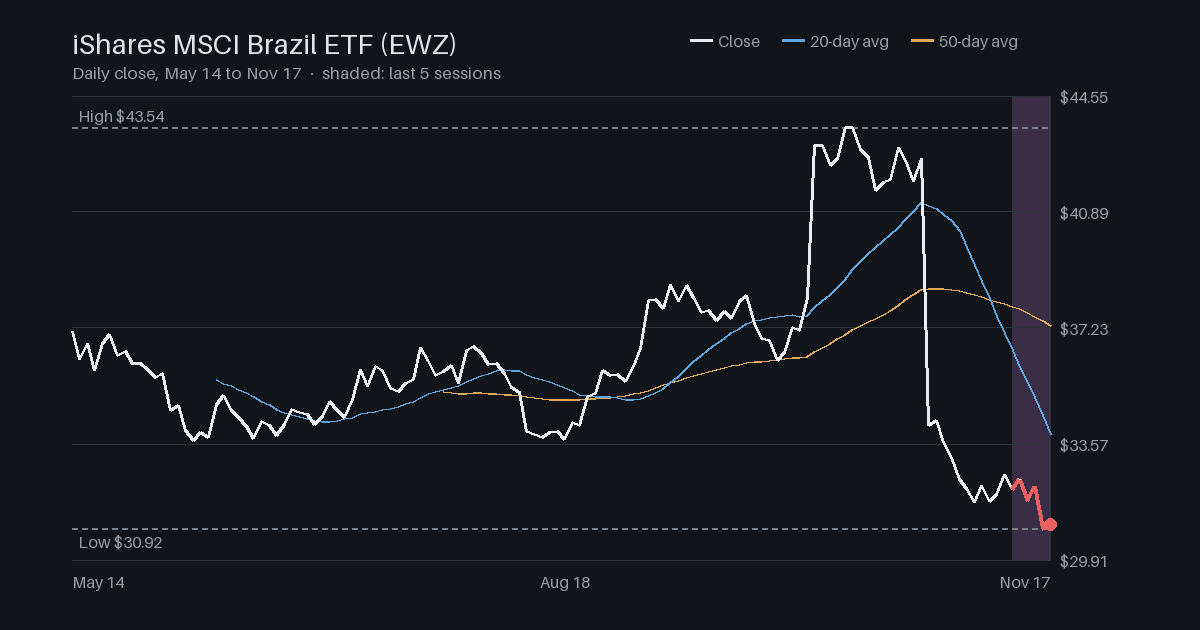
| Last close | $31.02 | Closing price on Nov 17, 2026. |
|---|---|---|
| 5-session move | -3.5% | Change in the closing price over the last five trading days. |
| 20-day average | $33.88 | The average closing price of the last 20 trading days. |
| 50-day average | $37.30 | The average closing price of the last 50 trading days. |
| Period high | $43.54 | Highest price since May 14, 2026. |
| Period low | $30.92 | Lowest price since May 14, 2026. |
Related coverage
 Senate's R$18B Tax Credit Cap Threatens Corporate Cash FlowThe Brazilian Senate is debating PLP 299/2026, a fiscal package that limits companies from offsetting federal taxes with accumulated tax credits.
 Citi Cuts Petrobras ADR Target to $18.50 on Capital Spending RisksCitigroup lowered its Petrobras ADR target to $18.50 on capital expenditure concerns, ahead of the oil company's strategic plan release on November 23.
 Congress Fast-Tracks $10.8 Billion Plan to Shore Up Brazil RealBrazilian leaders agree to fast-track a major budget spending-curb package to ease currency pressure and steady sovereign yields.