

Citi Cuts Petrobras ADR Target to $18.50 on Capital Spending Risks
Citigroup lowered its Petrobras ADR target to $18.50 on capital expenditure concerns, ahead of the oil company's strategic plan release on November 23.

Key takeaways
- Citigroup lowered its Petrobras ADR target price from $21.50 to $18.50 on November 17, 2026, citing capital expenditure risks, per InfoMoney
- Petrobras is scheduled to release its new five-year strategic business plan on November 23, 2026, which is expected to feature higher investment projections
- The company will pay the first installment of a previously declared R$ 17.4 billion dividend on November 23, 2026, according to company disclosures
American retail investors holding Petrobras shares in their US brokerage accounts face a potential squeeze on the company's famous high-yield payouts. On November 17, 2026, Citigroup lowered its target price for Petrobras's New York-listed American Depositary Receipts (ADRs) to $18.50 from $21.50, maintaining a neutral rating, as reported by InfoMoney. For global investors tracking the state-controlled energy giant, the revision reflects growing Wall Street caution regarding rising capital expenditures ahead of a major corporate roadmap release.
The primary driver behind the target cut is an anticipated surge in capital expenditure. Petrobras is scheduled to release its new five-year strategic business plan on November 23, 2026, which market participants expect will feature higher investment projections. Citi analysts Gabriel Barra, Pedro Gama, and Andrés Cardona noted that the company has signaled a strong intent to expand refining capacity, particularly diesel production, and to accelerate its exploration and production projects. While these plans could secure long-term production, they require massive up-front cash outflows.
While daily stock prices remain highly sensitive to international crude fluctuations, investors who prioritize cash distributions are tracking these cash flow implications. In its November 17, 2026 report, Citi warned that under a scenario of lower crude oil prices, Petrobras could face higher financial leverage if it maintains its current investment pace. Under its shareholder remuneration policy, the company is committed to distributing 45% of its free cash flow as long as its gross debt remains below its strategic ceiling. However, if massive capital expenditures eat into free cash flow, the total capital available for dividends will naturally shrink.
Despite the warning on future payouts, short-term cash flow remains on track. Petrobras is scheduled to distribute the first installment of a previously declared R$ 17.4 billion ($3.1 billion) shareholder remuneration on November 23, 2026. This payment aligns with the company's established distribution timeline detailed on the Petrobras Investor Relations portal. Additionally, Citi analysts note that the company may still announce robust dividends in the final quarter of the year, supported by high oil and fuel prices, though there is a risk that these payouts could once again exceed free cash flow to equity.
In your brokerage app
American retail investors can track these capital allocation risks through Petrobras stock certificates traded on the New York Stock Exchange as PBR (common ADRs) and PBR-A (preferred ADRs). The company’s domestic shares trade on the B3 exchange in São Paulo under the tickers PETR3 and PETR4. For broader exposure, the iShares MSCI Brazil ETF (EWZ) holds a significant weighting in the state-controlled oil giant, making it sensitive to any major shifts in Petrobras's spending and dividend policies.
Analysis · NWX analysis desk
Which Brazil assets this touches
- PBR, PBR-A, PETR4, IBOV, BRENT — Named in this story.
- PRIO3 — Crude oil is the main product of Petrobras and PRIO, so their revenue moves with the price of oil.
Fundamentals · Petrobras (PETR4)
Petrobras (PETR4) trades at 4.0x its yearly earnings and 1.1x its book value. Its return on equity is 27.8%. Its dividend yield is 8.3%. The market values the company at R$607.3 billion. Its financial health score is 81 out of 100 (strong), based on profitability, liquidity, debt and growth. Latest: Q3 2026 results, published Nov 10, 2026.
| Price / earnings (P/E) | 4.0x | How many years of the current yearly profit the share price adds up to. |
|---|---|---|
| Price / book (P/B) | 1.1x | The share price compared with the accounting value of what the company owns, per share. |
| Return on equity (ROE) | 27.8% | Yearly profit for every R$100 that shareholders have put into the company. |
| Net margin | 23.8% | The part of every R$100 in sales that is left as profit. |
| Dividend yield | 8.3% | Cash paid to shareholders over the past year, as a share of today's price. |
| Market value | R$607.3 billion | What the whole company is worth at today's share price. |
Technical picture · Petrobras (PETR4)
Petrobras (PETR4) closed at R$44.02 on Nov 16, 2026, down 2.6% from five sessions earlier. The last close is below its 20-day average of R$50.57 and below its 50-day average of R$50.88. Since May 21, 2026 it has traded between R$37.40 (low, Jul 1, 2026) and R$59.79 (high, Oct 23, 2026).
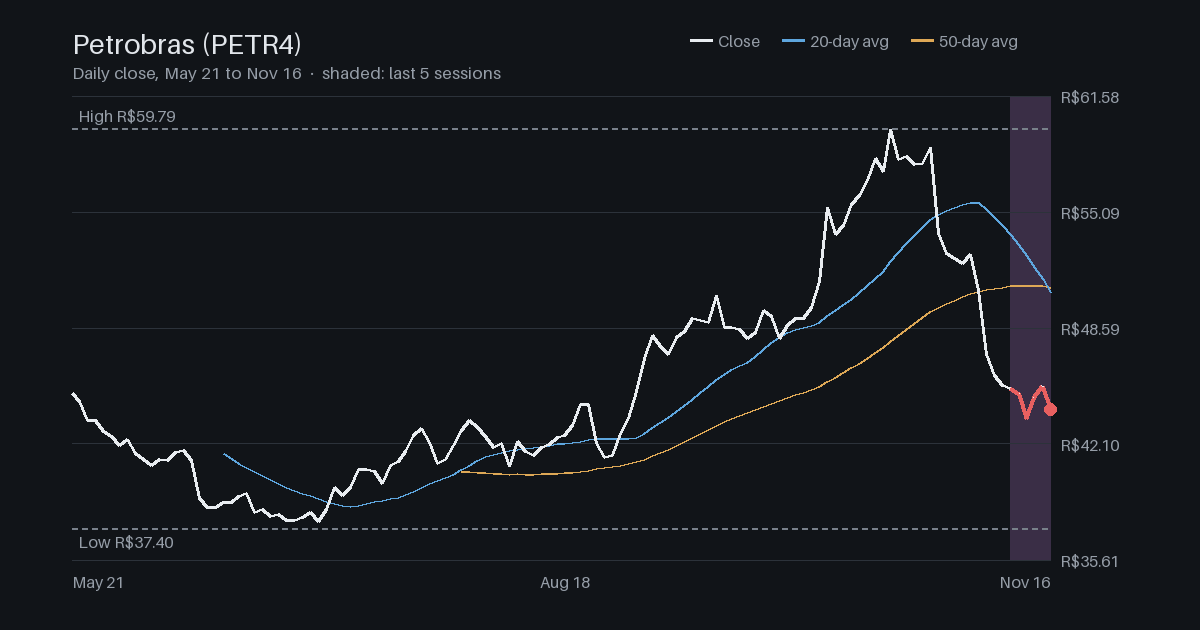
| Last close | R$44.02 | Closing price on Nov 16, 2026. |
|---|---|---|
| 5-session move | -2.6% | Change in the closing price over the last five trading days. |
| 20-day average | R$50.57 | The average closing price of the last 20 trading days. |
| 50-day average | R$50.88 | The average closing price of the last 50 trading days. |
| Period high | R$59.79 | Highest price since May 21, 2026. |
| Period low | R$37.40 | Lowest price since May 21, 2026. |
Related coverage
 Brazil Policy Shifts and Tax Overhaul Pressure Stock MarketBrazil's dual VAT proposals, tech regulations, and utility license reviews are creating headwinds for international investors.
 Senate's R$18B Tax Credit Cap Threatens Corporate Cash FlowThe Brazilian Senate is debating PLP 299/2026, a fiscal package that limits companies from offsetting federal taxes with accumulated tax credits.
 Congress Fast-Tracks $10.8 Billion Plan to Shore Up Brazil RealBrazilian leaders agree to fast-track a major budget spending-curb package to ease currency pressure and steady sovereign yields.