

Senate's R$18B Tax Credit Cap Threatens Corporate Cash Flow
The Brazilian Senate is debating PLP 299/2026, a fiscal package that limits companies from offsetting federal taxes with accumulated tax credits.

Key takeaways
- Brazilian Senate postponed a final vote on fiscal package PLP 299/2026 to November 18, 2026, per Senate reports
- Companies used R$ 200.1 billion in tax credits to offset federal taxes, up 14.6% YoY, per Federal Revenue data on November 17, 2026
- New restrictions aim to raise R$ 12.8 billion to R$ 18.3 billion in 2027, per Senate committee estimates on November 12, 2026
- Limiting tax offsets forces companies to pay federal taxes in cash rather than using valid accumulated credits
American retail investors holding broad Brazilian equities in their brokerage accounts face an immediate threat to the cash flows of their holdings as a key legislative package advances in Brasília. The proposal to restrict companies from using their accumulated tax credits to offset federal tax payments could significantly reduce corporate liquidity. For investors tracking the country's fiscal adjustment, the move shifts the burden of balancing the federal budget directly onto corporate balance sheets.
The Brazilian Senate postponed a final vote on Tuesday, November 17, 2026, on the controversial fiscal package known as PLP 299/2026. The bill, which passed its base text by a 45-31 vote on November 12, 2026, aims to give the executive branch new tools to contain public spending and boost revenue. However, a major point of contention remains a provision that allows the government to limit tax credit compensations whenever spending containment triggers are activated. On November 17, 2026, Senate President Davi Alcolumbre delayed the vote on four crucial amendments (destaques) until Wednesday, November 18, 2026, to allow the bill's rapporteur, Senator Eduardo Braga, more time to negotiate with opposing lawmakers.
The stakes for the corporate sector are massive, as the volume of tax offsets has grown rapidly. Corporate tax offsets reached R$ 200.1 billion ($34.6 billion) between January and September 2026, representing a 14.6% nominal increase compared to the same period in 2025, according to Federal Revenue data reported by InfoMoney on November 17, 2026. By restricting these offsets, the government estimates it can bolster federal revenues by R$ 12.8 billion to R$ 18.3 billion in 2027 to help meet its primary surplus goals, as outlined in the Senate's official report on November 12, 2026. However, analysts warn this forces companies to pay their federal taxes in hard cash despite holding billions in valid, government-recognized credits.
To understand why these credits exist, a foreign investor must look at the complexity of the Brazilian tax system. Companies frequently accumulate credits by overpaying taxes or winning court disputes against the federal government, such as the exclusion of state-level ICMS taxes from federal PIS and Cofins bases. Additionally, export-heavy companies do not pay export taxes but pay domestic taxes on their raw materials, which generates large volumes of valid PIS/Cofins tax credits. Under current laws, they use these credits to offset other federal liabilities. As reported by Gazeta do Povo on November 16, 2026, blocking this "cross-compensation" drains working capital, effectively functioning as an interest-free, compulsory loan from private companies to the government.
What is at stake in the final vote?
The upcoming vote on November 18, 2026, will decide whether these limits remain in the package. A critical amendment proposed by Senator Alan Rick (Republicanos-AC) seeks to entirely delete the tax-offset restrictions from the bill. If the government successfully defeats the amendment and preserves the tax credit limits, the entire PLP 299/2026 package will then head to the Chamber of Deputies for a final vote before it can be signed into law by President Luiz Inácio Lula da Silva.
In your brokerage app
U.S. retail investors holding the iShares MSCI Brazil ETF, an exchange-traded fund listed in New York that tracks broad Brazilian equities, have indirect exposure to this cash-flow squeeze. Major export-oriented and heavy-industry companies, which form the core holdings of the ETF, are the most vulnerable to tax credit restrictions because they rely heavily on cross-compensation to maintain operational liquidity.
Analysis · NWX analysis desk
Which Brazil assets this touches
- EWZ, USDBRL, DI1 — Named in this story.
Technical picture · iShares MSCI Brazil ETF (EWZ)
iShares MSCI Brazil ETF (EWZ) closed at $31.02 on Nov 17, 2026, down 3.5% from five sessions earlier. The last close is below its 20-day average of $33.88 and below its 50-day average of $37.30. Since May 14, 2026 it has traded between $30.92 (low, Nov 16, 2026) and $43.54 (high, Oct 9, 2026).
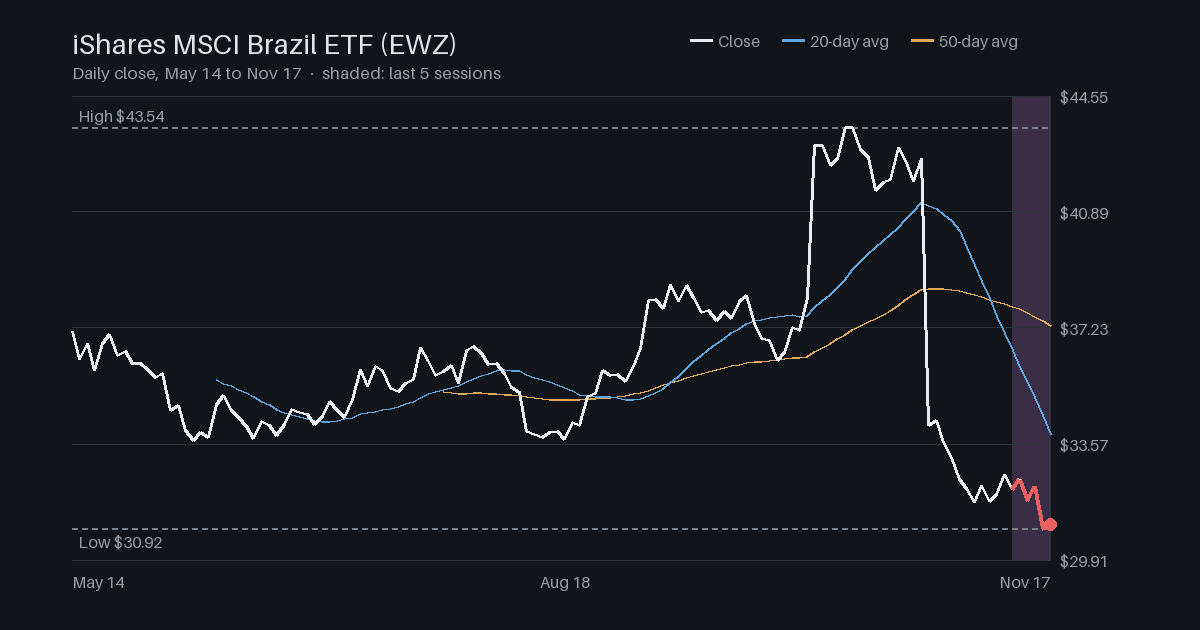
| Last close | $31.02 | Closing price on Nov 17, 2026. |
|---|---|---|
| 5-session move | -3.5% | Change in the closing price over the last five trading days. |
| 20-day average | $33.88 | The average closing price of the last 20 trading days. |
| 50-day average | $37.30 | The average closing price of the last 50 trading days. |
| Period high | $43.54 | Highest price since May 14, 2026. |
| Period low | $30.92 | Lowest price since May 14, 2026. |
Related coverage
 Brazil Policy Shifts and Tax Overhaul Pressure Stock MarketBrazil's dual VAT proposals, tech regulations, and utility license reviews are creating headwinds for international investors.
 Citi Cuts Petrobras ADR Target to $18.50 on Capital Spending RisksCitigroup lowered its Petrobras ADR target to $18.50 on capital expenditure concerns, ahead of the oil company's strategic plan release on November 23.
 Congress Fast-Tracks $10.8 Billion Plan to Shore Up Brazil RealBrazilian leaders agree to fast-track a major budget spending-curb package to ease currency pressure and steady sovereign yields.