

Congress Fast-Tracks $10.8 Billion Plan to Shore Up Brazil Real
Brazilian leaders agree to fast-track a major budget spending-curb package to ease currency pressure and steady sovereign yields.

Key takeaways
- Brazilian Senate approved the base text of Complementary Bill PLP 299/2026, targeting up to R$60 billion ($10.8 billion) in cuts, per G1 and RANE on November 12, 2026
- BNamericas reported that the package reduces the real spending growth ceiling to 2.0% and cuts tax incentives, per BNamericas on November 16, 2026
- Government reached an agreement with Chamber President Hugo Motta to pass the Senate text without amendments, per Money Times on November 17, 2026
US retail investors holding emerging market ETFs or keeping an eye on the USDBRL exchange rate may see currency-driven pressure on their portfolios begin to ease. In an effort to restore fiscal credibility and cool down sovereign bond yields, Brazil's Congress has entered a fast-track agreement to pass a sweeping R$60 billion ($10.8 billion) budget spending-curb package. For global investors who have watched their emerging-market holdings face headwinds from a weakened local currency, this policy coordination marks a critical attempt to stabilize the real.
The legislative vehicle for this adjustment, known as Complementary Bill PLP 299/2026, cleared its first major hurdle on November 12, 2026, when the Brazilian Senate approved the base text of the bill by a 45-to-31 vote. According to reports by G1 and RANE on November 12, 2026, the package targets up to R$60 billion ($10.8 billion) in fiscal adjustments to support the federal government’s 2027 budget. The rapid movement of the bill signals a unified push by the executive and legislative branches to reassure global credit markets of Brazil's commitment to debt sustainability.
To generate these savings, the bill introduces structural curbs on both the expenditure and revenue sides of the ledger. As reported by BNamericas on November 16, 2026, the legislation reduces the annual real expenditure growth ceiling to 2.0%, down from the previous 2.5% limit set by the country's fiscal framework. Additionally, the package mandates an across-the-board 10% cut on tax expenditures, which will scale back corporate tax incentives to help shore up government revenues.
The package gained further momentum on November 17, 2026, when government leaders secured a fast-track agreement with Chamber of Deputies President Hugo Motta. According to Money Times on November 17, 2026, Motta agreed to steer the bill through the lower house under urgency rules and ratify the exact Senate text without introducing new amendments. This deal prevents the legislation from bouncing back to the Senate, shielding the projected fiscal savings from dilution by special-interest lobbying in the lower house.
Looking ahead, the immediate focus turns to the completion of the vote on outstanding opposition amendments in the Senate before the Chamber of Deputies formally registers its vote. If the fast-track agreement holds, the bill is expected to pass into law before the year-end recess, establishing the legal framework for the 2027 federal budget. Investors will be watching whether this legislative victory succeeds in lowering local interest rate futures and stabilizing the exchange rate over the coming weeks.
In your brokerage app
American retail investors holding a broad brazil stock market etf—such as the iShares MSCI Brazil ETF or the broader iShares Latin America 40 ETF—will want to monitor how this legislative package affects the USDBRL exchange rate. Because these funds hold underlying B3 stocks priced in Brazilian reals, a stronger real directly boosts the net asset value of the fund in dollar terms. Furthermore, a reduction in sovereign risk premiums could alleviate downward pressure on Brazilian sovereign bonds, providing a supportive backdrop for emerging market fixed-income portfolios.
Analysis · NWX analysis desk
Which Brazil assets this touches
- EWZ, USDBRL, DI1 — Named in this story.
Technical picture · iShares MSCI Brazil ETF (EWZ)
iShares MSCI Brazil ETF (EWZ) closed at $30.92 on Nov 16, 2026, down 5.2% from five sessions earlier. The last close is below its 20-day average of $34.48 and below its 50-day average of $37.46. Since May 14, 2026 it has traded between $30.92 (low, Nov 16, 2026) and $43.54 (high, Oct 9, 2026).
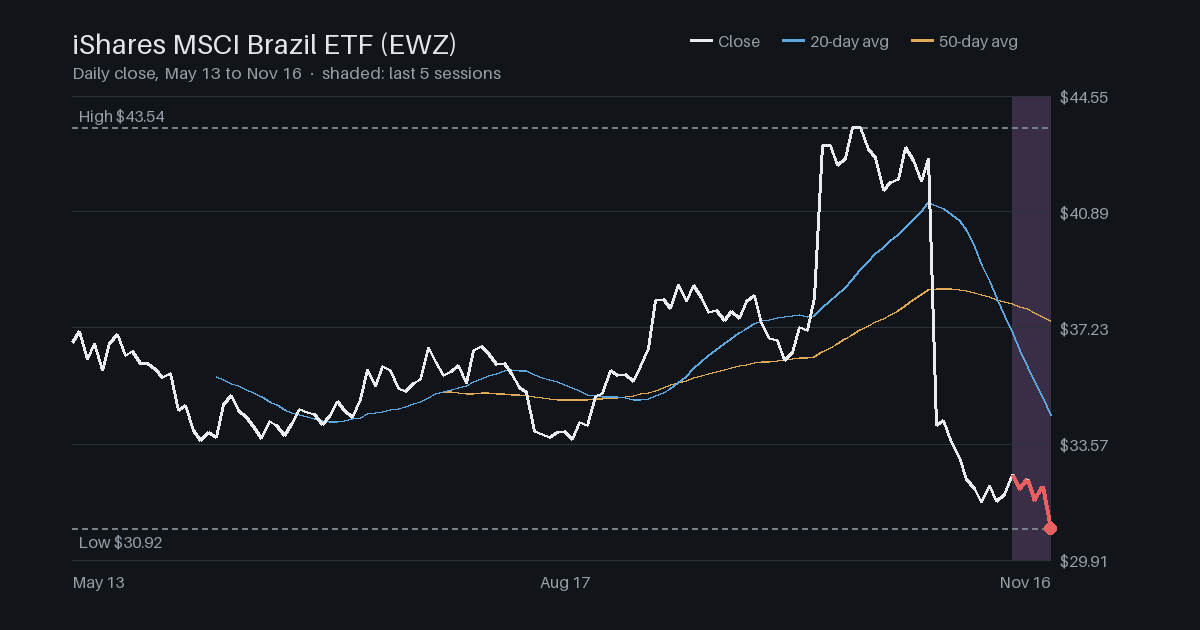
| Last close | $30.92 | Closing price on Nov 16, 2026. |
|---|---|---|
| 5-session move | -5.2% | Change in the closing price over the last five trading days. |
| 20-day average | $34.48 | The average closing price of the last 20 trading days. |
| 50-day average | $37.46 | The average closing price of the last 50 trading days. |
| Period high | $43.54 | Highest price since May 14, 2026. |
| Period low | $30.92 | Lowest price since May 14, 2026. |
Related coverage
 Brazil Policy Shifts and Tax Overhaul Pressure Stock MarketBrazil's dual VAT proposals, tech regulations, and utility license reviews are creating headwinds for international investors.
 Senate's R$18B Tax Credit Cap Threatens Corporate Cash FlowThe Brazilian Senate is debating PLP 299/2026, a fiscal package that limits companies from offsetting federal taxes with accumulated tax credits.
 Citi Cuts Petrobras ADR Target to $18.50 on Capital Spending RisksCitigroup lowered its Petrobras ADR target to $18.50 on capital expenditure concerns, ahead of the oil company's strategic plan release on November 23.