

Senate Approves PLP 299 Fiscal Adjustment Bill to Calm Rates
On November 18, 2026, Brazil's Senate approved the PLP 299/2026 fiscal adjustment bill by a 69-2 vote, aiming to improve the 2027 primary budget balance.

Key takeaways
- Brazil's Senate approved fiscal bill PLP 299/2026 by a 69-to-2 vote on November 18, 2026
- The legislative adjustment package aims to improve the 2027 primary budget balance by R$45.1 billion to R$56.1 billion
- Finance Minister Dario Durigan called the bill a first step to help cut the 13.75% Selic rate, per Reuters on November 18, 2026
- The fiscal adjustment bill now moves to the Chamber of Deputies for an expected vote in the week of November 23, 2026
On November 18, 2026, Brazil's Senate approved the federal government's primary fiscal adjustment bill, PLP 299/2026, in a decisive 69-to-2 vote. The legislative package, which now moves to the Chamber of Deputies for a vote expected in the week of November 23, 2026, aims to improve the country's 2027 primary budget balance by between R$45.1 billion and R$56.1 billion. This fiscal progress is seen as a key step in stabilizing the national debt and providing the necessary economic conditions to eventually ease monetary policy.
Speaking following the vote, Finance Minister Dario Durigan emphasized that the bill is only a first step in the government's broader strategy to manage public finances. According to a report by Reuters, Durigan stated that passing the fiscal framework is necessary to establish the foundation for the Central Bank of Brazil to begin lowering its benchmark Selic interest rate, which currently stands at 13.75%. The high cost of domestic borrowing has been a primary concern for international investors, who watch fiscal policy as the main indicator of future interest rate directions.
With the Senate's approval secured, the bill's next hurdle is in the lower house of Congress. To become law, PLP 299/2026 must be approved by the Chamber of Deputies before it can be sent to President Luiz Inácio Lula da Silva for his signature. If passed, the executive branch expects the newly created tools to help rein in federal expenditures and support the country's macroeconomic stability. However, market participants remain cautious, noting that any eventual rate cuts by the central bank's monetary policy committee will depend on how effectively the government implements these fiscal targets in the coming years.
In your brokerage app
For foreign investors tracking Brazil's fiscal health, the progress of PLP 299/2026 directly impacts the iShares MSCI Brazil ETF (NYSE Arca: EWZ), the primary exchange-traded fund for Brazilian equities. A sustained reduction in fiscal risk could also influence DI1 interest rate futures—the main derivatives used by institutions to hedge local rate exposure—and support the Brazilian real (USDBRL). Furthermore, a potential reduction in the Selic benchmark rate would ease credit costs for major Brazilian financial institutions listed in New York, such as Itaú Unibanco (NYSE: ITUB; B3: ITUB4) and Banco Bradesco (NYSE: BBD), which are highly sensitive to domestic interest rates.
Analysis · NWX analysis desk
Which Brazil assets this touches
- EWZ, ITUB, BBD, ITUB4, USDBRL, DI1 — Named in this story.
Fundamentals · Itaú Unibanco (ITUB4)
Itaú Unibanco (ITUB4) trades at 9.7x its yearly earnings and 1.9x its book value. Its return on equity is 20.8%. Its dividend yield is 7.7%. The market values the company at R$465.3 billion. Its financial health score is 61 out of 100 (stable), based on profitability, liquidity, debt and growth. Latest: Q3 2026 results, published Nov 3, 2026. Next: FY 2026 results expected Feb 3, 2027 (confirmed date).
| Price / earnings (P/E) | 9.7x | How many years of the current yearly profit the share price adds up to. |
|---|---|---|
| Price / book (P/B) | 1.9x | The share price compared with the accounting value of what the company owns, per share. |
| Return on equity (ROE) | 20.8% | Yearly profit for every R$100 that shareholders have put into the company. |
| Net margin | 12.2% | The part of every R$100 in sales that is left as profit. |
| Dividend yield | 7.7% | Cash paid to shareholders over the past year, as a share of today's price. |
| Market value | R$465.3 billion | What the whole company is worth at today's share price. |
Technical picture · iShares MSCI Brazil ETF (EWZ)
iShares MSCI Brazil ETF (EWZ) closed at $28.54 on Nov 20, 2026, down 11.4% from five sessions earlier. The last close is below its 20-day average of $31.94 and below its 50-day average of $36.77. Since May 19, 2026 it has traded between $28.54 (low, Nov 20, 2026) and $43.54 (high, Oct 9, 2026).
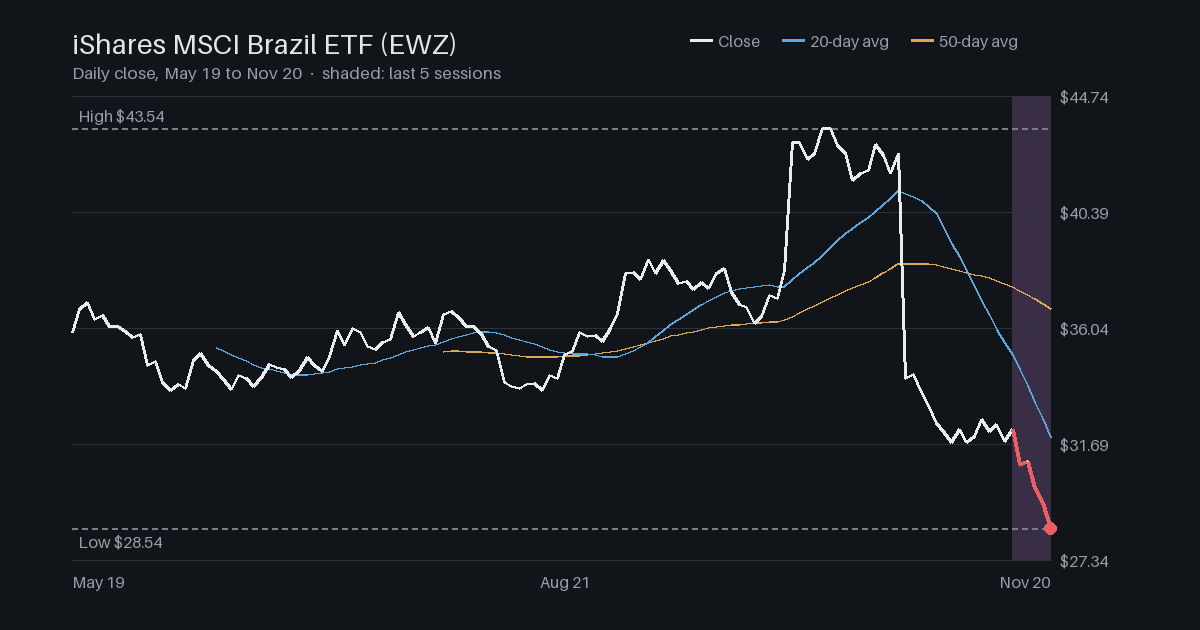
| Last close | $28.54 | Closing price on Nov 20, 2026. |
|---|---|---|
| 5-session move | -11.4% | Change in the closing price over the last five trading days. |
| 20-day average | $31.94 | The average closing price of the last 20 trading days. |
| 50-day average | $36.77 | The average closing price of the last 50 trading days. |
| Period high | $43.54 | Highest price since May 19, 2026. |
| Period low | $28.54 | Lowest price since May 19, 2026. |
Related coverage
 US Beverage Processors Squeezed as Global Orange Harvest Drops 7%A Florida Department of Citrus report projects a 7% drop in combined orange harvests in Brazil, the US, and Mexico, raising costs for beverage processors.
 Yield Spread With US Gaps Past 10% as Brazil Futures Hit 14.82%A massive 10% yield gap between U.S. and Brazilian debt is depressing the Real and hurting dollar returns for emerging-market fund investors.
 MSCI Brazil ETF Faces $10 Billion Test After Senate Spending Cap VoteThe Brazilian Senate approved the PLP 299/2026 fiscal package to cap spending growth at 2%, aiming for a $10 billion primary balance improvement in 2027.