

US AI Chip Limits Hit Brazil, Raising Tech Hurdles for EWZ Investors
The US imposes export licenses on advanced AI chips sent to Brazil, raising compliance hurdles for regional data centers and Latin American tech ETFs like EWZ.

Key takeaways
- The US Bureau of Industry and Security established export licensing requirements on AI semiconductors for Brazil on November 19, 2026, per the Federal Register
- Brazil's Ministry of Development, Industry, Trade and Services began monitoring technology import impacts on November 17, 2026, per MDIC statements
- Data centers serving restricted entities have a 90-day grace period from November 19, 2026 to obtain licenses, per the Federal Register
U.S. government restrictions on advanced technology exports are moving beyond direct targets like China, creating a complex new regulatory hurdle for global investors holding Latin American tech assets. On November 16, 2026, the Bureau of Industry and Security (BIS) issued an Interim Final Rule establishing sweeping export licensing requirements on advanced artificial intelligence semiconductors. This federal intervention represents a significant expansion of Washington’s technological containment perimeter, aiming to prevent high-performance computing hardware from being diverted to countries of concern.
The new controls, published in the Federal Register on November 19, 2026, formally added Brazil alongside Southeast Asian digital hubs—specifically Indonesia, Malaysia, Singapore, and Thailand—to a restricted destination list. The BIS designated Brazil due to what it identified as a "higher-than-normal risk" of state-of-the-art U.S. semiconductors being diverted or accessed remotely by restricted Chinese entities. To enforce this, the rule requires exporters to obtain specialized case-by-case licenses before shipping advanced AI chips, servers, and related software, significantly complicating supply chains for local cloud infrastructure.
Crucially, the rule exempts shipments destined for facilities owned by companies headquartered in the U.S. or with U.S.-based parent companies, provided the exporter complies with monthly reporting. This exception effectively splits the Brazilian data center market down the middle. While U.S. hyperscalers like Amazon Web Services and Microsoft Azure can bypass the licensing bottleneck, local Brazilian data center providers and non-U.S. regional operators must navigate a lengthy, case-by-case licensing process. The disparity threatens to drive up operational costs and lengthen hardware lead times for independent regional cloud providers.
In response to the sudden policy shift, Brazil’s Ministry of Development, Industry, Trade and Services (MDIC) confirmed on November 17, 2026, that it is closely monitoring the potential impact on local technology imports. However, MDIC officials emphasized that the measure is an administrative licensing requirement rather than a flat embargo or trade ban. Technology companies and cloud operators in the region now have a tight timeline to adjust, as comments on the interim rule are due to the BIS by January 19, 2027, and data centers have a 90-day window from the November 19, 2026 effective date to secure licenses, according to the official rule text.
In your brokerage app
This regulatory shift exposes major U.S.-listed Brazilian technology and fintech players to potential hardware procurement delays. While retail banking giant Nu Holdings (NU), StoneCo (STNE), and PagSeguro (PAGS)—all listed in New York—primarily run on U.S. cloud hyperscalers that benefit from the rule's exemptions, any localized data center dependencies could trigger compliance audits and procurement bottlenecks. Investors in the broader Brazil ETF (EWZ) should watch for potential capital expenditure increases or deployment delays in the domestic tech sector as local firms adapt to the dual-speed cloud market created by Washington’s new export controls.
Analysis · NWX analysis desk
Which Brazil assets this touches
- NU, STNE, PAGS, EWZ, USDBRL — Named in this story.
- IBOV — Big swings in U.S. tech stocks tend to spill into Brazil's fintechs listed in New York and into the broad Brazil fund, as global investors change how much risk they hold.
Technical picture · Nu Holdings (NU)
Nu Holdings (NU) closed at $11.25 on Nov 20, 2026, down 14.9% from five sessions earlier. The last close is below its 20-day average of $12.08 and below its 50-day average of $13.45. Since May 19, 2026 it has traded between $11.25 (low, Nov 20, 2026) and $16.12 (high, Oct 9, 2026).
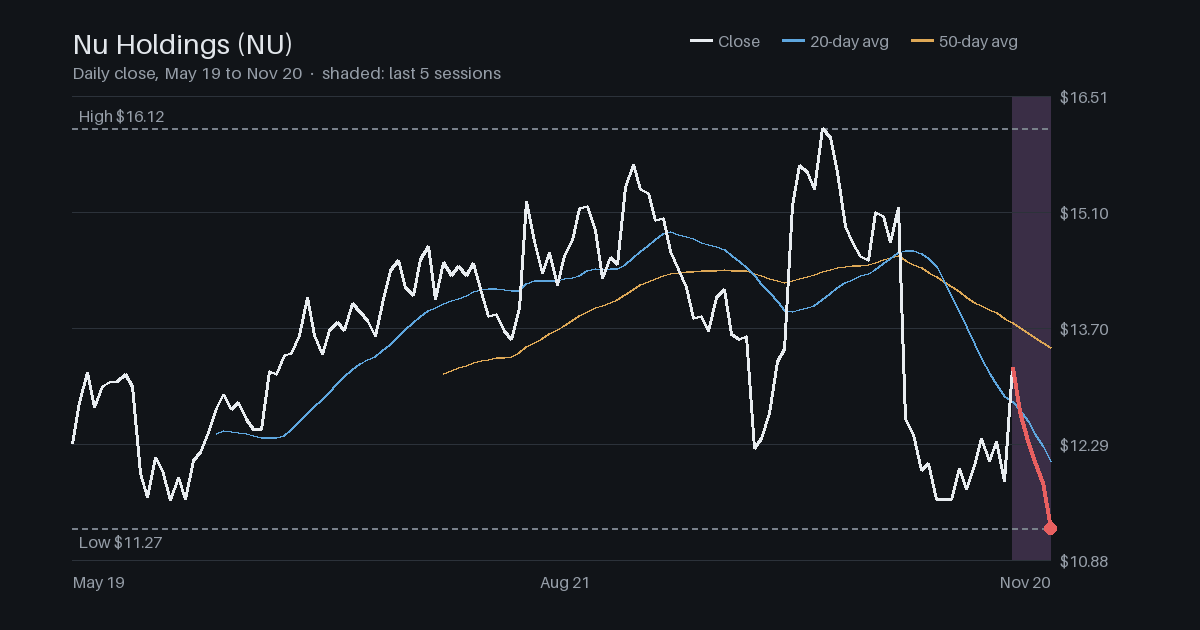
| Last close | $11.25 | Closing price on Nov 20, 2026. |
|---|---|---|
| 5-session move | -14.9% | Change in the closing price over the last five trading days. |
| 20-day average | $12.08 | The average closing price of the last 20 trading days. |
| 50-day average | $13.45 | The average closing price of the last 50 trading days. |
| Period high | $16.12 | Highest price since May 19, 2026. |
| Period low | $11.25 | Lowest price since May 19, 2026. |
Latest articles
 Lula Seeks ASEAN Upgrade as Bilateral Trade Hits $38.4 BillionPresident Lula visited Manila to lobby for Brazil's upgrade to an ASEAN Dialogue Partner, as annual trade with the ten-nation bloc reached $38.4 billion.
 Senate Approves PLP 299 Fiscal Adjustment Bill to Calm RatesOn November 18, 2026, Brazil's Senate approved the PLP 299/2026 fiscal adjustment bill by a 69-2 vote, aiming to improve the 2027 primary budget balance.
 Goldman Sachs Cuts Brazil Stocks to Neutral on Fiscal RisksGoldman Sachs downgraded Brazilian equities to neutral on Nov. 17, 2026, citing a slowing economy, sticky inflation, and fiscal risks.