

Goldman Sachs Cuts Brazil Stocks to Neutral on Fiscal Risks
Goldman Sachs downgraded Brazilian equities to neutral on Nov. 17, 2026, citing a slowing economy, sticky inflation, and fiscal risks.
Key takeaways
- Goldman Sachs downgraded Brazil's stock market recommendation from overweight to neutral on Nov. 17, 2026, per an Estadão report
- The bank projected Brazil's GDP growth to decelerate from 1.6% in 2026 to 0.6% in 2027, per an Estadão report on Nov. 18, 2026
- Chief Latin American Economist Alberto Ramos stated a BRL 400 billion fiscal adjustment is required to stabilize public debt, currently at 83% of GDP, per a CNN interview on Nov. 22, 2026
American retail investors holding emerging market and Latin American index funds are facing a new headwind as Wall Street begins trimming exposure to South America's largest economy. Goldman Sachs downgraded its recommendation on Brazilian equities from overweight to neutral on Nov. 17, 2026, citing a slowing economy, restrictive monetary policy, and risks to corporate earnings, according to a report published by Estadão. In the same regional reallocation, the bank shifted its preferred status to Mexico, India, and China, where analysts see more attractive earnings recovery or stable interest rates.
For global allocators watching the brazil goldman sachs downgrade, the shift reflects a deteriorating macroeconomic outlook. The bank projects Brazil's GDP growth to decelerate sharply from 1.6% in 2026 to just 0.6% in 2027, according to an analysis published by Estadão on Nov. 18, 2026. Alberto Ramos, Goldman's chief Latin American economist, warned in an interview on Nov. 22, 2026, that the country faces a "quasi-stagflation" environment where sluggish growth is paired with sticky inflation.
To stabilize Brazil's rising public debt, which currently hovers around 83% of GDP, Ramos stated that the country requires a massive fiscal adjustment of BRL 400 billion ($68 billion)—equivalent to achieving a 3% primary budget surplus. However, Ramos added that such a correction is highly improbable. He criticized the Brazilian government's recently announced BRL 50 billion fiscal containment package as "insufficient" and of "poor quality," arguing that it focuses on temporary short-term tax collection rather than deep spending cuts.
The lack of a credible fiscal correction is expected to keep the Central Bank of Brazil's benchmark Selic interest rate elevated, leaving virtually no room for rate cuts throughout 2027, according to reports. This high-rate environment is already putting severe pressure on domestic companies, with Goldman Sachs citing risks to corporate earnings.
In your brokerage app
For U.S. retail investors, this defensive shift signals potential drag on broad-basket foreign funds like the iShares MSCI Brazil ETF (EWZ), which directly tracks the largest companies listed on the São Paulo stock exchange. With major investment houses reducing their weighting of Brazilian equities in late November 2026, global capital is increasingly migrating toward alternative emerging markets.
Analysis · NWX analysis desk
Which Brazil assets this touches
- EWZ, IBOV, USDBRL, DI1 — Named in this story.
Technical picture · iShares MSCI Brazil ETF (EWZ)
iShares MSCI Brazil ETF (EWZ) closed at $28.54 on Nov 20, 2026, down 11.4% from five sessions earlier. The last close is below its 20-day average of $31.94 and below its 50-day average of $36.77. Since May 19, 2026 it has traded between $28.54 (low, Nov 20, 2026) and $43.54 (high, Oct 9, 2026).
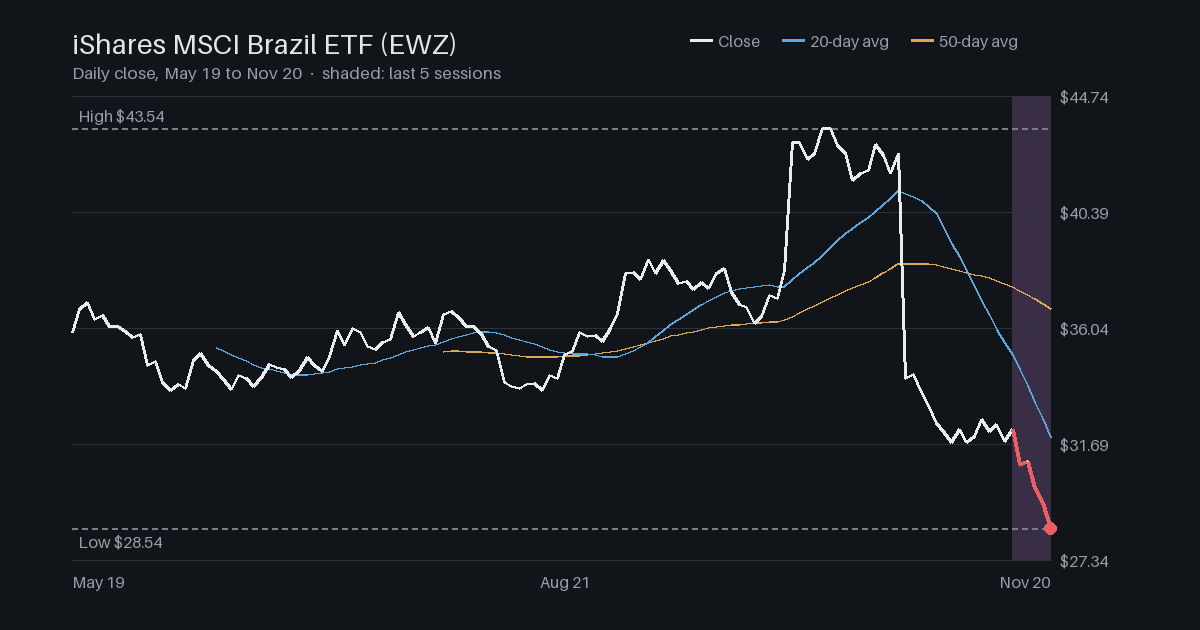
| Last close | $28.54 | Closing price on Nov 20, 2026. |
|---|---|---|
| 5-session move | -11.4% | Change in the closing price over the last five trading days. |
| 20-day average | $31.94 | The average closing price of the last 20 trading days. |
| 50-day average | $36.77 | The average closing price of the last 50 trading days. |
| Period high | $43.54 | Highest price since May 19, 2026. |
| Period low | $28.54 | Lowest price since May 19, 2026. |
Related coverage
 Easing Consumer Prices Rose 0.14% in October but Top Brazil's TargetBrazil’s October inflation slowed to 0.14%, but the 12-month trailing rate rose to 4.63%, exceeding the Central Bank's 4.5% target ceiling.
 BofA Eyes Rare Earths, Infrastructure if Spending Cuts DeliveredBank of America's Brazil leadership says global capital could flow back into critical minerals and infrastructure if the government executes spending cuts.
 Itaúsa Sets Nov. 30 Cutoff for Brazil Real 0.02 Dividend PayoutBrazilian holding giant Itaúsa sets a November 30 cutoff for its fourth-quarter dividend, yielding a net R$ 0.02 per share to be paid on January 4, 2027.