

Easing Consumer Prices Rose 0.14% in October but Top Brazil's Target
Brazil’s October inflation slowed to 0.14%, but the 12-month trailing rate rose to 4.63%, exceeding the Central Bank's 4.5% target ceiling.
Key takeaways
- Brazil's monthly IPCA consumer inflation slowed to 0.14% in October 2026, according to the IBGE on November 12, 2026
- The 12-month trailing inflation rate rose to 4.63% in October 2026, breaching the central bank's 4.50% ceiling, according to the IBGE on November 12, 2026
- Brazil's benchmark Selic interest rate was held steady at 13.75% on November 4, 2026, per the central bank's policy statement
American retail investors holding emerging-market assets or tracking benchmark funds are watching a delicate macroeconomic balancing act unfold, as short-term consumer price relief clashes with long-term interest rate realities. For those managing positions in foreign exchange or Latin American financial equities, the latest consumer data shows immediate pressure easing at the checkout counter, but the broader brazil inflation rate 2026 trajectory remains a concern.
Brazil's official consumer price index, the IPCA, rose by 0.14% in October 2026, slowing down significantly from a 0.82% surge in September 2026, according to a report released on November 12, 2026, by the Brazilian Institute of Geography and Statistics (IBGE). The monthly reading came in comfortably below the 0.25% consensus projected by market analysts and the 0.32% indicated in the mid-month preview, primarily driven by a 1.92% drop in residential electricity bills and a 9.21% decline in airfares, per the same IBGE report on November 12, 2026.
Despite the monthly deceleration, the broader price outlook remains challenging for the central bank's restrictive policy stance. Over the trailing 12 months through October 2026, the brazil inflation rate rose to 4.63%, up from 4.58% in September 2026, according to the IBGE on November 12, 2026. This means annual inflation has exceeded the upper limit of the brazil inflation target range—which allows a ceiling of 4.50% over a 3.00% target—for the second consecutive month, as highlighted by Rico aos Poucos on November 12, 2026. Stubborn food and beverage costs, which jumped 1.04% in October 2026, continue to underpin the annual drift, overriding the temporary relief from energy tariffs, per IBGE on November 12, 2026.
This persistent annual overshoot keeps intense pressure on Brazil's monetary policy committee, Copom, which unanimously voted to halt its rate-cutting cycle and keep the benchmark Selic rate at 13.75% per year during its November 4, 2026, meeting. High inflation expectations and a weaker real (USDBRL) necessitate a highly contractionary stance, according to the central bank's policy statement on November 4, 2026. Economists surveyed in the central bank's weekly Focus market readout published on November 9, 2026, expect policymakers to hold the Selic rate steady at 13.75% at the upcoming December 9, 2026, meeting, capping the economy's short-term growth potential.
Looking ahead, market participants will be closely watching the December 9, 2026, Copom decision and subsequent policy minutes for any signs of a hawkish shift if inflation expectations continue to drift. For the annual rate to fall back within the central bank's 4.50% ceiling by the end of 2026, overall consumer price gains would need to remain below 0.39% combined over November and December, according to calculations from IBGE research manager Fernando Gonçalves reported by Rico aos Poucos on November 12, 2026.
In your brokerage app
For retail portfolios, persistent high interest rates in Brazil keep a lid on equity valuations, affecting the benchmark iShares MSCI Brazil ETF (EWZ). However, Brazil's exceptionally high real yields continue to draw attention to local fixed-income assets, directly impacting Brazilian interest-rate futures and sovereign bond yields. US-listed Brazilian digital banking and financial companies, such as Nu Holdings (NU) and StoneCo (STNE), both listed in New York, remain highly sensitive to these domestic borrowing costs as high rates influence both loan growth and credit delinquency trends.
Analysis · NWX analysis desk
Which Brazil assets this touches
- EWZ, IBOV, USDBRL, DI1 — Named in this story.
Technical picture · iShares MSCI Brazil ETF (EWZ)
iShares MSCI Brazil ETF (EWZ) closed at $28.54 on Nov 20, 2026, down 11.4% from five sessions earlier. The last close is below its 20-day average of $31.94 and below its 50-day average of $36.77. Since May 19, 2026 it has traded between $28.54 (low, Nov 20, 2026) and $43.54 (high, Oct 9, 2026).
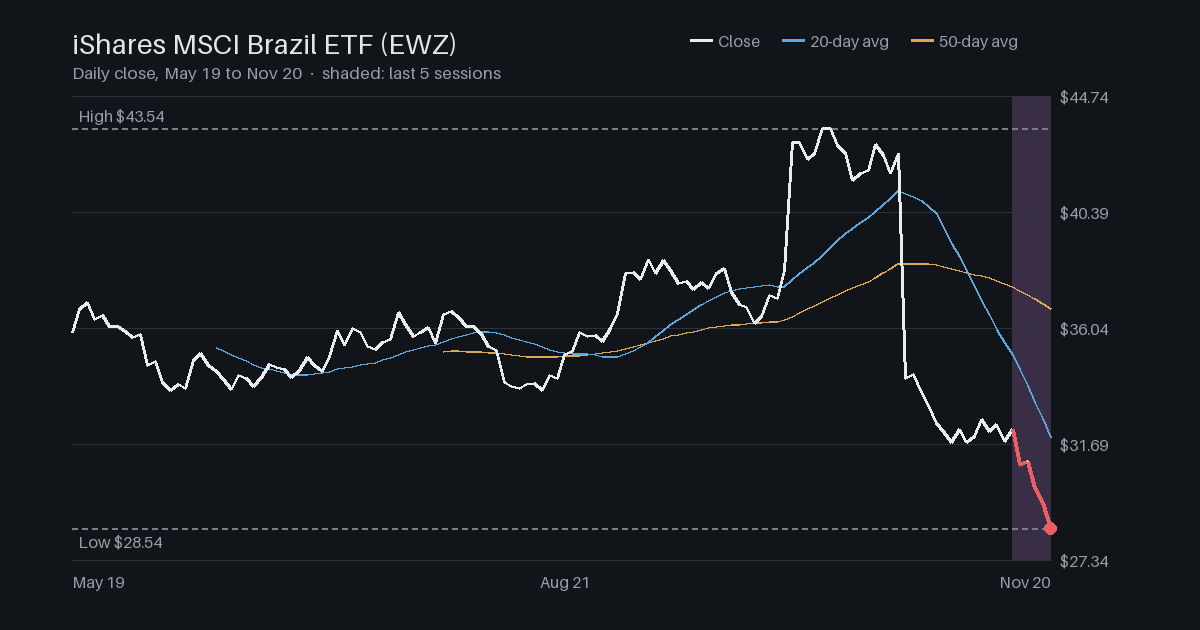
| Last close | $28.54 | Closing price on Nov 20, 2026. |
|---|---|---|
| 5-session move | -11.4% | Change in the closing price over the last five trading days. |
| 20-day average | $31.94 | The average closing price of the last 20 trading days. |
| 50-day average | $36.77 | The average closing price of the last 50 trading days. |
| Period high | $43.54 | Highest price since May 19, 2026. |
| Period low | $28.54 | Lowest price since May 19, 2026. |
Related coverage
 Goldman Sachs Cuts Brazil Stocks to Neutral on Fiscal RisksGoldman Sachs downgraded Brazilian equities to neutral on Nov. 17, 2026, citing a slowing economy, sticky inflation, and fiscal risks.
 BofA Eyes Rare Earths, Infrastructure if Spending Cuts DeliveredBank of America's Brazil leadership says global capital could flow back into critical minerals and infrastructure if the government executes spending cuts.
 Itaúsa Sets Nov. 30 Cutoff for Brazil Real 0.02 Dividend PayoutBrazilian holding giant Itaúsa sets a November 30 cutoff for its fourth-quarter dividend, yielding a net R$ 0.02 per share to be paid on January 4, 2027.