

US Beverage Processors Squeezed as Global Orange Harvest Drops 7%
A Florida Department of Citrus report projects a 7% drop in combined orange harvests in Brazil, the US, and Mexico, raising costs for beverage processors.

Key takeaways
- The Florida Department of Citrus projected that combined orange harvests in Brazil, Mexico, and the US will decline 7.3% year-on-year in the 2026/27 cycle, per its report on November 17, 2026
- Brazil's dominant crop is expected to reach 323.2 million boxes, compared to 47.1 million in the US and 37 million in Mexico, per the Florida Department of Citrus on November 17, 2026
- Orange production for processing in São Paulo and Southwest Minas Gerais is projected to fall 10% year-on-year, per the Florida Department of Citrus on November 17, 2026
American grocery shoppers and beverage processors are facing another expensive squeeze at the supermarket juice aisle. According to a November 17, 2026, market outlook report by the Florida Department of Citrus, combined orange harvests across the world's leading suppliers—Brazil, the United States, and Mexico—are projected to drop 7.3% year-on-year for the 2026/27 cycle. The report, prepared by the department's Director of Economic and Market Research Marisa Zansler, predicts that combined production will fall to approximately 407.3 million 90-pound equivalent boxes. This tightening supply of raw fruit is forcing U.S. retailers and major beverage giants to pay historic premiums for raw materials, directly driving up the retail costs of juice brands that American consumers pull off the shelves.
At the heart of this global supply squeeze is Brazil, which remains the undisputed giant of the international citrus trade. The Florida Department of Citrus report projects that Brazil’s dominant orange crop will reach 323.2 million boxes in the 2026/27 cycle. By comparison, the U.S. harvest is estimated at just 47.1 million boxes, while Mexico is expected to yield 37 million boxes, per the same November 2026 outlook. Because U.S. processors rely heavily on imported Brazilian concentrate to blend into domestic juice supplies, any disruption in South American groves immediately dictates how brazil beverage companies manage their inventory and export pricing.
The primary driver of this year’s tight supply is a projected 10% year-on-year drop in orange production for processing in Brazil’s primary Citrus Belt, which covers the state of São Paulo and Southwest Minas Gerais. According to a November 20, 2026, report by FreshFruitPortal, local growers have battled unusually heavy, off-season rains alongside severe pressure from citrus greening—an incurable bacterial disease that causes fruit to drop prematurely. This double blow has severely curtailed the volume of fruit reaching the massive industrial crushers that supply international markets.
With Florida's own groves still recovering from a historic freeze and persistent disease, U.S. processors have increasingly turned to Mexico to fill the gap. Mexico has incrementally shifted its orange crop away from domestic fresh consumption and toward the processed export sector. Indeed, the Florida Department of Citrus report highlights that between 80% and 83% of Mexican orange juice exports are now destined for the United States. However, Mexico's projected 37 million boxes are far from enough to offset the double-digit drop in Brazil's core processing regions, ensuring that global orange juice commodity prices will remain highly elevated.
Global beverage processors and commodity traders will be closely watching the next crop forecast updates. Brazil's citrus defense association, Fundecitrus, is scheduled to release its next official crop re-estimate on December 10, 2026, while the U.S. Department of Agriculture will publish its updated domestic citrus forecast on January 12, 2027. These data points will determine whether raw material prices will plateau or if beverage manufacturers will have to pass even steeper costs onto retail consumers through the first half of 2027.
In your brokerage app
While retail investors cannot easily trade orange juice futures, they can track the economic fallout of this crop squeeze through equities listed in New York. Ambev, a prominent brazilian beverage company traded on the New York Stock Exchange under the ADR ticker ABEV, is a major player in South American beverage flows, though its portfolio leans heavily toward beer and soft drinks rather than direct citrus processing. For direct exposure to the crop squeeze, investors must look to the major consumer defensive conglomerates and grocery giants that buy this concentrate; persistent raw material inflation in the global orange harvest is poised to pressure the gross margins of household brands found in major retail portfolios.
Analysis · NWX analysis desk
Which Brazil assets this touches
- ABEV, ABEV3, OJ — Named in this story.
Fundamentals · Ambev (ABEV3)
Ambev (ABEV3) trades at 15.9x its yearly earnings and 2.7x its book value. Its return on equity is 17.3%. Its dividend yield is 5.3%. The market values the company at R$248.9 billion. Its financial health score is 67 out of 100 (strong), based on profitability, liquidity, debt and growth. Latest: Q3 2026 results, published Oct 29, 2026.
| Price / earnings (P/E) | 15.9x | How many years of the current yearly profit the share price adds up to. |
|---|---|---|
| Price / book (P/B) | 2.7x | The share price compared with the accounting value of what the company owns, per share. |
| Return on equity (ROE) | 17.3% | Yearly profit for every R$100 that shareholders have put into the company. |
| Net margin | 18.3% | The part of every R$100 in sales that is left as profit. |
| Dividend yield | 5.3% | Cash paid to shareholders over the past year, as a share of today's price. |
| Market value | R$248.9 billion | What the whole company is worth at today's share price. |
Technical picture · Ambev (ABEV3)
Ambev (ABEV3) closed at R$16.08 on Nov 19, 2026, up 2.1% from five sessions earlier. The last close is above its 20-day average of R$15.63 and above its 50-day average of R$15.78. Since May 26, 2026 it has traded between R$14.35 (low, Oct 30, 2026) and R$17.00 (high, Oct 23, 2026).
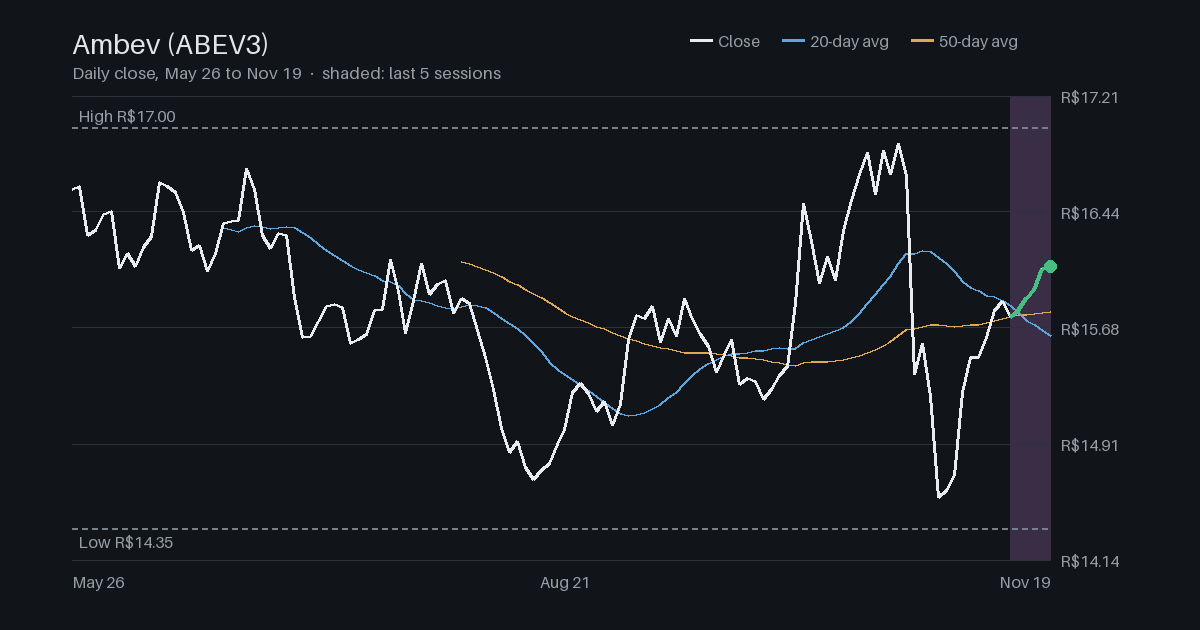
| Last close | R$16.08 | Closing price on Nov 19, 2026. |
|---|---|---|
| 5-session move | +2.1% | Change in the closing price over the last five trading days. |
| 20-day average | R$15.63 | The average closing price of the last 20 trading days. |
| 50-day average | R$15.78 | The average closing price of the last 50 trading days. |
| Period high | R$17.00 | Highest price since May 26, 2026. |
| Period low | R$14.35 | Lowest price since May 26, 2026. |
Related coverage
 Senate Approves PLP 299 Fiscal Adjustment Bill to Calm RatesOn November 18, 2026, Brazil's Senate approved the PLP 299/2026 fiscal adjustment bill by a 69-2 vote, aiming to improve the 2027 primary budget balance.
 Yield Spread With US Gaps Past 10% as Brazil Futures Hit 14.82%A massive 10% yield gap between U.S. and Brazilian debt is depressing the Real and hurting dollar returns for emerging-market fund investors.
 MSCI Brazil ETF Faces $10 Billion Test After Senate Spending Cap VoteThe Brazilian Senate approved the PLP 299/2026 fiscal package to cap spending growth at 2%, aiming for a $10 billion primary balance improvement in 2027.