

MSCI Brazil ETF Faces $10 Billion Test After Senate Spending Cap Vote
The Brazilian Senate approved the PLP 299/2026 fiscal package to cap spending growth at 2%, aiming for a $10 billion primary balance improvement in 2027.

Key takeaways
- The Brazilian Senate approved the primary text of Complementary Bill PLP 299/2026, an up to R$56.1 billion fiscal package, per Senate records on November 18, 2026
- The legislation introduces supplementary freezes capping real spending growth at 2%, down from 2.5%, per official Senate documentation on November 18, 2026
- The government projects a 2027 primary balance improvement between R$45.1 billion and R$56.1 billion, per Senate report findings on November 18, 2026
U.S. retail investors holding diversified international funds face a defining moment for their emerging-market exposure as Brazil's legislative overhaul advances to secure its public accounts. On November 18, 2026, the Brazilian Senate approved the primary text of Complementary Bill PLP 299/2026, a critical fiscal package designed to compress sovereign risk premiums and restore stability to South America's largest economy. This move aims to bolster confidence in the broader brazil msci etf ecosystem, following an intense equity sell-off that previously erased billions in market value.
According to official Senate legislative records updated on November 19, 2026, the approved bill establishes a tighter ceiling on public finances by introducing supplementary budget freezes. Specifically, the framework authorizes the federal government to cap real spending growth at 2.0%—down from the standard 2.5% limit—during years when containment measures are active. The legislation, sponsored by Senator Jaques Wagner and reported by Senator Eduardo Braga, now heads to the Chamber of Deputies, where voting is expected to begin the week of November 23, 2026.
The fiscal adjustment is expected to deliver substantial improvements to Brazil's fiscal trajectory. Government projections indicate that the combination of tighter spending caps, corporate tax-credit restrictions, and a 20% reduction in specific tax exemptions will improve the 2027 primary balance by between R$45.1 billion and R$56.1 billion. At recent exchange rates, this improvement translates to a fiscal relief of roughly $9 billion to $10 billion. To build consensus, the Senate negotiated a compromise on the Lei Kandir, adjusting annual compensation transfers to states to R$2 billion between 2028 and 2030, rather than the steeper cut to R$1 billion originally proposed.
For foreign observers, the bill represents a major legislative milestone to control a public debt load that economists warn could otherwise rise significantly over the coming decade. By tightening structural obligations, the government of President Luiz Inácio Lula da Silva hopes to calm persistent market anxiety regarding fiscal sustainability, curb inflation, and pave the way for lower domestic interest rates. The Chamber of Deputies represents the final hurdle; while government leaders are confident, left-wing factions in the lower house have already floated amendments to exclude strategic investments and university funding from the strict spending limits.
In your brokerage app
American retail investors' exposure to this regulatory shift is primarily concentrated in the msci brazil etf stock (EWZ), the largest exchange-traded fund tracking Brazilian equities. Broad-market indexes and currency-hedged funds remain highly sensitive to these fiscal negotiations, as a successful passage through the Chamber of Deputies could compress sovereign risk premiums, support the Brazilian real, and revive interest in corporate giants listed in both São Paulo and New York.
Analysis · NWX analysis desk
Which Brazil assets this touches
- EWZ, IBOV, USDBRL, DI1 — Named in this story.
Technical picture · iShares MSCI Brazil ETF (EWZ)
iShares MSCI Brazil ETF (EWZ) closed at $28.54 on Nov 20, 2026, down 11.4% from five sessions earlier. The last close is below its 20-day average of $31.94 and below its 50-day average of $36.77. Since May 19, 2026 it has traded between $28.54 (low, Nov 20, 2026) and $43.54 (high, Oct 9, 2026).
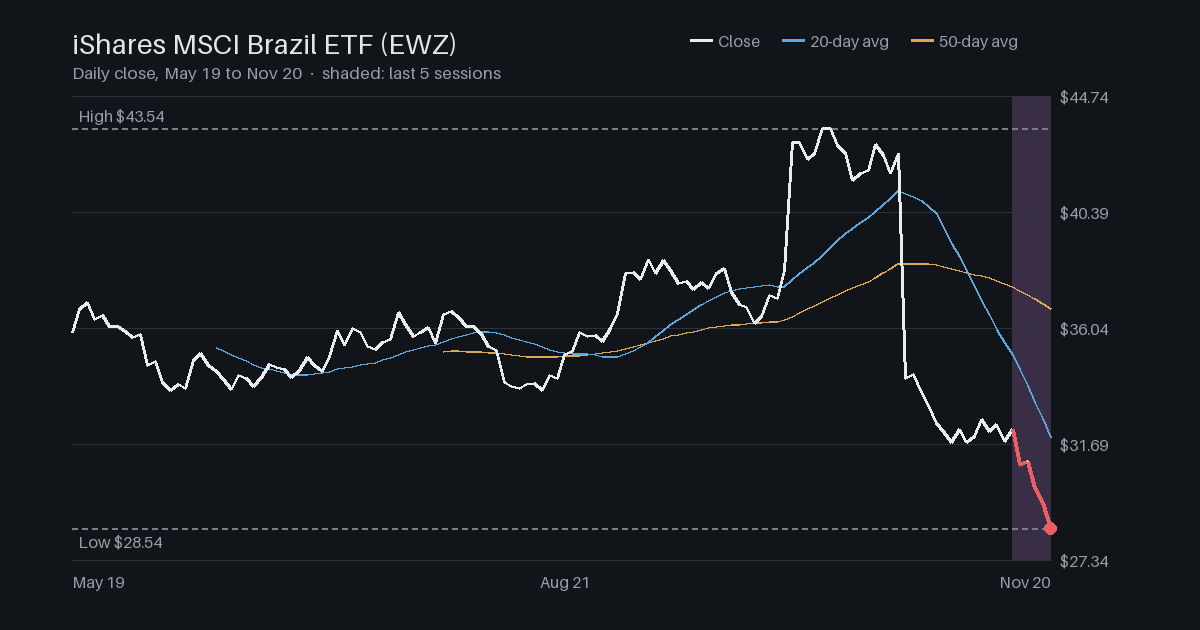
| Last close | $28.54 | Closing price on Nov 20, 2026. |
|---|---|---|
| 5-session move | -11.4% | Change in the closing price over the last five trading days. |
| 20-day average | $31.94 | The average closing price of the last 20 trading days. |
| 50-day average | $36.77 | The average closing price of the last 50 trading days. |
| Period high | $43.54 | Highest price since May 19, 2026. |
| Period low | $28.54 | Lowest price since May 19, 2026. |
Related coverage
 Senate Approves PLP 299 Fiscal Adjustment Bill to Calm RatesOn November 18, 2026, Brazil's Senate approved the PLP 299/2026 fiscal adjustment bill by a 69-2 vote, aiming to improve the 2027 primary budget balance.
 US Beverage Processors Squeezed as Global Orange Harvest Drops 7%A Florida Department of Citrus report projects a 7% drop in combined orange harvests in Brazil, the US, and Mexico, raising costs for beverage processors.
 Yield Spread With US Gaps Past 10% as Brazil Futures Hit 14.82%A massive 10% yield gap between U.S. and Brazilian debt is depressing the Real and hurting dollar returns for emerging-market fund investors.