

Petrobras ADR Caught in the Middle as Brazil Cuts Off Imported Diesel Subsidies
Brazil's Ministry of Finance ended its extra R$1.40 per liter subsidy for imported diesel on November 12, 2026, exposing Petrobras's downstream margins.

Key takeaways
- Brazil's Ministry of Finance let the extra R$1.40 per liter import subsidy expire, per official Ministry of Finance announcement on November 13, 2026
- The government maintained a separate R$2.12 per liter diesel subsidy, per S&P Global on October 27, 2026
- Petrobras increased its domestic diesel market share to 75.4%, up from 73.3%, per ANP data in November 2026
For American investors holding New York-listed shares of Petróleo Brasileiro S.A., known as Petrobras, a sudden shift in domestic fuel subsidies is reshaping the company's margins and market dominance. On November 13, 2026, Brazil’s Ministry of Finance announced it will not renew a temporary R$1.40 ($0.25) per liter extra subsidy for imported diesel, which expired on November 12, 2026, according to an official Ministry of Finance announcement released on November 13, 2026. This move forces private fuel distributors to rely on Petrobras's domestic supply, effectively boosting the state-controlled giant's market share while locking in its profit margins at below-market rates.
Brazil relies on foreign shipments to cover more than 25% of its domestic diesel consumption, making the local fuel market highly vulnerable to international price spikes, according to data from Agência Brasil published on November 14, 2026. To shield consumers from high global oil prices driven by geopolitical tensions in the Middle East, the government had implemented a multi-layered support program in October 2026. While the temporary R$1.40 per liter import complement has now expired, a regular R$2.12 per liter subsidy for domestic road diesel remains active to cap retail fuel price volatility, as detailed by the government's Communications Secretariat and reported by S&P Global on October 27, 2026.
Squeezing refining margins
Without the additional Treasury support, private importers face high international replacement costs and are expected to scale back their operations. Consequently, private fuel distributors are shifting their demand to Petrobras's domestic output, which trades significantly below international parity. According to data from Brazil's National Agency of Petroleum, Natural Gas and Biofuels (ANP), Petrobras's share of the domestic diesel market rose to 75.4% between January and September 2026, up from 73.3% during the same period in 2025, as published on the official ANP portal in November 2026. While this shift solidifies the state-run producer's control over the domestic market, it forces Petrobras to absorb the price difference between imported and local fuel, squeezing its refining margins.
Looking ahead, the pressure on Petrobras will largely depend on global crude oil benchmarks and the strength of the Brazilian real. If international oil prices remain elevated, the gap between local refinery prices and import parity will widen, further disincentivizing private imports. Company executives indicated during a conference call on November 11, 2026, that if further federal funds are denied, Petrobras may utilize its internal Market and Price Group (GEMP) to make targeted technical adjustments to its commercial pricing strategy, bypassing the need for a formal board of directors vote.
In your brokerage app
For retail investors holding Petróleo Brasileiro S.A. (Petrobras) common ADRs listed in New York under the ticker PBR, or the company's preferred ADRs under PBR-A, this regulatory change highlights the constant play between state policy and shareholder value in Brazil. While Petrobras benefits from a larger domestic market share, the expiration of federal import support means its downstream profit margins remain tightly bound to government fiscal decisions and domestic fuel caps rather than international market realities.
Analysis · NWX analysis desk
Which Brazil assets this touches
- PBR, PBR-A, PETR4, BRENT, USDBRL — Named in this story.
- PRIO3 — Crude oil is the main product of Petrobras and PRIO, so their revenue moves with the price of oil.
Fundamentals · Petrobras (PETR4)
Petrobras (PETR4) trades at 4.2x its yearly earnings and 1.2x its book value. Its return on equity is 27.8%. Its dividend yield is 8.1%. The market values the company at R$626.6 billion. Its financial health score is 81 out of 100 (strong), based on profitability, liquidity, debt and growth. Latest: Q3 2026 results, published Nov 10, 2026.
| Price / earnings (P/E) | 4.2x | How many years of the current yearly profit the share price adds up to. |
|---|---|---|
| Price / book (P/B) | 1.2x | The share price compared with the accounting value of what the company owns, per share. |
| Return on equity (ROE) | 27.8% | Yearly profit for every R$100 that shareholders have put into the company. |
| Net margin | 23.8% | The part of every R$100 in sales that is left as profit. |
| Dividend yield | 8.1% | Cash paid to shareholders over the past year, as a share of today's price. |
| Market value | R$626.6 billion | What the whole company is worth at today's share price. |
Technical picture · Petrobras (PETR4)
Petrobras (PETR4) closed at R$45.30 on Nov 13, 2026, down 0.1% from five sessions earlier. The last close is below its 20-day average of R$51.35 and below its 50-day average of R$50.96. Since May 20, 2026 it has traded between R$37.40 (low, Jul 1, 2026) and R$59.79 (high, Oct 23, 2026).
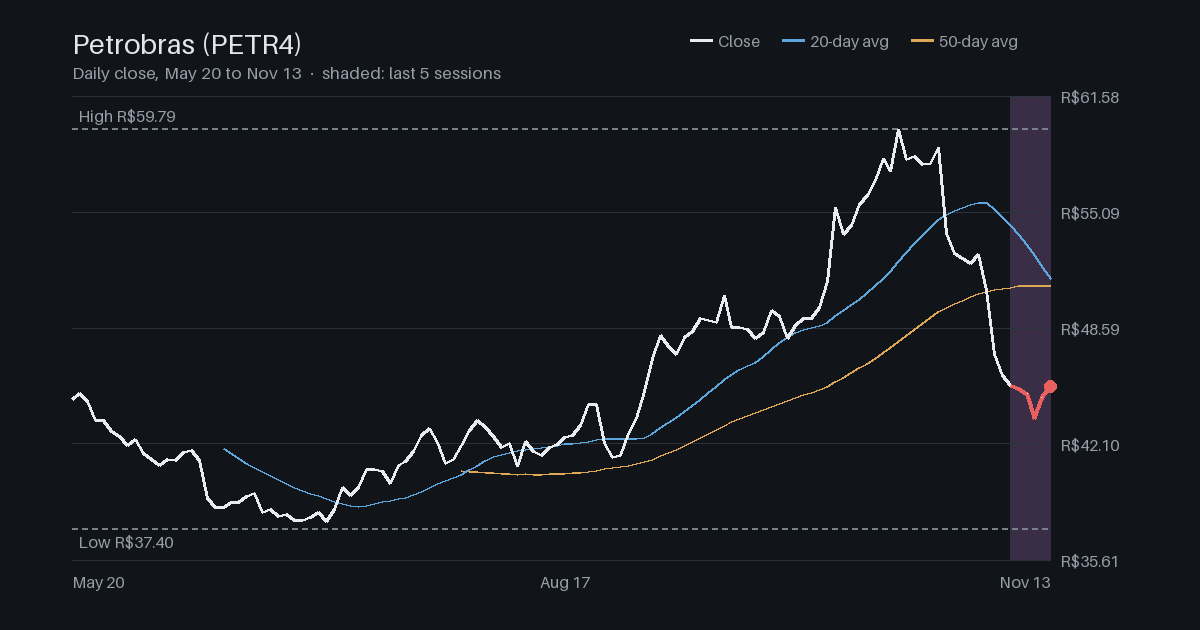
| Last close | R$45.30 | Closing price on Nov 13, 2026. |
|---|---|---|
| 5-session move | -0.1% | Change in the closing price over the last five trading days. |
| 20-day average | R$51.35 | The average closing price of the last 20 trading days. |
| 50-day average | R$50.96 | The average closing price of the last 50 trading days. |
| Period high | R$59.79 | Highest price since May 20, 2026. |
| Period low | R$37.40 | Lowest price since May 20, 2026. |
Related coverage
 Brazil Policy Shifts and Tax Overhaul Pressure Stock MarketBrazil's dual VAT proposals, tech regulations, and utility license reviews are creating headwinds for international investors.
 Senate's R$18B Tax Credit Cap Threatens Corporate Cash FlowThe Brazilian Senate is debating PLP 299/2026, a fiscal package that limits companies from offsetting federal taxes with accumulated tax credits.
 Citi Cuts Petrobras ADR Target to $18.50 on Capital Spending RisksCitigroup lowered its Petrobras ADR target to $18.50 on capital expenditure concerns, ahead of the oil company's strategic plan release on November 23.