

PagSeguro Q3 Net Profit Rises to 611 Million Reais on Credit Push
PagSeguro reported a 7% rise in Q3 adjusted net profit to 611 million reais on November 16, 2026, driven by a 25.2% expansion of its credit book.

Key takeaways
- PagBank reported Q3 adjusted net income of R$ 611 million, up 7% year-over-year, per SEC Form 6-K filing on November 16, 2026
- The fintech's credit portfolio expanded 25.2% to R$ 5.2 billion, per SEC Form 6-K filing on November 16, 2026
- Total payment volume grew 3.2% year-over-year to R$ 131.4 billion, per company earnings release on November 16, 2026
- Non-performing loans over 90 days reached 3.8%, up from 2.6% a year ago, per SEC Form 6-K filing on November 16, 2026
American retail investors holding shares of New York-listed fintech pioneer PagSeguro Digital Ltd. received a solid update after the market close on Monday. According to the company's U.S. Securities and Exchange Commission Form 6-K filing on November 16, 2026, the digital bank posted a 7% year-over-year rise in adjusted net income to 611 million Brazilian reais (R$) for the third quarter of 2026, up from R$ 571 million in the same period last year. This resilient bottom-line growth shows that the fintech is successfully pivoting toward interest-bearing assets to offset macro headwinds, even as high borrowing costs squeeze the local market.
To understand why this shift matters, one must look at the highly competitive retail banking landscape in Latin America's largest economy. PagSeguro, operating under the consumer brand Brazil PagBank, is a São Paulo-based heavyweight that initially made its name by selling payment-card reader terminals to millions of micro-entrepreneurs. Over the past few years, the company has transformed itself from a pure-play payment processor into a full-service digital bank. This strategic diversification is critical because credit expansion now serves as the primary engine to sustain profit margins in a country where the central bank recently held its benchmark Selic interest rate at a steep 13.75%.
According to the company's third-quarter earnings release on November 16, 2026, the driving force behind this profit rise was a major expansion of PagBank's credit book. The company's credit portfolio expanded by 25.2% year-over-year, reaching R$ 5.2 billion, fueled by a 171% surge in working capital loan offerings to small businesses. Total payment volume (TPV), the core metric for its legacy card-acquiring business, rose by 3.2% year-over-year to R$ 131.4 billion, according to company earnings data released on November 16, 2026. This indicates that while its payment-processing division is experiencing slower growth, the credit engine is picking up the slack.
However, PagBank's aggressive credit push carries some operational risks that global investors must monitor. According to the SEC filing on November 16, 2026, the digital bank's non-performing loans (NPLs) at least 90 days past due rose to 3.8% in the third quarter of 2026, up from 2.6% in the same quarter last year. To account for this worsening credit quality, the company reported expected credit losses of R$ 456 million in the quarter, according to the SEC filing on November 16, 2026. This rising delinquency rate suggests that lending to small-and-medium enterprises in Brazil's high-rate environment remains a double-edged sword, though deposit growth of 8.4% year-over-year to R$ 42.8 billion helps secure a cheaper pool of funding.
Looking ahead, the main event for investors to watch is how the company balances its asset quality with capital returns. On November 16, 2026, PagBank's board authorized a new share repurchase program of up to US$ 150 million, following approximately R$ 2.1 billion returned to shareholders over the past twelve months, according to the company's SEC filing. Additionally, the company announced a cash dividend of US$ 0.26 per common share to be paid on December 30, 2026, to shareholders of record as of December 14, 2026, according to the SEC filing on November 16, 2026. How the bank manages its capital buffers in the coming quarters will determine whether it can maintain this dividend run rate without eroding its regulatory capital ratios.
In your brokerage app
Investors can track this development through PagSeguro Digital Ltd., which trades on the New York Stock Exchange under the ticker PAGS. While the broader Brazilian market has been volatile under persistent high-interest-rate pressures, individual exposure to Brazilian fintech is also captured by diversified funds like the iShares MSCI Brazil ETF (EWZ), which holds major financial and industrial assets across the country.
Analysis · NWX analysis desk
Which Brazil assets this touches
- PAGS, EWZ, USDBRL — Named in this story.
Technical picture · PagSeguro (PAGS)
PagSeguro (PAGS) closed at $7.98 on Nov 13, 2026, up 5.0% from five sessions earlier. The last close is below its 20-day average of $8.81 and below its 50-day average of $9.46. Since May 13, 2026 it has traded between $7.60 (low, Nov 6, 2026) and $11.72 (high, Oct 20, 2026).
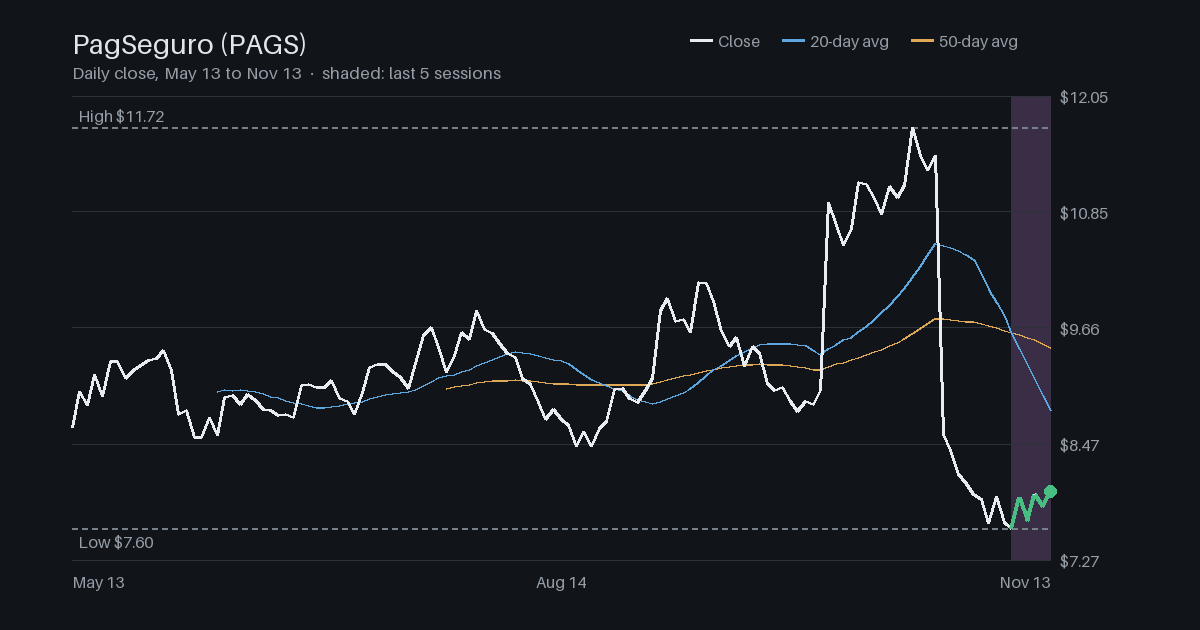
| Last close | $7.98 | Closing price on Nov 13, 2026. |
|---|---|---|
| 5-session move | +5.0% | Change in the closing price over the last five trading days. |
| 20-day average | $8.81 | The average closing price of the last 20 trading days. |
| 50-day average | $9.46 | The average closing price of the last 50 trading days. |
| Period high | $11.72 | Highest price since May 13, 2026. |
| Period low | $7.60 | Lowest price since May 13, 2026. |
Related coverage
 Brazil Policy Shifts and Tax Overhaul Pressure Stock MarketBrazil's dual VAT proposals, tech regulations, and utility license reviews are creating headwinds for international investors.
 Senate's R$18B Tax Credit Cap Threatens Corporate Cash FlowThe Brazilian Senate is debating PLP 299/2026, a fiscal package that limits companies from offsetting federal taxes with accumulated tax credits.
 Citi Cuts Petrobras ADR Target to $18.50 on Capital Spending RisksCitigroup lowered its Petrobras ADR target to $18.50 on capital expenditure concerns, ahead of the oil company's strategic plan release on November 23.