

Morgan Stanley Downgrade Knocks Brazil ETF as Deficit Worries Grow
Morgan Stanley downgraded Brazilian equities to underweight on November 16, 2026, warning of deficit worries and high interest rates.

Key takeaways
- Morgan Stanley downgraded Brazilian equities to underweight, cutting its end-2027 target to 160,000 points, per InfoMoney on November 16, 2026
- Brazil’s Senate approved the base text of PLP 299/2026 to save up to R$ 60 billion, per official legislative records on November 12, 2026
- The Brazilian Real depreciated to 5.78 per US dollar following the Wall Street downgrade, per Forbes on November 16, 2026
American retail investors tracking the ishares msci brazil etf stock face a new headwind after Morgan Stanley downgraded Brazilian equities to underweight on November 16, 2026, according to InfoMoney. The Wall Street bank advised clients in its strategy report to slash exposure to Latin America’s largest economy and favor US-dollar-exposed exporters over domestic-facing businesses due to persistent deficit worries and soaring public debt.
The downgrade by Morgan Stanley strategists Nikolaj Lippmann, Julia Nogueira, and Marcos Rios came despite a recent legislative milestone in Brasília, according to Forbes. On November 12, 2026, the Brazilian Senate approved the base text of PLP 299/2026, a critical fiscal adjustment package designed to generate up to R$ 60 billion ($10.8 billion USD) in budget savings for 2027, according to legislative records. However, Morgan Stanley argued in its report on November 16, 2026, that the legislative package remains insufficient to alter the upward trajectory of Brazil's gross public debt, which has climbed to 82.9% of the nation's gross domestic product (GDP).
The Wall Street firm set an end-2027 price target for the benchmark Ibovespa index at 160,000 points—marking a projected 7.2% decline from its November 13 close—per its strategists on November 16, 2026, as reported by InfoMoney. Following the downgrade, the USDBRL exchange rate spiked as the Brazilian Real depreciated to 5.78 per US dollar on November 16, 2026, marking its highest level since April 2025, per currency market data reported by Forbes.
The strategists pointed out on November 16, 2026, that high interest rates have driven the local cost of capital to approximately 20%, which siphons money from equities and risks cutting corporate earnings by 10% to 20%, per InfoMoney. DI interest rate futures have also reacted as expectations build that Brazil's benchmark Selic interest rate will remain locked at 13.75% through the end of 2026, per market survey estimates on November 16, 2026. This dynamic makes high-yielding fixed-income assets far more attractive than local stocks, further starving the equity market of liquidity.
Looking ahead, the fiscal bill must still clear individual amendment votes in the Senate before heading to the Chamber of Deputies, where the government will seek final passage before the December congressional recess. Investors will closely watch whether these additional legislative steps can provide any concrete structural deficit relief, or if the country's public debt will continue its upward climb, further weighing on international asset allocations.
In your brokerage app
For retail investors holding the iShares MSCI Brazil ETF—a popular fund tracking Brazilian equities under the ticker EWZ—or broad Latin American vehicles like the iShares Latin America 40 ETF, this Wall Street downgrade signals a defensive shift. Individual stock pickers with US brokerage accounts may see increased volatility in major US-listed Brazilian ADRs like oil producer Petrobras or financial giants like Banco Bradesco and Nu Holdings. While domestic-facing businesses face pressure, Morgan Stanley's strategy highlights large exporters like food giant JBS N.V., which is listed in New York, as potentially more resilient due to their US-dollar-denominated revenue.
Analysis · NWX analysis desk
Which Brazil assets this touches
- EWZ, IBOV, USDBRL, DI1 — Named in this story.
Technical picture · iShares MSCI Brazil ETF (EWZ)
iShares MSCI Brazil ETF (EWZ) closed at $30.92 on Nov 16, 2026, down 5.2% from five sessions earlier. The last close is below its 20-day average of $34.48 and below its 50-day average of $37.46. Since May 14, 2026 it has traded between $30.92 (low, Nov 16, 2026) and $43.54 (high, Oct 9, 2026).
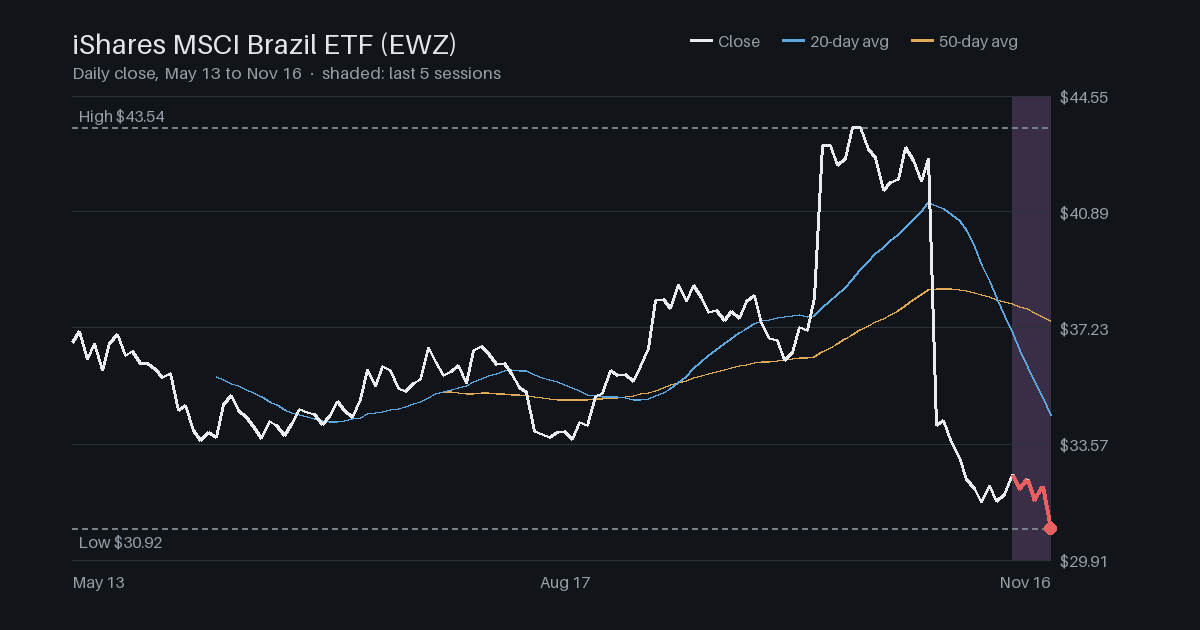
| Last close | $30.92 | Closing price on Nov 16, 2026. |
|---|---|---|
| 5-session move | -5.2% | Change in the closing price over the last five trading days. |
| 20-day average | $34.48 | The average closing price of the last 20 trading days. |
| 50-day average | $37.46 | The average closing price of the last 50 trading days. |
| Period high | $43.54 | Highest price since May 14, 2026. |
| Period low | $30.92 | Lowest price since May 14, 2026. |
Related coverage
 Brazil Policy Shifts and Tax Overhaul Pressure Stock MarketBrazil's dual VAT proposals, tech regulations, and utility license reviews are creating headwinds for international investors.
 Senate's R$18B Tax Credit Cap Threatens Corporate Cash FlowThe Brazilian Senate is debating PLP 299/2026, a fiscal package that limits companies from offsetting federal taxes with accumulated tax credits.
 Citi Cuts Petrobras ADR Target to $18.50 on Capital Spending RisksCitigroup lowered its Petrobras ADR target to $18.50 on capital expenditure concerns, ahead of the oil company's strategic plan release on November 23.