

Itaú Enters Low-Income Housing Program to Challenge State Dominance
Itaú Unibanco is entering Brazil's flagship affordable housing program, Minha Casa Minha Vida, to challenge state-owned lenders in the mortgage market.

Key takeaways
- Itaú Unibanco confirmed it will begin financing properties under the federal Minha Casa Minha Vida program, targeting clients with incomes of R$ 5,000 to R$ 9,600, per Times Brasil on November 24, 202
- Itaú Unibanco launched the Pró-Cotista mortgage line using FGTS funds for workers earning up to R$ 12,000 per month, per Times Brasil on November 24, 2026
- Itaú Unibanco grew its real estate credit portfolio to R$ 158.8 billion, representing a 54.1% private market share, per Itaú Unibanco on November 24, 2026
For American retail investors holding New York-listed shares of Latin America's largest financial institution, a strategic pivot in subsidized home lending is about to challenge state dominance. On November 24, 2026, Itaú Unibanco confirmed it will begin financing properties under the federal Minha Casa, Minha Vida (MCMV) affordable housing program, targeting middle-income clients in the Faixa 3 category with monthly incomes between R$ 5,000 and R$ 9,600, according to reports by Times Brasil.
In the Brazil affordable housing sector, the market has historically been a virtual monopoly of the state-owned lender Caixa Econômica Federal, as explained in reports by Estadão. The federal government’s MCMV program, created in 2009, relies on public subsidies and the national severance fund (FGTS) to provide low-interest mortgages to working-class families. By breaking into this segment, the nation's largest private bank intends to capture stable, long-term credit relationships that can be leveraged to cross-sell other financial products in a high-interest-rate environment.
Accessing Federal Housing Resources
The bank is also launching operations for the Pró-Cotista mortgage line, which utilizes FGTS resources to serve salaried workers earning up to R$ 12,000 per month, as announced on November 24, 2026, and reported by Times Brasil. This dual expansion allows the bank to bypass the more restrictive, high-interest rules of the traditional SBPE mortgage market, where interest rates for private clients ranged from 12.89% to 14.85% per year as of November 2026, as reported by Estadão. The new subsidized options will be rolled out gradually, subject to individual credit reviews and the formal regulations of the federal program.
This aggressive expansion builds on a highly profitable period for the bank's mortgage business. According to third-quarter financial data as of September 2026, Itaú Unibanco’s total real estate credit portfolio reached R$ 158.8 billion, marking a 15.8% increase compared to the same period in the previous year, as confirmed by the bank's investor relations updates at Itaú Unibanco on November 24, 2026. This volume represents a dominant 54.1% market share among private financial institutions, according to Itaú Unibanco's November 24, 2026 announcement, solidifying its lead in mortgage credit in Brazil.
Looking forward, market participants will be watching how competitors like Banco Bradesco and Santander Brasil react, as both have previously studied entering the federal housing program to defend their retail bases. Investors should monitor whether the gradual rollout of Itaú's new subsidized lending lines begins to impact its net interest margins and overall credit quality over the coming quarters, particularly if macroeconomic conditions keep benchmark interest rates in double digits.
In your brokerage app
American investors can access this shifting dynamic through New York-listed ADRs of Itaú Unibanco, which represents the primary vehicle for direct equity exposure to the bank. Broad exposure to the country's financial sector and its largest lenders is also available through diversified exchange-traded funds tracking South American equities.
Analysis · NWX analysis desk
Which Brazil assets this touches
- ITUB, ITUB4 — Named in this story.
Fundamentals · Itaú Unibanco (ITUB4)
Itaú Unibanco (ITUB4) trades at 9.6x its yearly earnings and 1.9x its book value. Its return on equity is 20.8%. Its dividend yield is 7.8%. The market values the company at R$458.5 billion. Its financial health score is 61 out of 100 (stable), based on profitability, liquidity, debt and growth. Latest: Q3 2026 results, published Nov 3, 2026. Next: FY 2026 results expected Feb 3, 2027 (confirmed date).
| Price / earnings (P/E) | 9.6x | How many years of the current yearly profit the share price adds up to. |
|---|---|---|
| Price / book (P/B) | 1.9x | The share price compared with the accounting value of what the company owns, per share. |
| Return on equity (ROE) | 20.8% | Yearly profit for every R$100 that shareholders have put into the company. |
| Net margin | 12.2% | The part of every R$100 in sales that is left as profit. |
| Dividend yield | 7.8% | Cash paid to shareholders over the past year, as a share of today's price. |
| Market value | R$458.5 billion | What the whole company is worth at today's share price. |
Technical picture · Itaú Unibanco (ITUB4)
Itaú Unibanco (ITUB4) closed at R$39.74 on Nov 24, 2026, down 3.8% from five sessions earlier. The last close is below its 20-day average of R$40.51 and below its 50-day average of R$43.62. Since May 29, 2026 it has traded between R$37.35 (low, Aug 20, 2026) and R$50.85 (high, Oct 6, 2026).
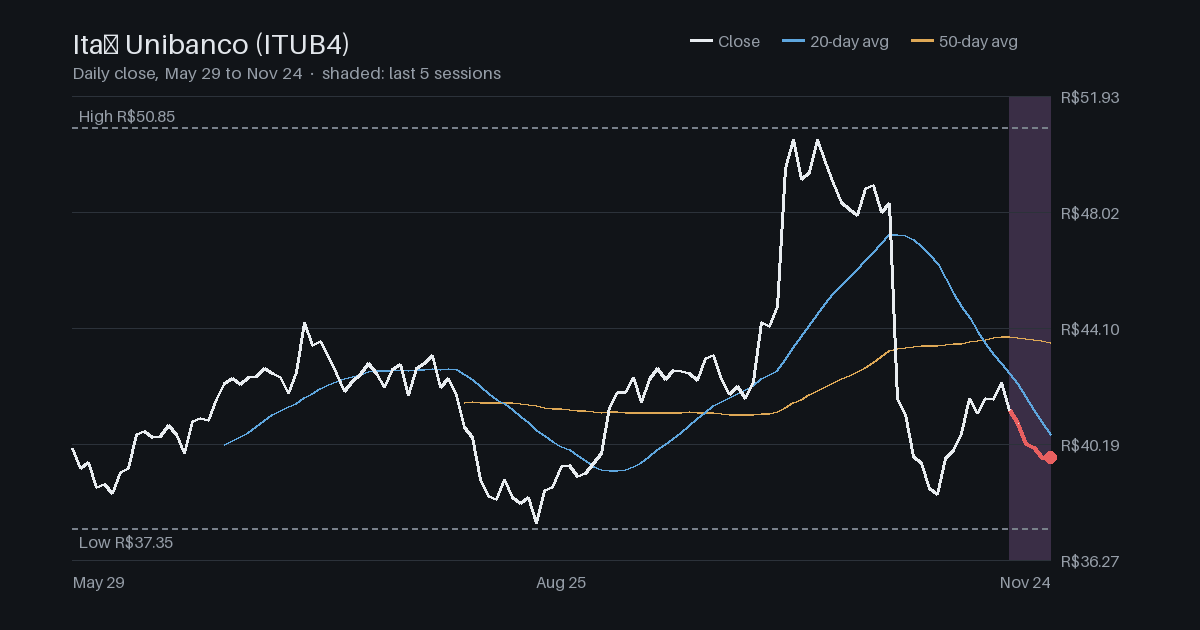
| Last close | R$39.74 | Closing price on Nov 24, 2026. |
|---|---|---|
| 5-session move | -3.8% | Change in the closing price over the last five trading days. |
| 20-day average | R$40.51 | The average closing price of the last 20 trading days. |
| 50-day average | R$43.62 | The average closing price of the last 50 trading days. |
| Period high | R$50.85 | Highest price since May 29, 2026. |
| Period low | R$37.35 | Lowest price since May 29, 2026. |
Related coverage
 Petrobras Approves $2.7B Extra Dividend, Hikes Capex to $122BPetrobras approved a $2.7 billion extra dividend on Nov. 23, 2026, alongside a larger-than-expected $122 billion five-year capital spending plan.
 Lower House Passes $9.6B Fiscal Plan, Boosting Brazil RealBrazil's Chamber of Deputies approved a R$56 billion ($9.6 billion) fiscal package, boosting the real as it corrected from a brief spike above R$6.00.