

MercadoLibre deploys 100 million reais for Brazil e-commerce push
MercadoLibre is spending heavily on discount coupons and interest-free credit in Brazil, driving down near-term operating margins to secure market dominance.

Key takeaways
- MercadoLibre launched its largest-ever promotional campaign in Brazil, offering over 100 million reais in coupons, per Exame on October 28, 2026
- Fintech arm Mercado Pago is offering up to 24 interest-free installments to boost credit card adoption, per Exame on October 28, 2026
- MercadoLibre reported Q3 2026 operating margins compressed to 6.3% from 6.7% in Q2, sending shares down, per Stock Analysis on November 4, 2026
Shares of New York-listed e-commerce giant MercadoLibre are trading near their 52-week low after the company chose to sacrifice short-term operating margins for a massive promotional offensive in Brazil, deploying more than 100 million reais (approximately $17.2 million) in discount coupons for this year's Black Friday sales season. The aggressive campaign, announced in late October 2026, represents the largest promotional investment in the company's history as it seeks to lock in long-term market share in Latin America's largest economy.
The company's commercial blitz includes listing more than 37 million products on promotion, according to an announcement reported by Exame on October 28, 2026. To stand out among competitor Brazil tech companies during this highly active retail period—which has effectively grown from a single day into an extended "brazil tech week" of promotional events—MercadoLibre is relying on deep commercial integration with its financial technology division, Mercado Pago.
The crucial mechanism driving this strategy is Mercado Pago's aggressive financing offer. In Brazil's high-interest-rate environment, where the central bank's Selic rate elevates credit costs for average consumers, Mercado Pago is allowing shoppers to split purchases into up to 24 interest-free installments starting on November 11, 2026, as reported by Meio e Mensagem on October 28, 2026. While offering interest-free credit over two years helps accelerate new credit card adoption, it also exposes the e-commerce giant to higher funding costs.
This heavy promotional and financing spending directly correlates with the margin compression that rattled Wall Street earlier this month. In its third-quarter financial results released on November 4, 2026, MercadoLibre reported that its operating margin had compressed to 6.3%, down from 6.7% in the second quarter of 2026, according to the company's Q3 2026 earnings call transcript. Although third-quarter net revenue and financial income grew 45% year-over-year to $10.75 billion, the disappointing margin performance fell below analysts' expectations, sending the company's stock tumbling nearly 8% in extended trading on November 5, 2026.
Investors are now watching whether this heavy upfront spending will successfully yield a stable, profitable base of long-term users. In the third quarter of 2026, Mercado Pago's credit portfolio grew 62% year-over-year to $17.9 billion, while its credit card portfolio surged 76% to $8.5 billion, per the company's Q3 2026 earnings call transcript on November 4, 2026. Management has maintained that they remain disciplined and are funding these newer growth initiatives with profits generated from their fast-growing advertising and payment acquiring businesses.
In your brokerage app
MercadoLibre is traded on the NASDAQ under the ticker MELI. Global investors can also gain diversified exposure to the company and broader Brazilian consumer sectors through exchange-traded funds such as the iShares MSCI Brazil ETF (EWZ), which holds positions in large Latin American consumer and tech companies.
Analysis · NWX analysis desk
Which Brazil assets this touches
- MELI — Named in this story.
- EWZ, NU, STNE, PAGS, IBOV — Big swings in U.S. tech stocks tend to spill into Brazil's fintechs listed in New York and into the broad Brazil fund, as global investors change how much risk they hold.
Technical picture · MELI (MELI)
MELI (MELI) closed at $1,450.31 on Nov 24, 2026, up 0.9% from five sessions earlier. The last close is below its 20-day average of $1,524.32 and below its 50-day average of $1,692.68. Since May 21, 2026 it has traded between $1,355.00 (low, Nov 20, 2026) and $2,006.58 (high, Sep 2, 2026).
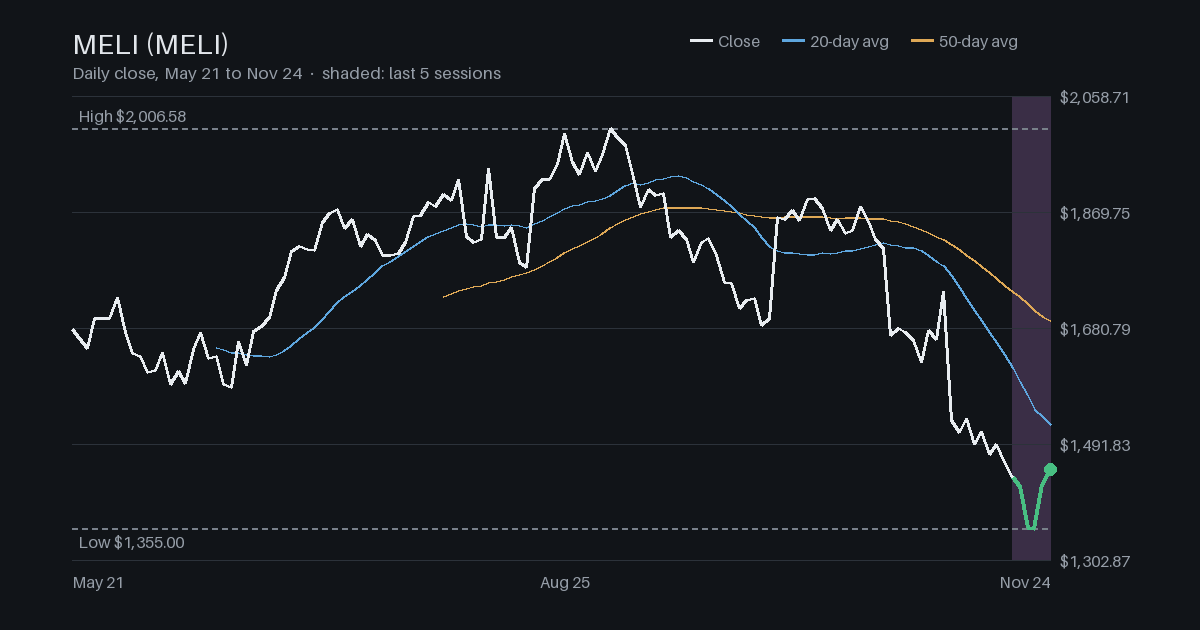
| Last close | $1,450.31 | Closing price on Nov 24, 2026. |
|---|---|---|
| 5-session move | +0.9% | Change in the closing price over the last five trading days. |
| 20-day average | $1,524.32 | The average closing price of the last 20 trading days. |
| 50-day average | $1,692.68 | The average closing price of the last 50 trading days. |
| Period high | $2,006.58 | Highest price since May 21, 2026. |
| Period low | $1,355.00 | Lowest price since May 21, 2026. |
Latest articles
 Meatpackers Face Squeeze as Brazilian Cattle Prices Hit Record HighRecord-high cattle prices and a sharp decline in slaughter rates in Brazil are squeezing margins for global beef giants like JBS and Tyson Foods.
 US Soybean Fund Braces for 12% Brazil Export Surcharge under EU RulesBrazil's Aprosoja warns EU environmental rules starting December 30 will raise soy export costs by 12 percent due to strict supply chain segregation.
 Itaú Enters Low-Income Housing Program to Challenge State DominanceItaú Unibanco is entering Brazil's flagship affordable housing program, Minha Casa Minha Vida, to challenge state-owned lenders in the mortgage market.