

Apple faces Brazil antitrust action over tap-to-pay block
CADE is upgrading its investigation of Apple's NFC restrictions into a formal administrative process over blocks on competitor tap-to-pay Pix.

Key takeaways
- CADE prepared to escalate its investigation of Apple's NFC restrictions into a formal administrative process, per reports on November 16, 2026
- Apple defended its NFC lock by noting 'Pix por aproximação' had only 2.09 million transactions compared to 3.14 billion QR transactions in September 2026, per Central Bank data
- Fintech association Zetta and the Central Bank argue Apple's NFC policy stifles competitive payment alternatives, per filings on November 16, 2026
Apple Inc. (NASDAQ: AAPL) is facing a formal antitrust escalation over its exclusive control of the iPhone's contactless payment chip, a move that could crack open the tech giant's highly profitable mobile wallet ecosystem to third-party competitors. On November 16, 2026, regulators moved to upgrade a preliminary investigation into the company's restrictive near-field communication (NFC) policies into a full administrative process.
The regulatory pushback comes from South America, where the Administrative Council for Economic Defense (CADE), Brazil’s federal antitrust watchdog, is taking aim at Apple’s refusal to let local fintechs utilize the device's NFC chip directly. Local digital payments lobby Zetta—which represents regional financial giants like Nubank and Mercado Pago—alongside the Central Bank of Brazil, argue that this hardware lock-in artificially limits options for consumers while protecting the company's exclusive Brazil Apple Pay ecosystem.
At the heart of the dispute is "Pix por aproximação" (tap-to-pay Pix), an upcoming contactless version of the country's wildly successful instant payment network, Pix. While Android users can already make tap-to-pay Pix transactions seamlessly via host card emulation, Apple's iOS ecosystem restricts rival apps from using the NFC hardware unless they route payments through Apple Pay's fee-bearing rails or its proprietary "NFC & SE" platform. According to a report by G1 Globo on November 16, 2026, CADE is investigating whether these technical and commercial barriers constitute an abuse of market dominance.
In its defense submitted to CADE, Apple argued that its restrictions are essential for maintaining user security and preventing fraud through its secure physical hardware element. The company also contended that the contactless payment market in the country is still nascent, pointing out that "Pix por aproximação" recorded only 2.09 million transactions in September 2026, according to Central Bank of Brazil data. By comparison, Brazilians executed over 3.14 billion operations via dynamic QR Codes during the exact same month, which Apple claims shows that NFC access is not yet a vital channel for digital commerce.
The conversion of the probe into a formal administrative process marks a significant regulatory challenge for the Brazil Apple subsidiary, which must now submit a comprehensive legal defense or face potential fines of up to 20% of its national revenue. The company has negotiated with CADE before; in December 2025, Apple settled a separate antitrust dispute, agreeing to allow alternative in-app payment methods in Brazil starting in June 2026. This new administrative case, however, represents a deeper struggle over hardware access that could mirror European Union open-NFC mandates.
In your brokerage app
Investors holding Apple (NASDAQ: AAPL) should monitor how this hardware-sharing precedent impacts the services division, which relies heavily on international Apple Pay transaction fees. On the other side, a regulatory victory for open NFC access could benefit Latin American fintech leaders listed in New York, including PagSeguro Digital (NYSE: PAGS), Inter & Co. (NASDAQ: INTR), and Nu Holdings (NYSE: NU), as they seek to roll out their own low-cost tap-to-pay services to millions of premium smartphone owners.
Analysis · NWX analysis desk
Which Brazil assets this touches
- NU, MELI, PAGS, EWZ, USDBRL — Named in this story.
- STNE — Big swings in U.S. tech stocks tend to spill into Brazil's fintechs listed in New York and into the broad Brazil fund, as global investors change how much risk they hold.
Technical picture · Nu Holdings (NU)
Nu Holdings (NU) closed at $13.22 on Nov 13, 2026, up 9.9% from five sessions earlier. The last close is above its 20-day average of $12.80 and below its 50-day average of $13.76. Since May 13, 2026 it has traded between $11.60 (low, Jun 8, 2026) and $16.12 (high, Oct 9, 2026).
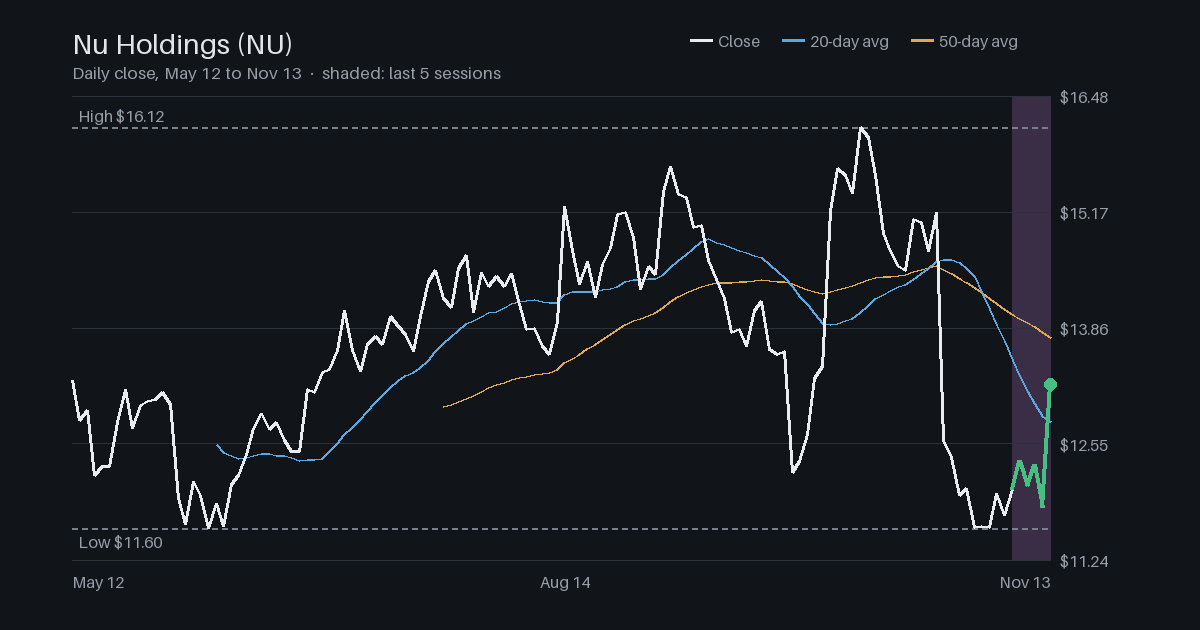
| Last close | $13.22 | Closing price on Nov 13, 2026. |
|---|---|---|
| 5-session move | +9.9% | Change in the closing price over the last five trading days. |
| 20-day average | $12.80 | The average closing price of the last 20 trading days. |
| 50-day average | $13.76 | The average closing price of the last 50 trading days. |
| Period high | $16.12 | Highest price since May 13, 2026. |
| Period low | $11.60 | Lowest price since May 13, 2026. |
Related coverage
 Brazil Policy Shifts and Tax Overhaul Pressure Stock MarketBrazil's dual VAT proposals, tech regulations, and utility license reviews are creating headwinds for international investors.
 Senate's R$18B Tax Credit Cap Threatens Corporate Cash FlowThe Brazilian Senate is debating PLP 299/2026, a fiscal package that limits companies from offsetting federal taxes with accumulated tax credits.
 Citi Cuts Petrobras ADR Target to $18.50 on Capital Spending RisksCitigroup lowered its Petrobras ADR target to $18.50 on capital expenditure concerns, ahead of the oil company's strategic plan release on November 23.