

Trade Dispute Moves to WTO After U.S.-Brazil Tariff Talks Fail
Brazil asks the WTO to intervene after bilateral talks with the U.S. over 25% industrial and agricultural tariffs failed, hitting New York-listed Suzano.
Key takeaways
- Brazil formalized a WTO dispute panel request on November 18, 2026, per Poder360
- Bilateral tariff consultations collapsed after starting in Geneva on September 25, 2026, per Poder360
- U.S. tariffs of 25% took effect on July 22, 2026, and could hit 37.5%, per Greenberg Traurig
- The iShares MSCI Brazil ETF fell 1.20% to 29.71 USD on November 19, 2026, per BRZ News
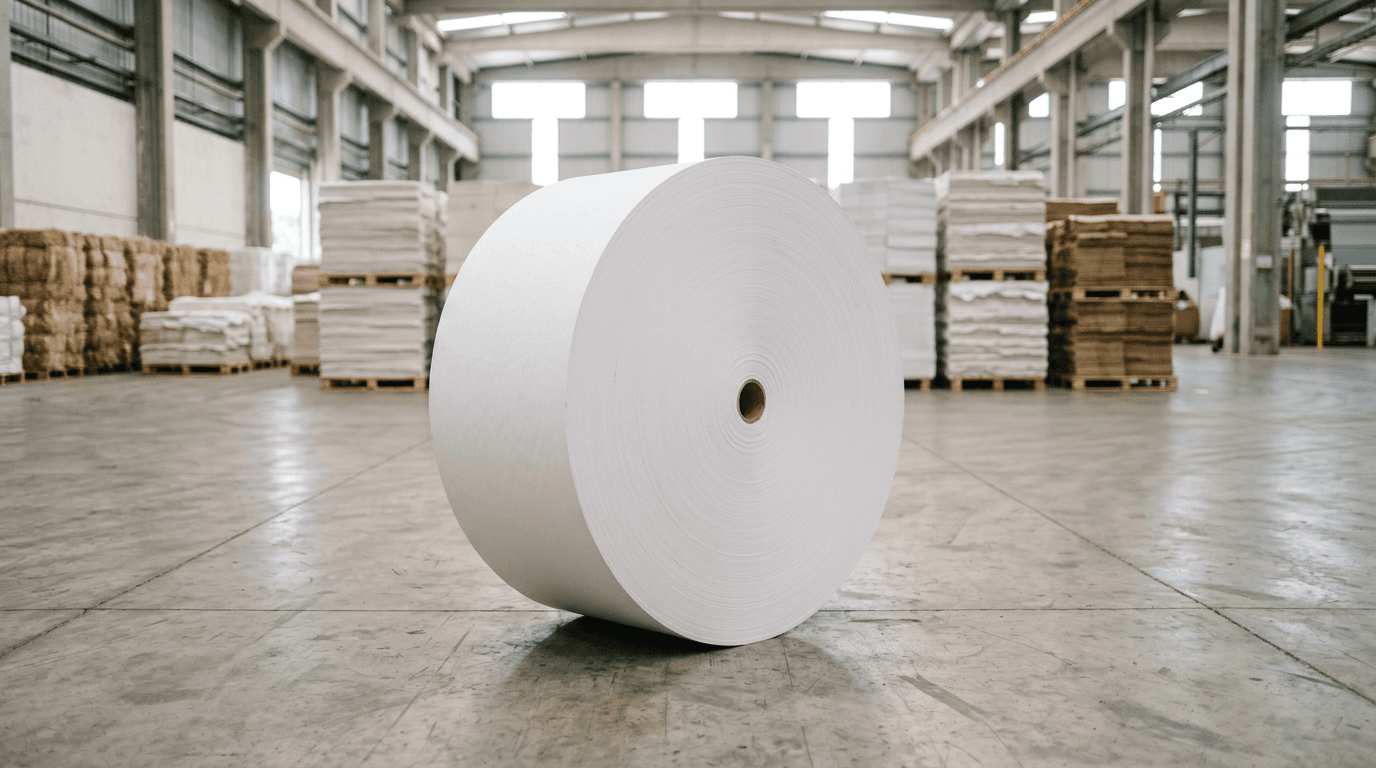
American investors holding shares of Brazilian industrial giants are braced for prolonged margin pressures after bilateral trade negotiations between Washington and Brasília collapsed. The failure of these high-stakes talks on U.S. tariffs on imported paper and ethanol has forced the escalating dispute onto the international stage, clouding the outlook for major exporters of pulp, paper, and biofuel to the United States.
On November 18, 2026, the Brazilian government formalized a request to the World Trade Organization (WTO) to convene a dispute panel regarding unilateral U.S. tariffs, according to a report by Poder360 published on November 19, 2026. The escalation follows the breakdown of bilateral consultations originally initiated in Geneva on September 25, 2026, which failed to produce a consensus within the standard 60-day window, per the official WTO documents cited by Poder360 on November 19, 2026. The country is seeking to have the Dispute Settlement Body vote on convening the panel at its upcoming session on November 24, 2026, per the petition cited by Poder360 on November 19, 2026.
The conflict stems from a year-long Section 301 trade investigation by the Office of the U.S. Trade Representative (USTR). Effective July 22, 2026, the U.S. imposed a 25% tariff on a wide array of Brazilian industrial and agricultural goods, including ethanol and paper, as detailed in a trade alert by Greenberg Traurig. Washington justified the unilateral duties by citing what it characterized as unreasonable trade barriers, deficiencies in intellectual property protection, and illegal deforestation. Crucially, these duties can combine with an additional 12.5% tariff linked to separate U.S. forced-labor investigations, potentially exposing certain Brazilian imports to a maximum tariff rate of 37.5%, as Greenberg Traurig noted in July 2026.
For global investors, the collapse of these talks directly affects major New York-listed commodity players. Brazil is one of the world's largest producers of pulp and paper, led by giants like Suzano, which rely heavily on open trade lanes to the North American market. By moving the fight to a formal WTO dispute panel, Brazil is attempting to force a reversal of the tariffs, though trade experts note that the WTO's appellate body remains paralyzed, meaning a quick resolution is highly unlikely.
In your brokerage app
Investors holding New York-listed paper giant Suzano (NYSE: SUZ) or the iShares MSCI Brazil ETF (NYSE Arca: EWZ)—which slipped 1.20% to close at 29.71 USD on November 19, 2026, according to BRZ News market data—should expect continued pressure on export margins. These unilateral U.S. duties are additive to existing customs rates, meaning pulp, paper, and biofuel exports to the United States will face elevated costs as long as the legal battle drags on at the WTO.
Analysis · NWX analysis desk
Which Brazil assets this touches
- SUZ, EWZ, SUZB3, SUGAR, USDBRL — Named in this story.
Fundamentals · Suzano (SUZB3)
Suzano (SUZB3) trades at 8.1x its yearly earnings and 1.3x its book value. Its return on equity is 16.1%. Its dividend yield is 2.1%. The market values the company at R$69.6 billion. Its financial health score is 85 out of 100 (strong), based on profitability, liquidity, debt and growth. Latest: Q3 2026 results, published Nov 5, 2026.
| Price / earnings (P/E) | 8.1x | How many years of the current yearly profit the share price adds up to. |
|---|---|---|
| Price / book (P/B) | 1.3x | The share price compared with the accounting value of what the company owns, per share. |
| Return on equity (ROE) | 16.1% | Yearly profit for every R$100 that shareholders have put into the company. |
| Net margin | 15.9% | The part of every R$100 in sales that is left as profit. |
| Dividend yield | 2.1% | Cash paid to shareholders over the past year, as a share of today's price. |
| Market value | R$69.6 billion | What the whole company is worth at today's share price. |
Technical picture · Suzano (SUZB3)
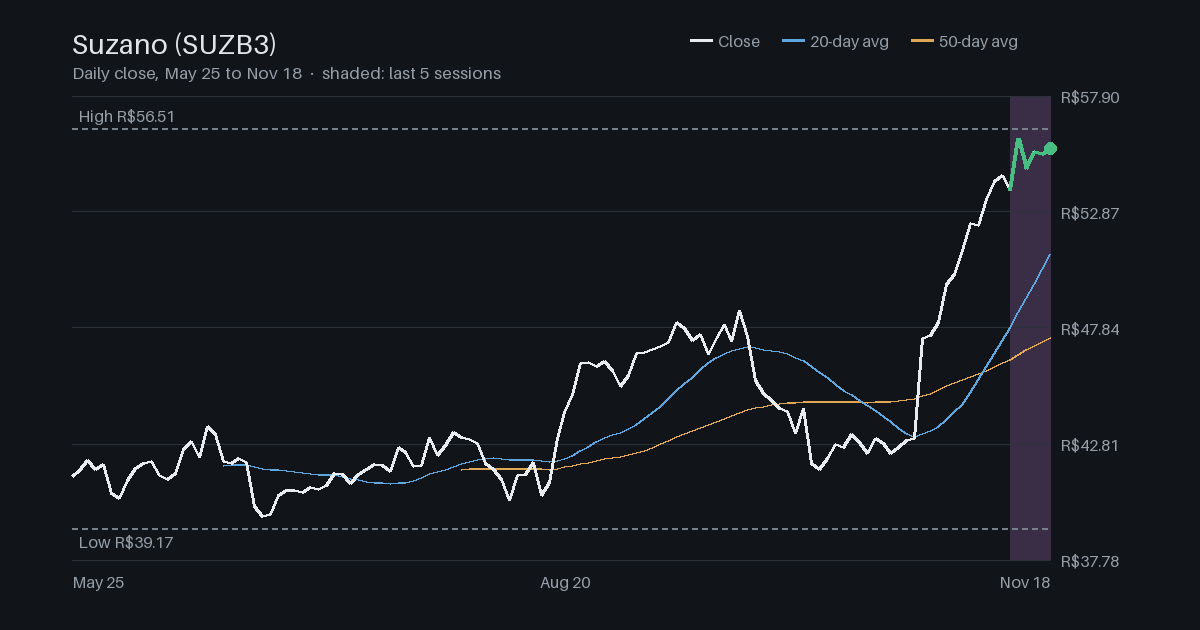
Suzano (SUZB3) closed at R$55.60 on Nov 18, 2026, up 3.3% from five sessions earlier. The last close is above its 20-day average of R$51.03 and above its 50-day average of R$47.41. Since May 25, 2026 it has traded between R$39.17 (low, Jun 30, 2026) and R$56.51 (high, Nov 17, 2026).
| Last close | R$55.60 | Closing price on Nov 18, 2026. |
|---|---|---|
| 5-session move | +3.3% | Change in the closing price over the last five trading days. |
| 20-day average | R$51.03 | The average closing price of the last 20 trading days. |
| 50-day average | R$47.41 | The average closing price of the last 50 trading days. |
| Period high | R$56.51 | Highest price since May 25, 2026. |
| Period low | R$39.17 | Lowest price since May 25, 2026. |
Related coverage
 Central Bank Injects $1 Billion as Brazil Real Falls Past 5.90US-listed Brazil ETFs face currency headwinds as the Central Bank of Brazil injects $1 billion into spot markets following a plunge in the real on fiscal policy worries.
 US Grocery Buyers Face Price Pressure as Beef Flows Shift to ChinaGlobal food inflation risks are rising for US grocery buyers as Brazil’s meatpackers divert lean beef shipments back to a rebounding Chinese market.
 Agribusiness Defaults Slash Banco do Brasil Profit, Shaking FundsBanco do Brasil's Q3 2026 profit fell 65.6% due to agribusiness defaults, impacting retail investors holding Brazil and emerging market ETFs.