

Dollar Rockets Past 5.90 Reais, Dragging Down US-Listed Brazil ETF
US-listed Brazil ETF holders face currency headwinds as a $1 billion central bank intervention fails to stop the dollar from surging past 5.90 reais.
Key takeaways
- US investors in Brazil's exchange face losses as the dollar rose past 5.90 reais on November 19, 2026, per Central Bank tracking
- The Central Bank of Brazil injected $1 billion in a spot and repo auction on November 18, 2026, according to a bank announcement on November 17, 2026
- Brazil's Senate approved a fiscal package on November 18, 2026, aimed at generating 50 billion to 60 billion reais in savings, per Exame
- Morgan Stanley downgraded Brazilian equities to underweight on November 16, 2026, citing structural fiscal concerns
American retail investors holding the largest US-listed Brazil fund are seeing their returns rapidly eaten away by a weakening exchange rate as the US dollar surged past 5.90 reais on November 19, 2026, according to daily exchange rate records from the Central Bank of Brazil. This steep currency drag occurs because a massive market intervention by South America's largest central bank has failed to stabilize the local currency, eroding gains made on local stocks and leaving foreign equity holders exposed to compounding foreign exchange losses.
The Central Bank of Brazil announced on November 17, 2026, that it would conduct a dual spot and repo auction of up to $1 billion to inject dollar liquidity into the financial system on November 18, 2026, according to official statements from the Central Bank of Brazil. However, the $1 billion intervention failed to reassure investors who remain deeply concerned about rising domestic inflation and the government's fiscal execution. As the auction concluded, the dollar's upward trajectory continued unabated, breaking past the psychological barrier of 5.90 reais the following day.
Underpinning the currency's slide is growing skepticism over the Brazilian government's budget discipline. On November 18, 2026, the Brazilian Senate approved a fiscal package designed to save between 50 billion and 60 billion reais, as reported by Exame. Although the legislative victory represents a primary step for the administration, international analysts labeled the package too "timid" to stabilize the country's public debt, meaning it is seen as insufficient to curb long-term inflation.
Global financial institutions have already begun pulling back. On November 16, 2026, Morgan Stanley downgraded Brazilian equities to "underweight" within its Latin American portfolio. The bank's strategists pointed to structural fiscal concerns, noting that high domestic interest rates are likely to crowd out equity investments and suppress corporate earnings. The downgrade triggered immediate capital outflows, compounding the pressure on local asset valuations and accelerating the currency's depreciation.
Moving forward, international investors will be watching the Chamber of Deputies to see if the fiscal package faces further dilutions or delays. Any signs of legislative gridlock are likely to increase pressure on the central bank to enact further rate hikes, which currently project the benchmark Selic rate at elevated levels through 2026.
In your brokerage app
The ongoing currency depreciation directly impacts the iShares MSCI Brazil ETF (EWZ), the primary investment vehicle for US-listed exposure to Brazilian equities. Even if local stock prices rise on the São Paulo exchange, the translation of those gains into US dollars will continue to face a steep uphill battle if the exchange rate remains stuck above 5.90 reais.
Analysis · NWX analysis desk
Which Brazil assets this touches
- EWZ, USDBRL, DI1 — Named in this story.
Technical picture · iShares MSCI Brazil ETF (EWZ)
iShares MSCI Brazil ETF (EWZ) closed at $30.07 on Nov 18, 2026, down 7.3% from five sessions earlier. The last close is below its 20-day average of $33.26 and below its 50-day average of $37.14. Since May 18, 2026 it has traded between $30.07 (low, Nov 18, 2026) and $43.54 (high, Oct 9, 2026).
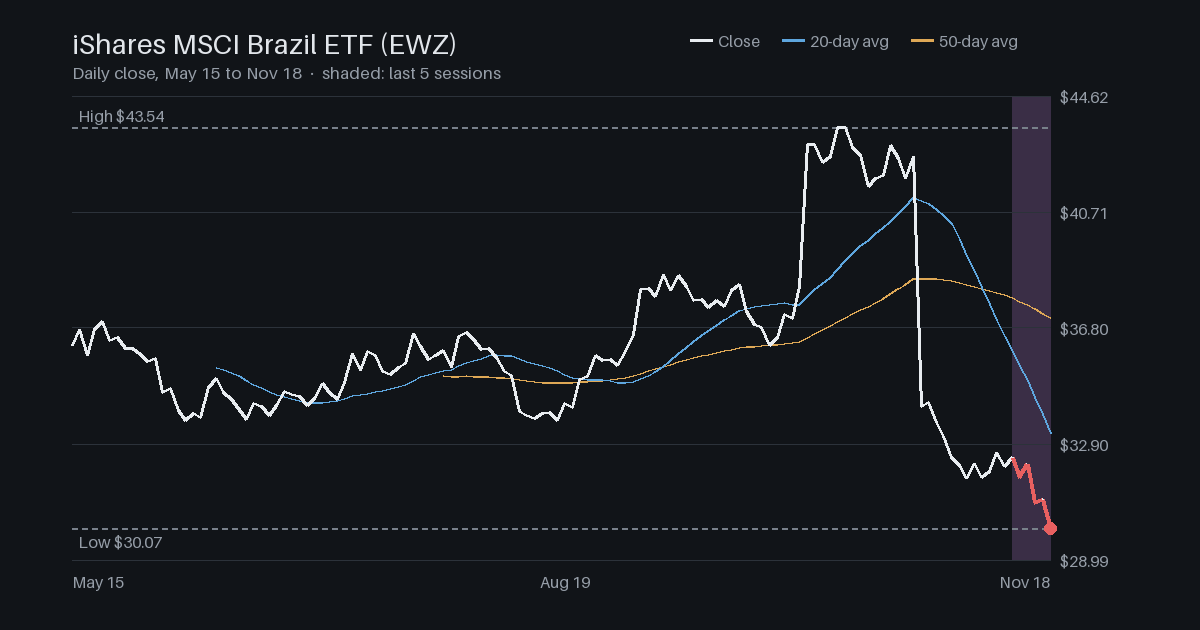
| Last close | $30.07 | Closing price on Nov 18, 2026. |
|---|---|---|
| 5-session move | -7.3% | Change in the closing price over the last five trading days. |
| 20-day average | $33.26 | The average closing price of the last 20 trading days. |
| 50-day average | $37.14 | The average closing price of the last 50 trading days. |
| Period high | $43.54 | Highest price since May 18, 2026. |
| Period low | $30.07 | Lowest price since May 18, 2026. |