

Central Bank Injects $1 Billion as Brazil Real Falls Past 5.90
US-listed Brazil ETFs face currency headwinds as the Central Bank of Brazil injects $1 billion into spot markets following a plunge in the real on fiscal policy worries.

Key takeaways
- Central Bank of Brazil sold $1 billion in an extraordinary spot auction at a cut-off rate of 5.860000 on November 19, 2026, per BCB data.
- The Brazilian real touched an intraday low of R$ 5.9287 on November 19, 2026, before paring losses to hover near R$ 5.90, per InfoMoney.
- Investors remain skeptical of the Senate-approved 'plano Moretti' fiscal adjustment package, citing a lack of structural spending cuts, according to market reports on November 19, 2026.
- US-listed Brazil ETFs like EWZ face strong currency erosion as the real hits its lowest levels in over 18 months, per trading data on November 19, 2026.
American retail investors holding the iShares MSCI Brazil ETF watched their returns slip on November 19, 2026, as a weakening Brazilian real forced an emergency $1 billion central bank intervention, according to market data. To contain mounting exchange rate pressures, the Central Bank of Brazil (BCB) executed an extraordinary spot market auction, injecting $1 billion into the financial system at a cut-off rate of 5.860000 on November 19, 2026, according to BCB data.
The intervention occurred after the Brazilian real sank to an intraday low of R$ 5.9287 against the US dollar during morning trading on November 19, 2026, as reported by InfoMoney. Though the $1 billion injection briefly cooled the market, the US dollar quickly climbed back to hover near the R$ 5.90 mark later in the afternoon on November 19, 2026, according to InfoMoney. Foreign investors and local traders alike pushed the currency to its lowest level in 18 months, driven by deep skepticism over the government's newly voted fiscal package.
The Limits of Plano Moretti
Known locally as 'plano Moretti' after Planning Minister Bruno Moretti, the fiscal adjustment package was approved by the Brazilian Senate on late Wednesday, November 18, 2026, and is scheduled for a vote in the Chamber of Deputies on Monday, November 23, 2026, according to InfoMoney. While the bill is designed to trim between R$ 46 billion and R$ 56 billion from the 2027 budget deficit, market analysts reported on November 19, 2026, that roughly two-thirds of the savings rely on increasing government tax revenues rather than slashing structural spending, per InfoMoney. This reliance on a higher corporate tax burden instead of deep spending cuts has failed to convince investors that Brazil can structurally stabilize its soaring public debt.
For investors tracking the brazil central bank interest rate, the currency's depreciation adds pressure for further monetary tightening. While the brazil central bank has been forced to act directly in the spot market, the broader brazil central bank news remains centered on whether these interventions and high rates can protect the real without a serious fiscal partner in the federal government. High interest rates in Brazil—with the benchmark Selic rate already elevated—remain a key tool to attract foreign capital and defend the real, but as the local currency crumbles, import costs rise, making it harder for the central bank to manage consumer prices.
In your brokerage app
For retail investors holding US-listed funds, the falling exchange rate acts as a direct drag on performance. The iShares MSCI Brazil ETF, which tracks large Brazilian corporations, fell 1.15% to $29.73 on November 19, 2026, as the local currency depreciation offset corporate gains, while the Franklin FTSE Brazil ETF slid 0.91% to $18.41 on the same day, according to New York stock exchange data. Major Brazilian American Depositary Receipts (ADRs) listed in New York, such as financial giant Itaú Unibanco, also felt the pinch, closing down 1.54% at $6.72 on November 19, 2026, as the cost of translating real-denominated earnings into US dollars grew steeper, according to exchange records.
Analysis · NWX analysis desk
Which Brazil assets this touches
- EWZ, IBOV, USDBRL, DI1 — Named in this story.
Technical picture · iShares MSCI Brazil ETF (EWZ)
iShares MSCI Brazil ETF (EWZ) closed at $30.07 on Nov 18, 2026, down 7.3% from five sessions earlier. The last close is below its 20-day average of $33.26 and below its 50-day average of $37.14. Since May 18, 2026 it has traded between $30.07 (low, Nov 18, 2026) and $43.54 (high, Oct 9, 2026).
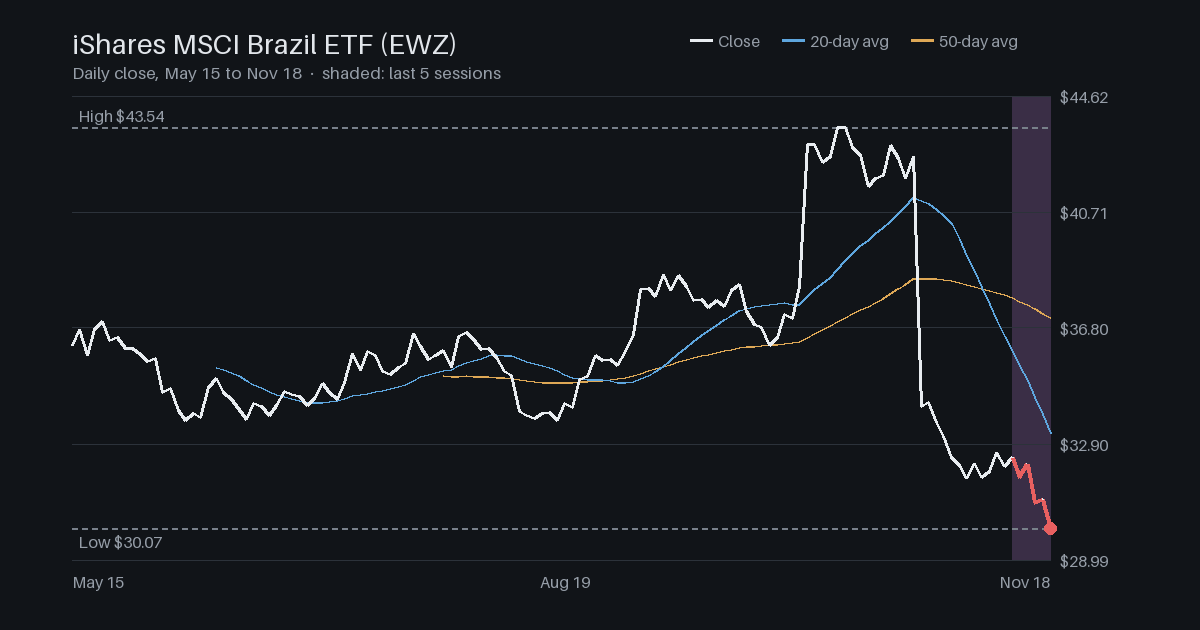
| Last close | $30.07 | Closing price on Nov 18, 2026. |
|---|---|---|
| 5-session move | -7.3% | Change in the closing price over the last five trading days. |
| 20-day average | $33.26 | The average closing price of the last 20 trading days. |
| 50-day average | $37.14 | The average closing price of the last 50 trading days. |
| Period high | $43.54 | Highest price since May 18, 2026. |
| Period low | $30.07 | Lowest price since May 18, 2026. |
Related coverage
 Trade Dispute Moves to WTO After U.S.-Brazil Tariff Talks FailBrazil asks the WTO to intervene after bilateral talks with the U.S. over 25% industrial and agricultural tariffs failed, hitting New York-listed Suzano.
 US Grocery Buyers Face Price Pressure as Beef Flows Shift to ChinaGlobal food inflation risks are rising for US grocery buyers as Brazil’s meatpackers divert lean beef shipments back to a rebounding Chinese market.
 Agribusiness Defaults Slash Banco do Brasil Profit, Shaking FundsBanco do Brasil's Q3 2026 profit fell 65.6% due to agribusiness defaults, impacting retail investors holding Brazil and emerging market ETFs.