

Inter Stock Drops 4.6% on Nasdaq After Goldman Sachs Trims Outlook
Inter & Co. stock fell 4.58% on Nasdaq after Goldman Sachs adjusted its valuation outlook downward, compounding technical pressure from a major share wind-down.

Key takeaways
- Inter & Co. stock fell 4.58% to close at $3.96, according to Nasdaq exchange data on November 16, 2026
- Goldman Sachs adjusted its 12-month valuation expectations downward for the company in a research report on November 16, 2026
- Inter completed a sales facility of 12,281,668 Class A common shares to wind down its BDR program, according to an SEC filing on November 16, 2026
American retail investors holding shares of New York-listed digital bank Inter & Co. faced a setback on Monday, November 16, 2026, as the stock fell following a revised valuation outlook from Goldman Sachs. Unlike most Latin American plays that require navigating complex depositary receipts, this digital lender is one of the few international financial institutions that retail brokers allow US investors to trade directly on the Nasdaq.
The stock dropped 4.58% to close at $3.96 on November 16, 2026, according to Nasdaq exchange data. The decline followed a Goldman Sachs research report issued on the same day, which adjusted its 12-month valuation expectations for the company downward. For US investors exploring Brazil stocks, Inter represents a unique structure: it bypassed the traditional American Depositary Receipt framework entirely to list its primary common shares directly in the United States. The drop in Inter's share price stood out among Brazil equities, which have been facing broader headwinds from regional macroeconomic adjustments.
Based in Belo Horizonte, Brazil, Inter operates a digital "super app" that serves 46.8 million customers, with 27.1 million active users, according to its third-quarter financial report released on November 12, 2026. The bank has been aggressively expanding its footprint, securing regulatory approval from the Federal Reserve to open an international banking branch in Miami, per a company announcement on October 24, 2026. While the company's latest quarterly earnings, released on November 12, 2026, showed a healthy return on equity of 15.29% and a net margin of 10.44% for the period, the stock has faced downward pressure, currently trading near its 52-week low of $3.75, according to Nasdaq trading logs on November 16, 2026.
The broader context for Brazilian assets includes a tight monetary policy environment, with the central bank's Selic benchmark interest rate sitting at 13.75% and 12-month IPCA inflation at 4.63%, according to Central Bank of Brazil data from mid-November 2026. This high-rate environment has weighed on local consumer credit and bank valuations, even as digital-first institutions like Inter continue to gain market share from legacy brick-and-mortar competitors. Investors are keeping a close watch on how the company manages credit quality, given that its debt-to-equity ratio remains low at 0.08, per market data compiled by MarketBeat on November 16, 2026.
The stock's movement also follows an SEC filing on November 16, 2026, in which Inter announced the final payment details for the completion of its share sales facility. The bank sold 12,281,668 Class A common shares on the Nasdaq between October 21, 2026, and November 9, 2026, at an average price of $5.0201 per share to facilitate the wind-down of its sponsored Brazilian Depositary Receipts, according to an SEC filing on November 16, 2026. This technical supply of shares on the open market, combined with Goldman's revised outlook, added to the downward pressure on the stock. While most Brazil financial news focuses on traditional commodities players, this digital banking shift represents a critical transition in how retail capital flows into the country.
Looking forward, investors will watch the bank's next quarterly earnings report, scheduled for February 11, 2027, according to company financial calendars, to see if its US expansion and super-app monetization can reverse the stock's recent decline. Analysts maintain a mixed outlook overall on the stock, reflecting diverging views on its rapid loan growth against high domestic interest rates that have contributed to a slight rise in non-performing loans.
In your brokerage app
For retail investors using major platforms like Schwab, Fidelity, or Robinhood, Inter & Co. is traded under the symbol INTR. Unlike most Brazilian corporations that trade as ADRs, which often incur annual custodian fees, INTR is a direct Class A common stock listing on the Nasdaq.
Analysis · NWX analysis desk
Which Brazil assets this touches
- INTR — Named in this story.
- EWZ, NU, STNE, PAGS, IBOV — Big swings in U.S. tech stocks tend to spill into Brazil's fintechs listed in New York and into the broad Brazil fund, as global investors change how much risk they hold.
Technical picture · Inter&Co (INTR)
Inter&Co (INTR) closed at $4.15 on Nov 13, 2026, up 7.5% from five sessions earlier. The last close is below its 20-day average of $4.81 and below its 50-day average of $5.52. Since May 13, 2026 it has traded between $3.78 (low, Nov 5, 2026) and $7.74 (high, Oct 12, 2026).
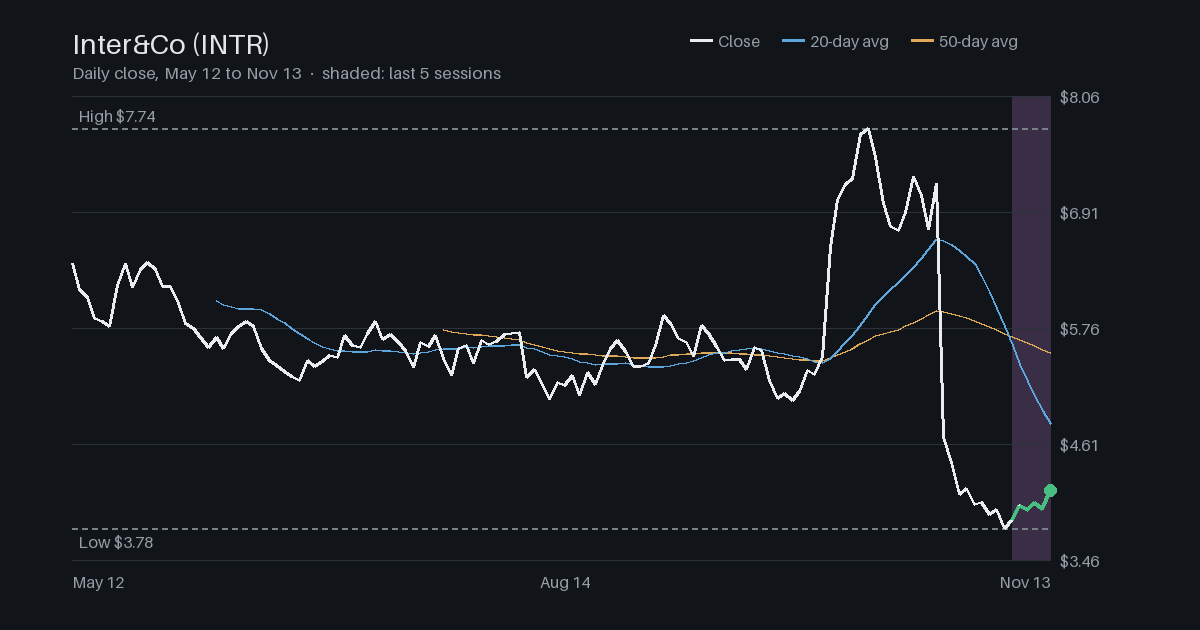
| Last close | $4.15 | Closing price on Nov 13, 2026. |
|---|---|---|
| 5-session move | +7.5% | Change in the closing price over the last five trading days. |
| 20-day average | $4.81 | The average closing price of the last 20 trading days. |
| 50-day average | $5.52 | The average closing price of the last 50 trading days. |
| Period high | $7.74 | Highest price since May 13, 2026. |
| Period low | $3.78 | Lowest price since May 13, 2026. |
Related coverage
 Vale stock hits 52-week low as Chinese iron ore inventories surgeVale shares fell to a 52-week low of $10.66 as Chinese port stockpiles built to 152.12 million tons and the miner ruled out extraordinary dividends.
 iShares Latin America 40 ETF falls 3.22% to $31.28On November 17, 2026, the iShares Latin America 40 ETF (ILF) declined 3.22% to $31.28, reminding investors that it is a regional fund, not a Brazilian stock.
 Nu Holdings Shares Fall 4.1 Percent on New York Stock ExchangeUS retail investors trading Nubank's parent company directly saw positions drop as broader Brazilian asset shifts impacted the fee-free NYSE listing.