

Vale stock hits 52-week low as Chinese iron ore inventories surge
Vale shares fell to a 52-week low of $10.66 as Chinese port stockpiles built to 152.12 million tons and the miner ruled out extraordinary dividends.

Key takeaways
- Vale SA stock fell 5% to a 52-week low of $10.66, per market data on November 16, 2026
- Port stockpiles in China reached 152.12 million metric tons, per SMM on November 13, 2026
- Vale's adjusted EBITDA dropped 20% to $3.5 billion, per vale.com on October 29, 2026
- Vale ruled out extraordinary dividends for 2026, per company management on October 29, 2026
US retail investors holding New York-listed shares of mining giant Vale SA watched their holdings plummet 5% to a new 52-week low of $10.66 on November 16, 2026, according to market data, as a massive stockpile build of iron ore in China dashed expectations of winter steel demand. The sharp drop reflects mounting concerns that decelerating Chinese industrial output is hitting major basic materials exporters, directly compressing operational margins and prompting dividend-focused investors to re-examine their emerging-market exposure.
Based in Rio de Janeiro, Brazil, Vale is one of the world’s largest producers of iron ore and nickel. Because the Brazilian miner exports a significant portion of its raw materials to Chinese steelmakers, the performance of the brazil vale stock serves as a major bellwether for global basic materials and steel production chains. When construction activity in China stumbles, the financial ripples travel directly to the balance sheets of Brazilian exporters, directly impacting American investors who trade the asset in US dollars.
Oversupply hits Chinese ports
The primary catalyst for this recent slide is a severe accumulation of unused raw materials at Chinese ports. According to Shanghai Metals Market (SMM) statistics published on November 15, 2026, iron ore stockpiles across 35 major Chinese ports climbed to 152.12 million metric tons as of November 13, 2026. This represents a month-on-month build-up of 2.99 million metric tons, compounding a broader domestic oversupply as Chinese steel mills curtail production due to collapsing profit margins.
Squeezed earnings and dividend curbs
This severe oversupply is already leaving a mark on the miner's financial performance. In its third-quarter earnings report released on October 29, 2026, vale.com posted a 20% year-on-year drop in adjusted EBITDA to $3.5 billion, squeezed by a 10% fall in realized iron ore prices and rising freight costs. Crucially for income-seeking investors, Vale's management ruled out paying an extraordinary dividend for the fiscal year 2026 on October 29, 2026, choosing instead to focus on cash conservation amid heightened global market volatility.
Moving forward, market participants are bracing for further seasonal headwinds as winter production curbs in China typically cap steel mill output through the early months of the year. Analysts are closely tracking Vale's upcoming guidance updates to see if the miner will scale back its projected output to defend pricing, as well as watching for any potential macroeconomic intervention from Beijing.
In your brokerage app
For retail investors, the most direct exposure to this commodity cycle is Vale SA, which is listed in New York and trades as an American Depositary Receipt (ADR). The stock’s performance also heavily influences broad-market funds like the iShares MSCI Brazil ETF, which holds a substantial concentration of Brazilian equities.
Analysis · NWX analysis desk
Which Brazil assets this touches
- VALE, VALE3, IRONORE, USDBRL — Named in this story.
Fundamentals · Vale (VALE3)
Vale (VALE3) trades at 118.4x its yearly earnings and 1.4x its book value. Its return on equity is 1.1%. Its dividend yield is 9.3%. The market values the company at R$241.9 billion. Its financial health score is 50 out of 100 (stable), based on profitability, liquidity, debt and growth. Latest: Q3 2026 results, published Oct 29, 2026.
| Price / earnings (P/E) | 118.4x | How many years of the current yearly profit the share price adds up to. |
|---|---|---|
| Price / book (P/B) | 1.4x | The share price compared with the accounting value of what the company owns, per share. |
| Return on equity (ROE) | 1.1% | Yearly profit for every R$100 that shareholders have put into the company. |
| Net margin | 0.3% | The part of every R$100 in sales that is left as profit. |
| Dividend yield | 9.3% | Cash paid to shareholders over the past year, as a share of today's price. |
| Market value | R$241.9 billion | What the whole company is worth at today's share price. |
Technical picture · Vale (VALE3)
Vale (VALE3) closed at R$60.70 on Nov 16, 2026, down 8.2% from five sessions earlier. The last close is below its 20-day average of R$63.14 and below its 50-day average of R$68.59. Since May 21, 2026 it has traded between R$59.42 (low, Oct 30, 2026) and R$85.08 (high, Jun 2, 2026).
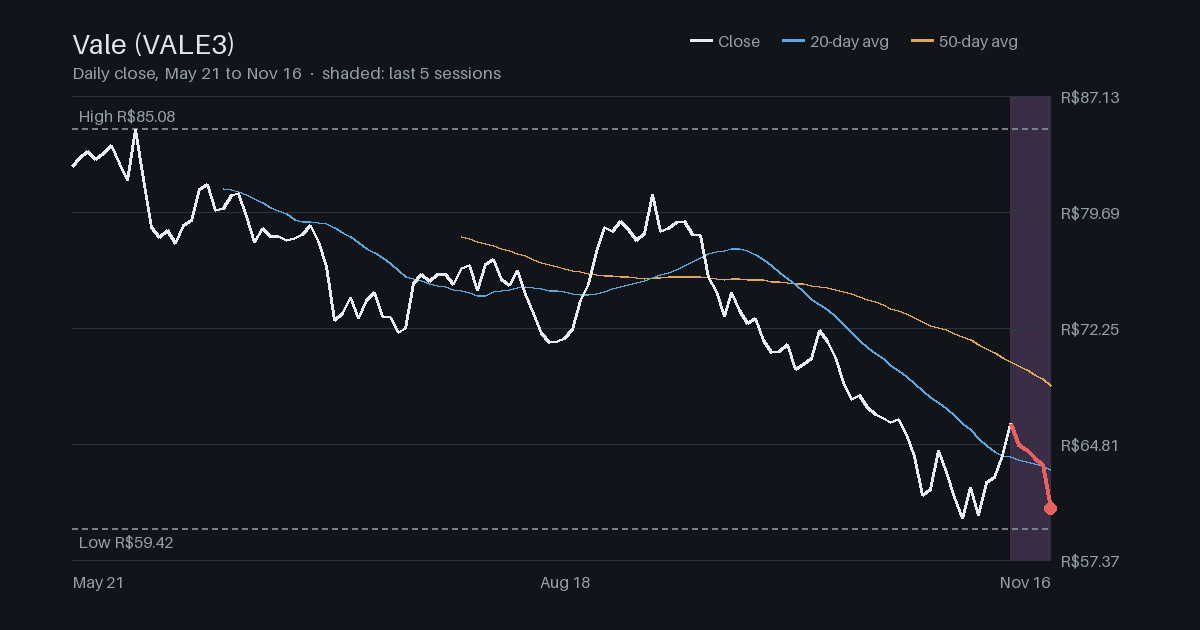
| Last close | R$60.70 | Closing price on Nov 16, 2026. |
|---|---|---|
| 5-session move | -8.2% | Change in the closing price over the last five trading days. |
| 20-day average | R$63.14 | The average closing price of the last 20 trading days. |
| 50-day average | R$68.59 | The average closing price of the last 50 trading days. |
| Period high | R$85.08 | Highest price since May 21, 2026. |
| Period low | R$59.42 | Lowest price since May 21, 2026. |
Related coverage
 iShares Latin America 40 ETF falls 3.22% to $31.28On November 17, 2026, the iShares Latin America 40 ETF (ILF) declined 3.22% to $31.28, reminding investors that it is a regional fund, not a Brazilian stock.
 Nu Holdings Shares Fall 4.1 Percent on New York Stock ExchangeUS retail investors trading Nubank's parent company directly saw positions drop as broader Brazilian asset shifts impacted the fee-free NYSE listing.