

US Dollar Climbs to R$ 5.9488 as Lula Dismisses Brazil Fiscal Reform
The US dollar closed at R$ 5.9488 on November 20, 2026, amid fiscal concerns aggravated by President Lula dismissing the Senate-approved bill as a minor adjustment.
Key takeaways
- The US dollar closed at R$ 5.9488 on November 20, 2026, marking six straight daily gains, per the Central Bank of Brazil
- President Lula dismissed the Senate-approved fiscal bill as a minor budget adjustment on November 21, 2026, per G1
- The Senate proposal aims to save R$ 50 billion to R$ 60 billion for the 2027 fiscal year, per InfoMoney
For foreign investors looking to invest in Brazil, the brazil real exchange rate lula has dampened optimism as unhedged holdings lose value with the local currency devaluing toward historic lows. The official USD BRL exchange rate published by the Central Bank of Brazil closed at R$ 5.9488 on November 20, 2026, marking its sixth consecutive daily gain. This persistent pressure has accelerated despite a massive US$ 1 billion spot market intervention conducted by the central bank on November 19, 2026, as political resistance to strict public spending limits continues to rattle foreign capital.
Lula Dismisses Fiscal Package as 'Minor Adjustment'
The fiscal friction reached a boiling point on November 21, 2026, when President Luiz Inácio Lula da Silva cooled market optimism during a live broadcast. Lula insisted that a newly approved Senate bill was not a comprehensive fiscal reform, but merely a minor budget adjustment designed to guarantee governability for the 2027 federal budget, according to G1. Speaking to his supporters, Lula dismissed concerns raised by financial market participants—whom he referred to as a "bando de yuppies" (bunch of yuppies) from São Paulo’s financial hub, Faria Lima—stating that "the financial system will not teach me how to run the country," as reported by InfoMoney.
Senate Package Excludes Major Welfare Cuts
The legislative package in question, approved by the Senate on November 18, 2026, aims to generate between R$ 50 billion and R$ 60 billion (approximately US$ 8.4 billion to US$ 10.1 billion) in savings for the 2027 fiscal year. The proposal caps federal expense growth at 2% above inflation and places limits on corporate tax credit compensations. However, to the disappointment of foreign investors tracking capital policies on the Central Bank of Brazil website, the package excludes cuts to major social welfare programs, which Lula reiterated are entirely off the table.
The proposal now heads to the Chamber of Deputies, where it will face further debate and voting in the coming days. Investors will be watching whether lawmakers dilute the spending caps further, or if the executive branch's rhetoric continues to push the currency toward deeper devaluations.
In your brokerage app
For retail investors holding the iShares MSCI Brazil ETF (EWZ), which tracks a basket of Brazilian equities, or individual American Depositary Receipts (ADRs) of Brazilian giants like state-run oil company Petrobras (PBR) and mining major Vale (VALE), currency depreciation directly dilutes equity returns when converted back into U.S. dollars. Since these holdings are generally unhedged against foreign exchange risk, a weaker real—the daily movements of which are logged by the Central Bank of Brazil—means that even if local share prices remain stable, the dollar value in a U.S. brokerage account declines.
Analysis · NWX analysis desk
Which Brazil assets this touches
- EWZ, PBR, VALE, PETR4, USDBRL, DI1 — Named in this story.
Fundamentals · Petrobras (PETR4)
Petrobras (PETR4) trades at 3.9x its yearly earnings and 1.1x its book value. Its return on equity is 27.8%. Its dividend yield is 8.6%. The market values the company at R$588.5 billion. Its financial health score is 81 out of 100 (strong), based on profitability, liquidity, debt and growth. Latest: Q3 2026 results, published Nov 10, 2026.
| Price / earnings (P/E) | 3.9x | How many years of the current yearly profit the share price adds up to. |
|---|---|---|
| Price / book (P/B) | 1.1x | The share price compared with the accounting value of what the company owns, per share. |
| Return on equity (ROE) | 27.8% | Yearly profit for every R$100 that shareholders have put into the company. |
| Net margin | 23.8% | The part of every R$100 in sales that is left as profit. |
| Dividend yield | 8.6% | Cash paid to shareholders over the past year, as a share of today's price. |
| Market value | R$588.5 billion | What the whole company is worth at today's share price. |
Technical picture · iShares MSCI Brazil ETF (EWZ)
iShares MSCI Brazil ETF (EWZ) closed at $28.54 on Nov 20, 2026, down 11.4% from five sessions earlier. The last close is below its 20-day average of $31.94 and below its 50-day average of $36.77. Since May 19, 2026 it has traded between $28.54 (low, Nov 20, 2026) and $43.54 (high, Oct 9, 2026).
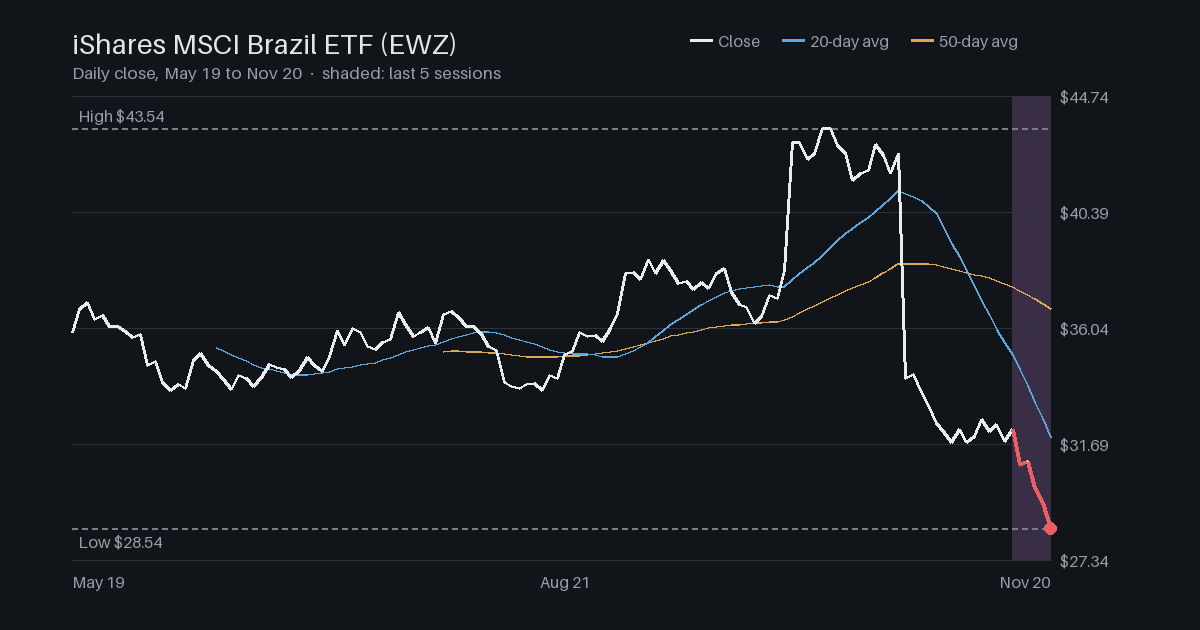
| Last close | $28.54 | Closing price on Nov 20, 2026. |
|---|---|---|
| 5-session move | -11.4% | Change in the closing price over the last five trading days. |
| 20-day average | $31.94 | The average closing price of the last 20 trading days. |
| 50-day average | $36.77 | The average closing price of the last 50 trading days. |
| Period high | $43.54 | Highest price since May 19, 2026. |
| Period low | $28.54 | Lowest price since May 19, 2026. |
Related coverage
 New Brazilian Labor Rules and High Interest Rates Squeeze RetailersBrazil's new 5x2 workweek decree and a high Selic rate squeeze retailers and fintechs, while Lula clashing with markets adds to fiscal caution.
 US Funds Keep 145,816 Net-Long Soybean Contracts, CFTC ReportsSpeculative funds held 145,816 net-long soybean contracts as of November 17, 2026, supporting Brazilian export expectations, according to the CFTC.
 Banco do Brasil Eyes CEO Change After Crop Calamity Squeezes ProfitBanco do Brasil faces a leadership shakeup as bad agricultural loans trigger a 66.5% profit drop and the suspension of 2027 intermediate dividends.