

New Brazilian Labor Rules and High Interest Rates Squeeze Retailers
Brazil's new 5x2 workweek decree and a high Selic rate squeeze retailers and fintechs, while Lula clashing with markets adds to fiscal caution.

Key takeaways
- President Lula signed Decreto 13.173/2026 to transition Brazil to a 5x2 workweek on November 19, 2026
- PagSeguro revised its 2026 gross profit growth guidance down to 3%-5% on November 16, 2026, per company disclosures
- Brazil's Senate approved a fiscal-adjustment bill on November 18, 2026, targeting up to 56.1 billion reais in 2027 savings
- Petrobras projected its 2026 cash investments at $22 billion, according to its November 11, 2026 financial update
U.S. retail investors holding Latin American market favorites like MercadoLibre and PagSeguro are navigating a double squeeze on operating margins this week. On November 19, 2026, Brazilian President Luiz Inácio Lula da Silva signed Decreto 13.173/2026, a labor decree implementing a mandatory transition to a 5x2 workweek that will drive up operating and logistics costs for e-commerce and retail firms. This regulatory shift occurs as Brazil's currency, the real, closed at a weak 5.8883 per U.S. dollar on November 20, 2026, according to Banco Central do Brasil data, reflecting ongoing caution among international capital allocators.
The new decree, which formally regulates the transition under Constitutional Amendment 141/2026, reduces the country's maximum weekly working hours from 44 to 42 hours starting December 16, 2026, and down to 40 hours by December 16, 2027, with no reduction in pay. To govern this shift, the regulation sets new hourly wage calculation divisors of 210 (for the 42-hour limit) and 200 (for the 40-hour limit), as outlined by the Ministry of Labor and Emprego. This mechanism automatically inflates hourly pay and overtime costs for logistics and retail operations. Companies with extensive delivery networks, such as e-commerce giant MercadoLibre and payments provider StoneCo, are especially exposed to these mandatory payroll spikes, drawing criticism from business groups like FecomercioSP over increased legal uncertainty.
Compounding these cost pressures is a high-interest-rate environment that refuses to break. PagSeguro Digital Ltd. announced on November 16, 2026, that it has revised its 2026 gross profit growth guidance down to a range of 3% to 5% from its original target of 6% to 9%, citing smaller and slower interest-rate cuts as the central bank held its Selic benchmark rate at 13.75%, per company disclosures. Amid this friction, President Lula clashed with the financial sector, calling a newly passed Senate fiscal adjustment bill (PLP 299/2026) a "mere budget fix" rather than a permanent structural reform, despite the legislation aiming to improve public finances by up to 56.1 billion reais ($9.6 billion) in 2027.
At the same time, the domestic financial system is absorbing the fallout of a major banking cleanup. Brazil's Supreme Federal Court has upheld the preventive detention of a liquidated bank's founder following a record $9.3 billion (R$ 54.8 billion) deposit insurance payout by the country's Credit Guarantee Fund (FGC), according to court and fund disclosures. The judicial decision leaves international observers tracking the systemic health and credit exposure of Brazil's mid-market financial sector.
To help offset domestic pressures and diversify trade, President Lula traveled to Manila on November 14, 2026, signing an agricultural cooperation agreement with Philippine President Ferdinand Marcos Jr. to expand food security and technical exchanges. The state visit highlights Brazil's broader push to deepen trade with the Association of Southeast Asian Nations (ASEAN), which accounted for $38.4 billion in bilateral trade last year. This trade diversification comes as U.S. speculative funds maintain a massive 145,816 net-long soybean contracts as of November 17, 2026, according to the Commodity Futures Trading Commission (CFTC).
Investors will be watching how these labor regulations and credit pressures impact company earnings in the coming quarters. The next key milestone occurs on December 9, 2026, when Brazil's central bank (Copom) will announce its final interest rate decision of the year, determining whether the benchmark Selic rate remains held at 13.75% or begins to move.
In your brokerage app
For retail investors tracking Latin American equities in their brokerage accounts, these policy decisions directly touch traded assets. High-growth tech and fintech giants listed on U.S. exchanges—including MercadoLibre (MELI), StoneCo (STNE), and PagSeguro (PAGS)—remain highly sensitive to local labor regulations and Selic rate adjustments. Meanwhile, state-controlled commodity giants like Petrobras (PBR), which projected its 2026 cash investments at $22 billion in its November 11, 2026 update, continue to navigate federal fiscal policies and fluctuations in the Brazilian real.
Analysis · NWX analysis desk
Which Brazil assets this touches
- EWZ, NU, STNE, PAGS, IBOV — Big swings in U.S. tech stocks tend to spill into Brazil's fintechs listed in New York and into the broad Brazil fund, as global investors change how much risk they hold.
Technical picture · iShares MSCI Brazil ETF (EWZ)
iShares MSCI Brazil ETF (EWZ) closed at $28.54 on Nov 20, 2026, down 11.4% from five sessions earlier. The last close is below its 20-day average of $31.94 and below its 50-day average of $36.77. Since May 19, 2026 it has traded between $28.54 (low, Nov 20, 2026) and $43.54 (high, Oct 9, 2026).
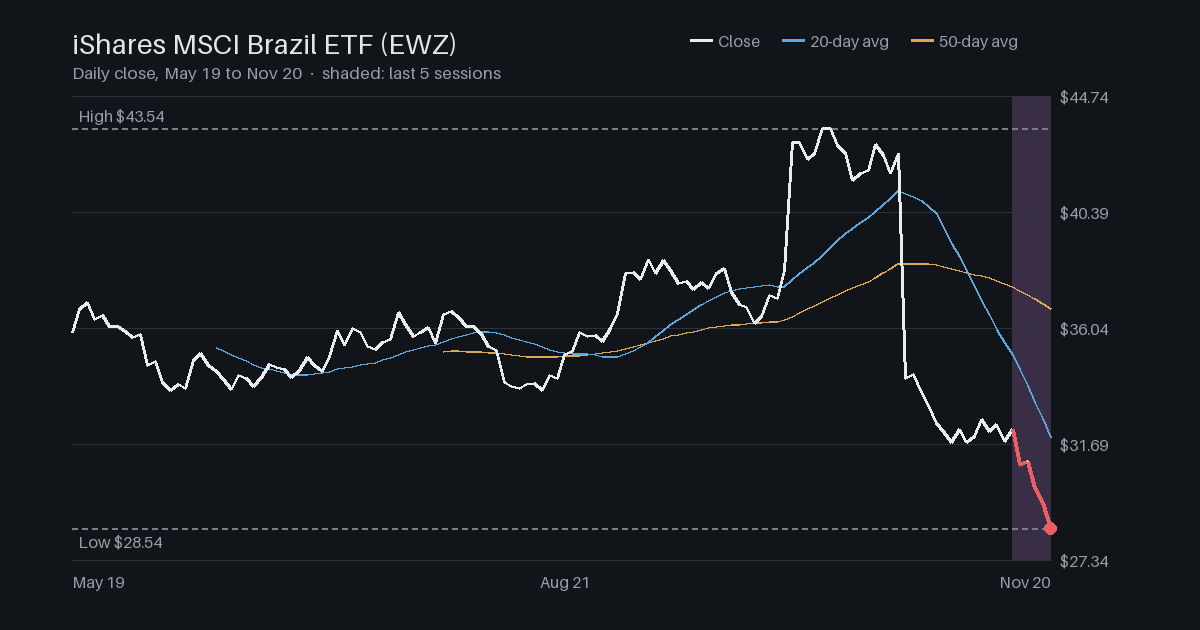
| Last close | $28.54 | Closing price on Nov 20, 2026. |
|---|---|---|
| 5-session move | -11.4% | Change in the closing price over the last five trading days. |
| 20-day average | $31.94 | The average closing price of the last 20 trading days. |
| 50-day average | $36.77 | The average closing price of the last 50 trading days. |
| Period high | $43.54 | Highest price since May 19, 2026. |
| Period low | $28.54 | Lowest price since May 19, 2026. |
Related coverage
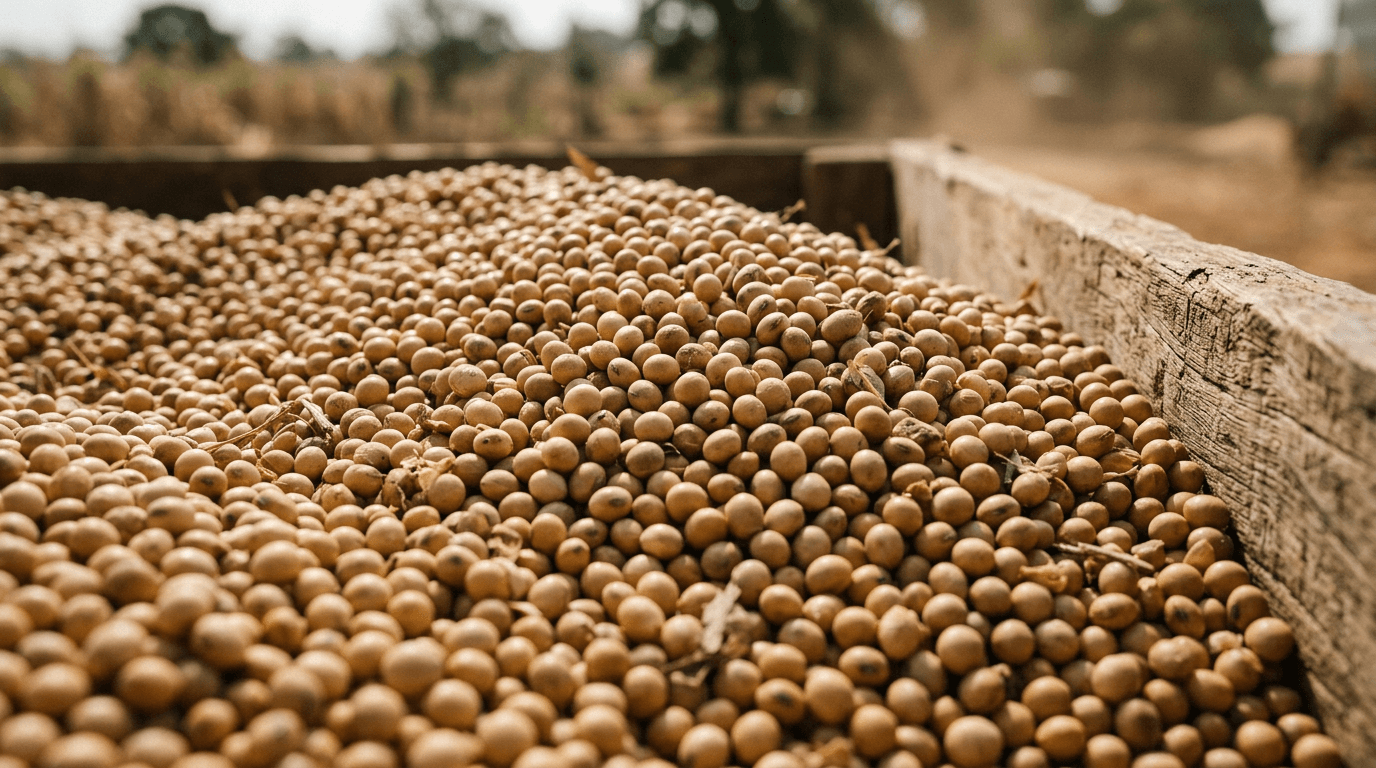 US Funds Keep 145,816 Net-Long Soybean Contracts, CFTC ReportsSpeculative funds held 145,816 net-long soybean contracts as of November 17, 2026, supporting Brazilian export expectations, according to the CFTC.
 Banco do Brasil Eyes CEO Change After Crop Calamity Squeezes ProfitBanco do Brasil faces a leadership shakeup as bad agricultural loans trigger a 66.5% profit drop and the suspension of 2027 intermediate dividends.
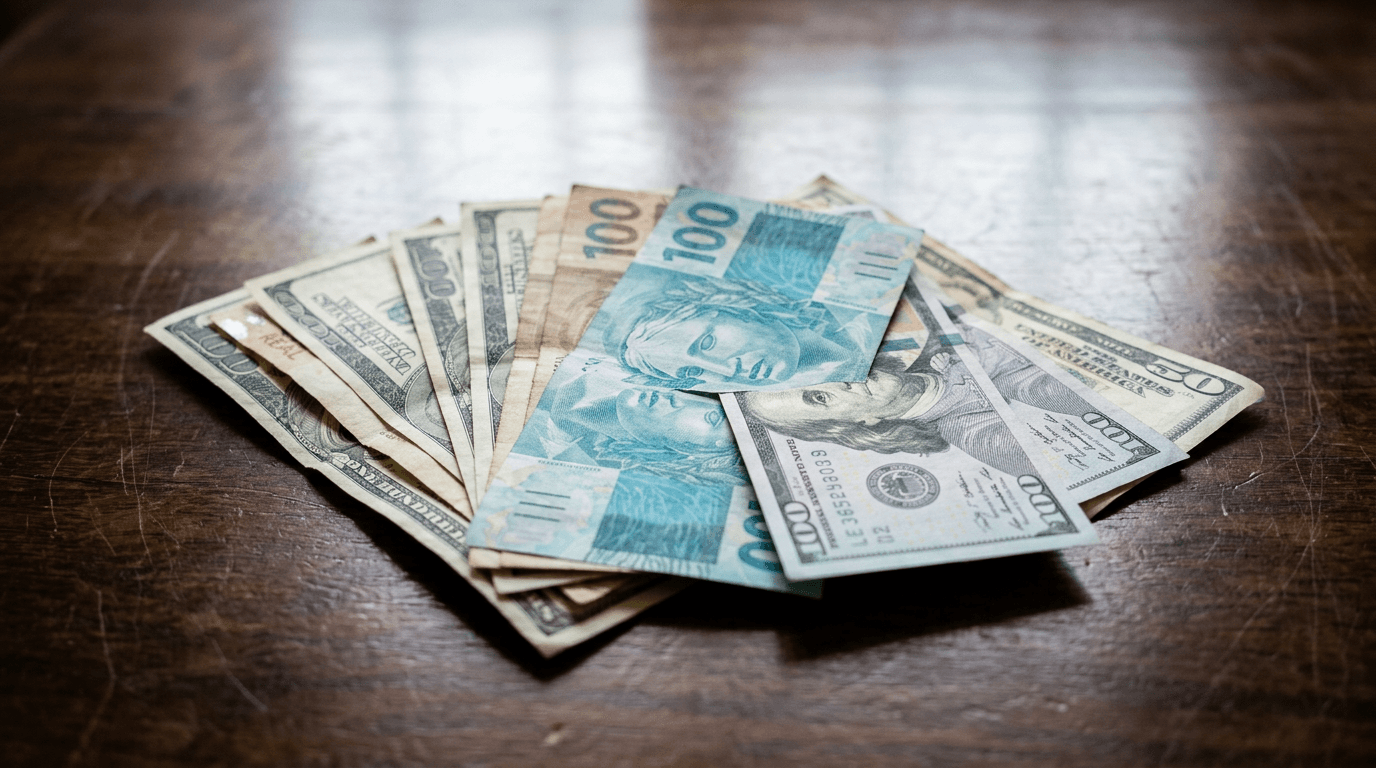 US Dollar Climbs to R$ 5.9488 as Lula Dismisses Brazil Fiscal ReformThe US dollar closed at R$ 5.9488 on November 20, 2026, amid fiscal concerns aggravated by President Lula dismissing the Senate-approved bill as a minor adjustment.