

Bank of America Warns Brazil Must Pass Fiscal Cuts to Keep Capital
Bank of America warns that foreign capital inflows to Brazil depend on its upcoming fiscal cuts, keeping its year-end 2027 exchange rate target at 5.85 reais.
Key takeaways
- Bank of America executives warned on November 19, 2026, that Brazil must deliver its fiscal package to retain foreign capital, per Bloomberg Línea
- BofA is revising its Selic interest rate forecast which previously projected eight cuts by late 2027, per brapi.dev on November 19, 2026
- BofA projects a year-end 2027 USD/BRL exchange rate of 5.85 reais as capital is diverted to US growth and AI, per Bloomberg Línea
American retail portfolios packed with high-performing domestic equities and artificial intelligence tech giants have left little reason for investors to look abroad. Yet for those seeking international diversification, emerging markets are presenting a steep premium. On November 19, 2026, Bank of America executives warned that Brazil must finalize its domestic fiscal adjustment package if it hopes to retain foreign capital, according to reports by Bloomberg Línea and brapi.dev. Without a credible spending plan, global liquidity is expected to remain anchored in the United States.
This warning comes as the strong US dollar continues to pressure emerging currencies. Bank of America announced on November 19, 2026, that it expects a year-end 2027 exchange rate of 5.85 Brazilian reais per dollar, as reported by Bloomberg Línea. While a weaker real makes local assets cheaper, the bank cautioned that foreign capital is being heavily diverted to US economic growth. Rising domestic fiscal premiums in Brazil act as an administrative tax on foreign portfolios, eroding the appeal of cheaper valuations.
The ongoing fiscal impasse is also disrupting local monetary policy, which directly affects corporate valuations. On November 19, 2026, Bank of America confirmed it is actively revising its forecast for Brazil's Selic interest rate path, according to brapi.dev. The bank had previously projected eight consecutive 25-basis-point interest rate cuts by late 2027, according to brapi.dev on November 19, 2026. However, persistent local fiscal premiums have forced a reassessment, meaning high local borrowing costs are likely to persist, capping domestic equity growth.
Despite these macroeconomic hurdles, Bank of America executives noted on November 19, 2026, that Brazil maintains a "relevant" opportunity to attract capital in critical minerals and infrastructure, per Bloomberg Línea. Yet, even if global risk appetite returns and the market for initial public offerings reopens, the benefits may not stay local. The bank projects that high-growth Brazilian companies will likely choose to list directly in the United States first rather than on the local B3 exchange, as reported by brapi.dev on November 19, 2026.
Going forward, global investors should watch whether the Brazilian government can finalize and legislate its fiscal spending cuts. The size and execution of this package will determine whether local interest rates can ease and if the Brazilian real can stabilize against the US dollar.
In your brokerage app
Broad Brazilian equity performance is tied closely to foreign capital flows. For retail investors looking at their US brokerage accounts, this dynamic is most directly tracked through the iShares MSCI Brazil ETF, an exchange-traded fund listed in New York that holds major Brazilian corporations. Additionally, investors looking at Brazil's critical minerals sector can track Sigma Lithium, a developer with lithium mining operations in Brazil that is listed in New York on the NASDAQ exchange.
Analysis · NWX analysis desk
Which Brazil assets this touches
- EWZ, USDBRL — Named in this story.
- NU, STNE, PAGS, IBOV — Big swings in U.S. tech stocks tend to spill into Brazil's fintechs listed in New York and into the broad Brazil fund, as global investors change how much risk they hold.
Technical picture · iShares MSCI Brazil ETF (EWZ)
iShares MSCI Brazil ETF (EWZ) closed at $28.54 on Nov 20, 2026, down 11.4% from five sessions earlier. The last close is below its 20-day average of $31.94 and below its 50-day average of $36.77. Since May 19, 2026 it has traded between $28.54 (low, Nov 20, 2026) and $43.54 (high, Oct 9, 2026).
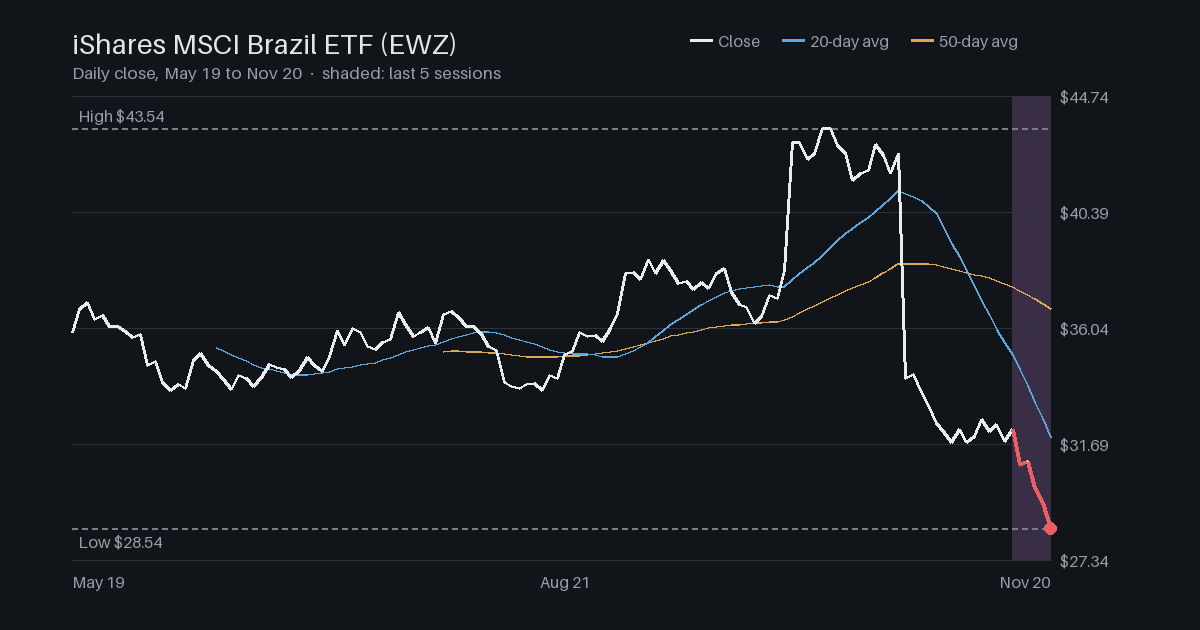
| Last close | $28.54 | Closing price on Nov 20, 2026. |
|---|---|---|
| 5-session move | -11.4% | Change in the closing price over the last five trading days. |
| 20-day average | $31.94 | The average closing price of the last 20 trading days. |
| 50-day average | $36.77 | The average closing price of the last 50 trading days. |
| Period high | $43.54 | Highest price since May 19, 2026. |
| Period low | $28.54 | Lowest price since May 19, 2026. |
Related coverage
 Petrobras Raises 2026 Investment to $22B and Approves DividendPetrobras approved a $2.786 billion dividend and boosted its 2026 cash investment target to up to $22 billion alongside higher production forecasts.
 Global Crop Supply Cushion Narrows as Farm Land Expansion SlowsBank of America forecasts Brazil's crop acreage expansion will slow to 1.5% in the 2026/27 season, tightening the global safety net for grains.
 Farm Debt Crisis Plunges Bank Profits, Squeezing iShares Brazil ETFA severe agribusiness default crisis at Banco do Brasil drove a 66.5% plunge in Q3 2026 profits, dragging down valuations in the iShares MSCI Brazil ETF.