

Banco do Brasil Eyes CEO Change After Crop Calamity Squeezes Profit
Banco do Brasil faces a leadership shakeup as bad agricultural loans trigger a 66.5% profit drop and the suspension of 2027 intermediate dividends.
Key takeaways
- Banco do Brasil reported Q3 2026 recurrent net profit of R$ 1.3 billion, a 66.5% drop YoY, per company filings on November 11, 2026
- Provisions for credit losses rose 23.1% YoY to R$ 22.1 billion due to bad agricultural loans, per company statements on November 11, 2026
- The bank's board lowered its 2026 dividend payout target to 25% and suspended 2027 intermediate dividends, per InfoMoney on November 11, 2026
- Economic officials are discussing candidates to replace CEO Tarciana Medeiros to restore confidence, per Money Times on November 21, 2026
US retail investors seeking yield through a brazil stock market etf or broad emerging market banking funds face a sudden hit to their payouts as state-controlled Banco do Brasil suspends its 2027 dividend distributions. According to the bank's third-quarter earnings report released on November 11, 2026, the lender posted a recurrent net profit of R$ 1.3 billion (approximately $225 million), representing a 66.5% drop year-over-year that fell far short of the Bloomberg analyst consensus of R$ 3.09 billion. This disastrous performance has prompted the federal government's economic team to begin discussions to replace the bank's chief executive officer, Tarciana Medeiros.
The earnings collapse stems from a severe credit crisis sweeping Brazil's agricultural sector. According to official company earnings figures from November 11, 2026, provisions for credit losses jumped 23.1% year-over-year to R$ 22.1 billion, as an increasing number of farmers struggled to repay their debts. The bank's over-90-day delinquency rate rose sharply to 6.08% during the same quarter, according to the same November 11, 2026 financial report. Speaking during a webcast on November 12, 2026, CEO Tarciana Medeiros acknowledged that the bank is navigating its worst agricultural crisis in history, pointing out that several medium and large-sized crop producers have opted not to pay or renegotiate their debts.
With capital ratios under pressure, Banco do Brasil's board was forced to scale back shareholder distributions to protect its balance sheet. In an investor filing on November 11, 2026, the board of directors announced it had lowered its 2026 payout target from 30% to 25% of adjusted net income, as reported by Seu Dinheiro. More critically, the bank is suspending all intermediate dividend declarations for the entirety of 2027, according to reporting by InfoMoney on November 11, 2026.
This sudden erosion of profit and shareholder returns has sparked a political reaction in Brasília. On November 21, 2026, members of the federal economic team began evaluating candidates to present to President Luiz Inácio Lula da Silva as potential replacements for Medeiros, according to a report from Money Times. Medeiros, who in 2023 became the first woman to lead the 200-year-old institution, has faced mounting scrutiny as the bank's shares fell approximately 34% over the course of 2026, as reported by Money Times on November 21, 2026. Economic officials are eager to install new leadership to restore market confidence and prevent any scenario where the bank would require a capital injection from the national treasury.
In your brokerage app
For US retail investors holding shares of the iShares MSCI Brazil ETF (NYSE Arca: EWZ), state-controlled Banco do Brasil (B3: BBAS3) represents a significant financial risk. While private-sector competitors like Itaú Unibanco (NYSE: ITUB) and Banco Bradesco (NYSE: BBD) have maintained stronger asset quality by limiting their exposure to the volatile agricultural sector, Banco do Brasil acts as the primary backer of Brazilian farming, holding 47.7% of all credit destined for the sector, according to Central Bank data compiled by Gazeta do Povo on November 21, 2026. This makes the lender uniquely vulnerable to structural swings in global crop prices and local harvest defaults, directly affecting broader emerging-market portfolios.
Analysis · NWX analysis desk
Which Brazil assets this touches
- EWZ, ITUB, BBD, BBAS3, ITUB4, USDBRL — Named in this story.
Fundamentals · Itaú Unibanco (ITUB4)
Itaú Unibanco (ITUB4) trades at 9.7x its yearly earnings and 1.9x its book value. Its return on equity is 20.8%. Its dividend yield is 7.7%. The market values the company at R$465.3 billion. Its financial health score is 61 out of 100 (stable), based on profitability, liquidity, debt and growth. Latest: Q3 2026 results, published Nov 3, 2026. Next: FY 2026 results expected Feb 3, 2027 (confirmed date).
| Price / earnings (P/E) | 9.7x | How many years of the current yearly profit the share price adds up to. |
|---|---|---|
| Price / book (P/B) | 1.9x | The share price compared with the accounting value of what the company owns, per share. |
| Return on equity (ROE) | 20.8% | Yearly profit for every R$100 that shareholders have put into the company. |
| Net margin | 12.2% | The part of every R$100 in sales that is left as profit. |
| Dividend yield | 7.7% | Cash paid to shareholders over the past year, as a share of today's price. |
| Market value | R$465.3 billion | What the whole company is worth at today's share price. |
Technical picture · iShares MSCI Brazil ETF (EWZ)
iShares MSCI Brazil ETF (EWZ) closed at $28.54 on Nov 20, 2026, down 11.4% from five sessions earlier. The last close is below its 20-day average of $31.94 and below its 50-day average of $36.77. Since May 19, 2026 it has traded between $28.54 (low, Nov 20, 2026) and $43.54 (high, Oct 9, 2026).
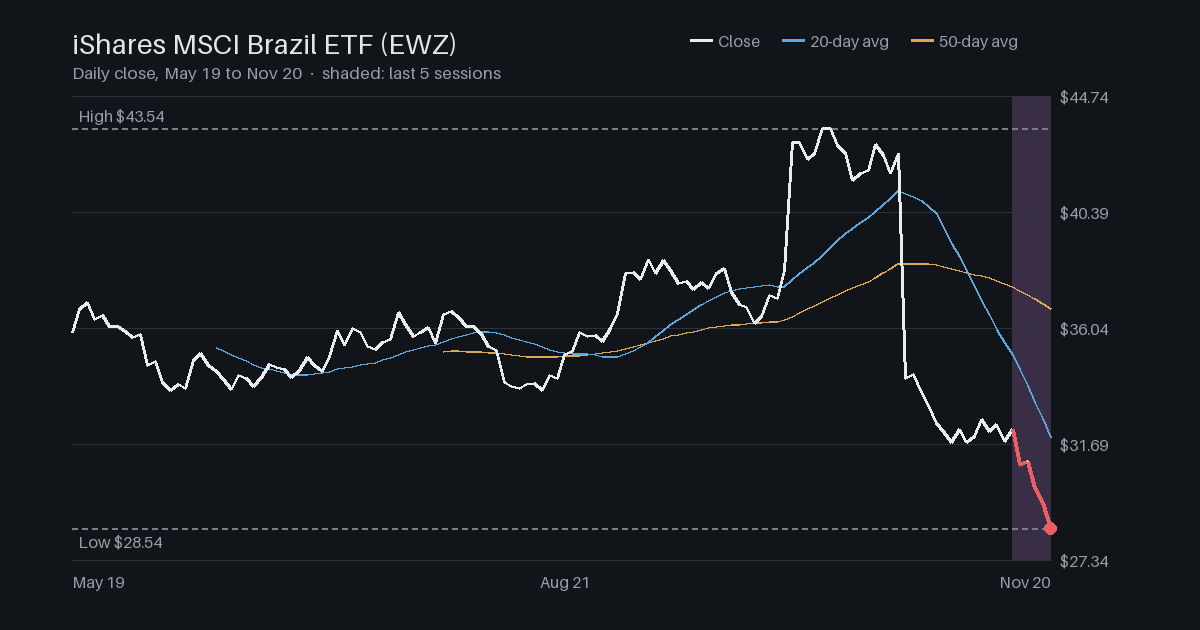
| Last close | $28.54 | Closing price on Nov 20, 2026. |
|---|---|---|
| 5-session move | -11.4% | Change in the closing price over the last five trading days. |
| 20-day average | $31.94 | The average closing price of the last 20 trading days. |
| 50-day average | $36.77 | The average closing price of the last 50 trading days. |
| Period high | $43.54 | Highest price since May 19, 2026. |
| Period low | $28.54 | Lowest price since May 19, 2026. |
Related coverage
 New Brazilian Labor Rules and High Interest Rates Squeeze RetailersBrazil's new 5x2 workweek decree and a high Selic rate squeeze retailers and fintechs, while Lula clashing with markets adds to fiscal caution.
 US Funds Keep 145,816 Net-Long Soybean Contracts, CFTC ReportsSpeculative funds held 145,816 net-long soybean contracts as of November 17, 2026, supporting Brazilian export expectations, according to the CFTC.
 US Dollar Climbs to R$ 5.9488 as Lula Dismisses Brazil Fiscal ReformThe US dollar closed at R$ 5.9488 on November 20, 2026, amid fiscal concerns aggravated by President Lula dismissing the Senate-approved bill as a minor adjustment.