

Yield Gap Between U.S. and Brazil Real Holds Steady at 9.75 Points
The interest rate spread between the U.S. and Brazil holds at 9.75 percentage points, offering a stable yield premium for foreign dollar investors.
Key takeaways
- The interest rate spread between the U.S. and Brazil remains at 9.75 percentage points, per central bank and Federal Reserve data on Nov. 22, 2026
- Brazil's benchmark Selic rate stands at 13.75%, according to the Banco Central do Brasil on Nov. 22, 2026
- The U.S. Federal Funds target upper limit is at 4.0%, per the Federal Reserve Bank of St. Louis on Nov. 21, 2026
- The yield premium has held unchanged for 30 days, serving as the baseline reward for foreign investors holding Brazilian debt
Foreign investors holding dollars face an unchanged 9.75 percentage point yield gap between the U.S. and Brazil as of November 22, 2026. This premium represents the difference between the Federal Reserve's 4.0% upper-target funds rate as of November 21, 2026 and Brazil's 13.75% benchmark Selic rate as of November 22, 2026. For international market participants, this brazil real interest rate gap represents the baseline reward for taking on South American sovereign risk over safe-haven U.S. Treasuries.
This spread has held completely steady over the last 30 days, reflecting a period of relative stability in the target policies of both central banks. When the yield gap remains unchanged, it provides a predictable backdrop for the currency market, helping to stabilize the brazil real to dollar exchange rate in the short term. Any future adjustment to either country's benchmark rate would immediately alter this spread and trigger capital reallocations.
In global finance, this yield differential acts as the primary engine for the currency carry trade. Investors borrow funds in lower-yield currencies, like the U.S. dollar, and invest the proceeds in higher-yielding assets denominated in the brazil real. A wider spread typically supports the local currency by encouraging foreign capital inflows, while a narrowing gap can prompt foreign investors to pull capital out of emerging markets and return to safe-haven U.S. dollar assets.
While Brazil’s high nominal interest rate offers an attractive headline yield compared to the 4.0% return on U.S. cash, foreign investors must weigh this against currency volatility and inflation. High domestic borrowing costs in Brazil are designed to curb domestic price pressures, but they can also limit economic growth and increase the government's fiscal burden. For this reason, international investors closely monitor the spread to gauge whether the yield premium sufficiently compensates for these systemic risks.
In your brokerage app
For retail investors who do not trade foreign currency directly, this spread directly influences the iShares MSCI Brazil ETF (EWZ), the largest U.S.-listed fund tracking Brazilian equities. While high benchmark rates can bolster the earnings of financial and banking sector stocks that carry large weightings in the ETF, a weakening of the local currency directly reduces the fund's net asset value when translated back into U.S. dollars. Consequently, a stable or compressing rate spread often functions as a crucial variable for those holding diversified Brazilian equity exposure in their portfolios.
Analysis · NWX analysis desk
Which Brazil assets this touches
- EWZ — Named in this story.
- USDBRL, IBOV — Higher U.S. interest rates tend to pull money out of emerging markets such as Brazil, which weighs on the real and on Brazilian stocks; lower rates tend to do the opposite.
Technical picture · iShares MSCI Brazil ETF (EWZ)
iShares MSCI Brazil ETF (EWZ) closed at $28.54 on Nov 20, 2026, down 11.4% from five sessions earlier. The last close is below its 20-day average of $31.94 and below its 50-day average of $36.77. Since May 19, 2026 it has traded between $28.54 (low, Nov 20, 2026) and $43.54 (high, Oct 9, 2026).
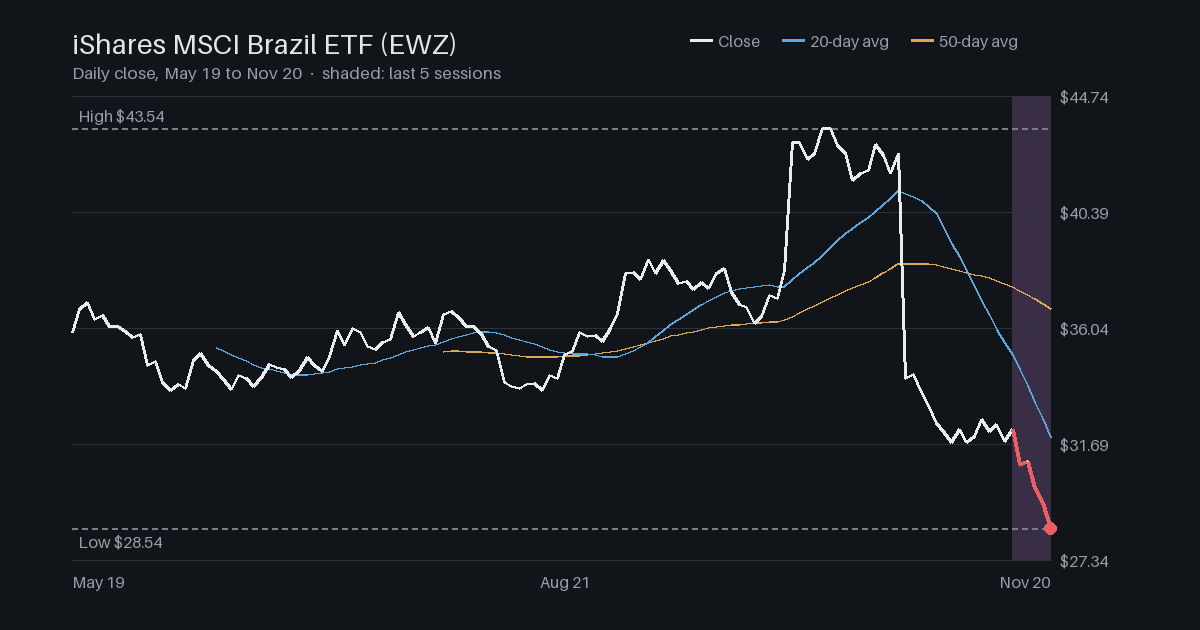
| Last close | $28.54 | Closing price on Nov 20, 2026. |
|---|---|---|
| 5-session move | -11.4% | Change in the closing price over the last five trading days. |
| 20-day average | $31.94 | The average closing price of the last 20 trading days. |
| 50-day average | $36.77 | The average closing price of the last 50 trading days. |
| Period high | $43.54 | Highest price since May 19, 2026. |
| Period low | $28.54 | Lowest price since May 19, 2026. |
