

Petrobras Boosts Five-Year Investment Target to $120 Billion
Brazil's state oil firm Petrobras is set to approve a 2027-2031 Strategic Plan raising total capital investments to $120 billion and lifting production targets.

Key takeaways
- Petrobras is scheduled to approve its 2027–2031 Strategic Plan on November 23, 2026, per company disclosures
- The plan boosts projected capital investments to between $115 billion and $120 billion, up from $109 billion in the previous cycle, per Petrobras announcements in November 2026
- Petrobras aims to raise average oil production targets to between 2.9 million and 3.0 million barrels per day through 2029, per corporate guidance in November 2026
On November 23, 2026, Brazilian state oil giant Petróleo Brasileiro S.A. is scheduled to officially approve and release its 2027–2031 Strategic Plan, boosting its projected five-year capital investments to between $115 billion and $120 billion. The Rio de Janeiro-based producer announced the timeline and core parameters of the upcoming cycle on its investor relations portal, marking a significant step up from the $109 billion earmarked during the previous 2026–2030 period. For international investors monitoring the Petrobras dividend and capex cut dynamics, this aggressive capital spending program represents a key transition point for the company's financial strategy.
The state-controlled champion, commonly known as Petrobras, has long balanced the political agenda of the federal government in Brasília, which owns a controlling stake, with the financial expectations of global shareholders. Under Chief Executive Officer Magda Chambriard, the company is seeking to reverse production declines in mature deepwater fields by accelerating exploration in offshore frontier areas while expanding domestic refining capacity. To fund these initiatives, the company is raising its investment targets, which in turn places new constraints on its legendary shareholder distributions.
The mechanism of this capex boost directly impacts shareholder distributions because Petrobras calculates dividends based on its free cash flow—the cash left over after paying for operations and capital investments. By raising its capital spending ceiling over the next five years, the company potentially has less immediate cash to distribute. This shifting capital allocation strategy has intensified discussions among Wall Street analysts regarding whether the era of massive, double-digit dividend yields is structurally impaired by the company's long-term infrastructure commitments.
Despite the increased capital spending, Petrobras is projecting higher physical output to eventually offset the costs. The new plan raises the company's average oil production targets to between 2.9 million and 3.0 million barrels per day through 2029, up from previous cycle targets. However, for investors counting on immediate dollar checks, the near-term cash drain remains the primary focus as the market waits to see how the board balances physical expansion with capital discipline.
In your brokerage app
American retail investors holding the New York-listed American Depositary Receipts of Petróleo Brasileiro S.A. (NYSE: PBR, NYSE: PBR-A), which correspond to the common and preferred shares traded in São Paulo (B3: PETR3, PETR4), are directly exposed to these capital decisions. While Petrobras remains a prominent high-yield energy stock, any structural increase in domestic infrastructure spending or exploration can trim the free cash flow available to fund these US dollar distributions. Investors will watch the official release of the plan for concrete details on the company's committed base dividends and its capacity for extraordinary payouts.
Analysis · NWX analysis desk
Which Brazil assets this touches
- PBR, PBR-A, PETR4, BRENT — Named in this story.
Fundamentals · Petrobras (PETR4)
Petrobras (PETR4) trades at 3.9x its yearly earnings and 1.1x its book value. Its return on equity is 27.8%. Its dividend yield is 8.6%. The market values the company at R$588.5 billion. Its financial health score is 81 out of 100 (strong), based on profitability, liquidity, debt and growth. Latest: Q3 2026 results, published Nov 10, 2026.
| Price / earnings (P/E) | 3.9x | How many years of the current yearly profit the share price adds up to. |
|---|---|---|
| Price / book (P/B) | 1.1x | The share price compared with the accounting value of what the company owns, per share. |
| Return on equity (ROE) | 27.8% | Yearly profit for every R$100 that shareholders have put into the company. |
| Net margin | 23.8% | The part of every R$100 in sales that is left as profit. |
| Dividend yield | 8.6% | Cash paid to shareholders over the past year, as a share of today's price. |
| Market value | R$588.5 billion | What the whole company is worth at today's share price. |
Technical picture · Petrobras (PETR4)
Petrobras (PETR4) closed at R$42.67 on Nov 19, 2026, down 4.5% from five sessions earlier. The last close is below its 20-day average of R$48.36 and below its 50-day average of R$50.62. Since May 26, 2026 it has traded between R$37.40 (low, Jul 1, 2026) and R$59.79 (high, Oct 23, 2026).
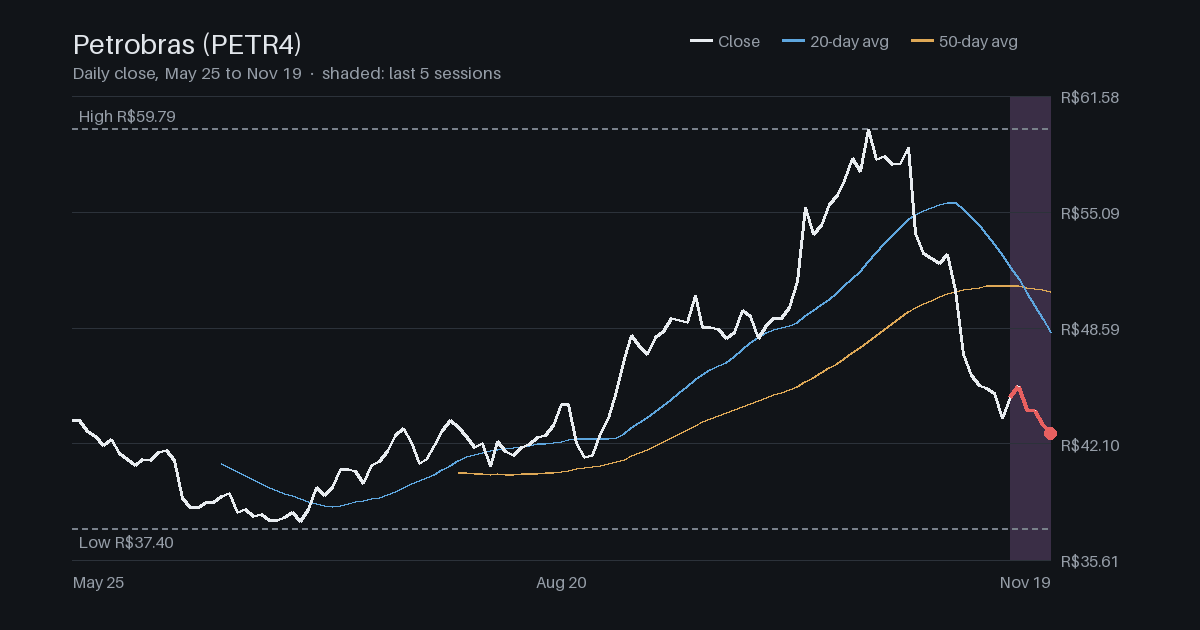
| Last close | R$42.67 | Closing price on Nov 19, 2026. |
|---|---|---|
| 5-session move | -4.5% | Change in the closing price over the last five trading days. |
| 20-day average | R$48.36 | The average closing price of the last 20 trading days. |
| 50-day average | R$50.62 | The average closing price of the last 50 trading days. |
| Period high | R$59.79 | Highest price since May 26, 2026. |
| Period low | R$37.40 | Lowest price since May 26, 2026. |
Related coverage
 Senate Approves PLP 299 Fiscal Adjustment Bill to Calm RatesOn November 18, 2026, Brazil's Senate approved the PLP 299/2026 fiscal adjustment bill by a 69-2 vote, aiming to improve the 2027 primary budget balance.
 US Beverage Processors Squeezed as Global Orange Harvest Drops 7%A Florida Department of Citrus report projects a 7% drop in combined orange harvests in Brazil, the US, and Mexico, raising costs for beverage processors.
 Yield Spread With US Gaps Past 10% as Brazil Futures Hit 14.82%A massive 10% yield gap between U.S. and Brazilian debt is depressing the Real and hurting dollar returns for emerging-market fund investors.