

Major Fiscal Package to Save Up to 56 Billion Reais Faces House Vote
Brazil’s Lower House will vote on the Plano Moretti fiscal adjustment package on November 23, 2026, aiming to generate up to 56.1 billion reais in savings.

Key takeaways
- Brazil's Senate approved the Plano Moretti fiscal package to save up to 56.1 billion reais in 2027, per Poder360 on November 18, 2026
- Lower House President Hugo Motta scheduled an extraordinary voting session for November 23, 2026, per Vero Notícias on November 19, 2026
- The fiscal package targets a primary budget surplus of 0.5% of GDP in 2027 to stabilize public debt, per government plans on November 18, 2026
American investors holding emerging market funds are facing a pivotal moment for sovereign credit risk and the value of the Brazilian real. On Monday, November 23, 2026, the Lower House will convene an extraordinary session to vote on a critical fiscal adjustment package known as the Plano Moretti. Designated as Complementary Law Project (PLP) 299/2026, the legislation aims to generate 45.1 billion to 56.1 billion reais ($7.8 billion to $9.7 billion) in budget savings for 2027, according to Senate legislative records on November 18, 2026.
The upcoming House vote follows a key legislative victory on November 18, 2026, when the Senate approved the core proposal, as reported by Poder360. Senators rejected opposition amendments that sought to block limits on corporate tax offsets and state transfer delays. To secure passage, the government compromised by raising the annual floor for state compensation transfers under the Lei Kandir from 1 billion reais to 2 billion reais between 2028 and 2030, according to Senate records on November 18, 2026.
Following the Senate's approval, Lower House President Hugo Motta announced on November 18, 2026, that he would call an extraordinary night session on Monday, November 23, 2026, to debate and vote on the fiscal measures, as reported by Vero Notícias. The proposal requires an absolute majority of 257 votes in the Lower House, according to legislative rules on November 19, 2026. Rapporteur Mauro Benevides Filho indicated on November 19, 2026, that he will present the Senate's version without changes to ensure swift approval, according to congressional transcripts.
The Plano Moretti alters Brazil's 2023 fiscal framework, lowering the real growth ceiling for federal expenditures from 2.5% to 2.0% during years when spending containment measures are active, according to Senate records on November 18, 2026. The package also curtails tax benefits and limits corporate tax credit offsets, a measure projected to yield up to 18.3 billion reais of the 2027 savings, according to Ministry of Planning projections on November 18, 2026. Easing public debt, which stood at 82.9% of GDP as of November 2026, is vital to relieving pressure on local interest rates and the currency, according to Central Bank data published on November 12, 2026.
While analysts remain skeptical that these measures alone can stabilize Brazil's long-term debt trajectory due to their reliance on revenue-raising provisions over structural spending cuts, the legislative progress marks a necessary step. Investors will watch the House vote on November 23, 2026, to gauge if the administration can maintain its coalition and deliver on its fiscal commitments.
In your brokerage app
For retail investors holding the iShares MSCI Brazil ETF (EWZ), the outcome of Monday’s session is a primary driver of near-term performance. A successful vote is expected to support the Brazilian real (USD/BRL) and lower domestic interest rates (DI1), whereas a legislative delay or further dilution of the savings targets could exacerbate sovereign credit risk and weigh on New York-listed Brazilian equities.
Analysis · NWX analysis desk
Which Brazil assets this touches
- EWZ, USDBRL, DI1 — Named in this story.
Technical picture · iShares MSCI Brazil ETF (EWZ)
iShares MSCI Brazil ETF (EWZ) closed at $28.54 on Nov 20, 2026, down 11.4% from five sessions earlier. The last close is below its 20-day average of $31.94 and below its 50-day average of $36.77. Since May 19, 2026 it has traded between $28.54 (low, Nov 20, 2026) and $43.54 (high, Oct 9, 2026).
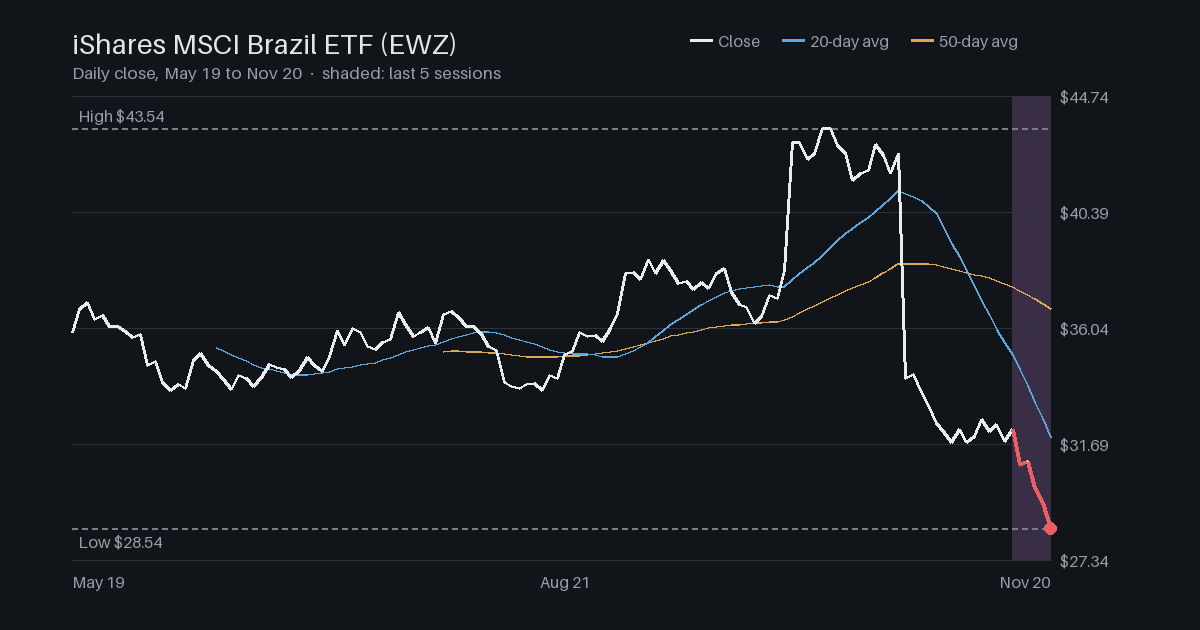
| Last close | $28.54 | Closing price on Nov 20, 2026. |
|---|---|---|
| 5-session move | -11.4% | Change in the closing price over the last five trading days. |
| 20-day average | $31.94 | The average closing price of the last 20 trading days. |
| 50-day average | $36.77 | The average closing price of the last 50 trading days. |
| Period high | $43.54 | Highest price since May 19, 2026. |
| Period low | $28.54 | Lowest price since May 19, 2026. |
Related coverage
 New Brazilian Labor Rules and High Interest Rates Squeeze RetailersBrazil's new 5x2 workweek decree and a high Selic rate squeeze retailers and fintechs, while Lula clashing with markets adds to fiscal caution.
 US Funds Keep 145,816 Net-Long Soybean Contracts, CFTC ReportsSpeculative funds held 145,816 net-long soybean contracts as of November 17, 2026, supporting Brazilian export expectations, according to the CFTC.
 Banco do Brasil Eyes CEO Change After Crop Calamity Squeezes ProfitBanco do Brasil faces a leadership shakeup as bad agricultural loans trigger a 66.5% profit drop and the suspension of 2027 intermediate dividends.