

Top Bank CEOs Warn of Near-Zero 2027 Growth, Urge Fiscal Cuts
Itaú and Bradesco CEOs warn of near-zero growth in 2027, urging immediate federal spending cuts to curb public debt and stabilize Brazil's economy.

Key takeaways
- Itaú and Bradesco CEOs warned of near-zero economic growth in 2027, projecting GDP expansion at 0.5% and 0.4%, respectively, per Mundo BA on November 9, 2026
- Bradesco CEO Marcelo Noronha projected system-wide credit growth will decelerate to 6% in 2027, per BP Money on November 20, 2026
- Gross public debt is warned to rise from 83% to 89% of GDP by 2027 without significant spending cuts, per Mundo BA on November 9, 2026
The chief executives of Brazil’s top private lenders, Itaú Unibanco and Banco Bradesco, have warned of near-zero economic growth in 2027, projecting gross domestic product (GDP) expansion of just 0.5% and 0.4%, respectively. Speaking at investor forums in São Paulo and New York, Itaú CEO Milton Maluhy Filho and Bradesco CEO Marcelo Noronha publicly urged the federal government to implement immediate, strict fiscal spending cuts to manage a public debt load projected to hit 89% of GDP by 2027, according to statements reported by Mundo BA on November 9, 2026.
Credit constraints and conservative lending
The sharp economic deceleration is tightly bound to high domestic borrowing costs and consumer strain. According to BP Money on November 20, 2026, Bradesco projects credit portfolio growth across the financial system to decelerate to approximately 6% in 2027, down from 8.6% in September 2026. To manage default risks in this environment, Bradesco is pivoting toward a conservative stance, focusing on lower-risk collateralized loans such as payroll-deducted and vehicle financing.
The bank executives emphasized that reviving the local economy requires a definitive fiscal shift from the federal government. During a New York investor forum, Noronha noted that household debt service absorbs nearly 29% of income as of November 2026, severely limiting credit capacity, as reported by Brazil Journal on November 19, 2026. He argued that implementing structural reforms is best done in the first year of an administration's term to successfully curve the national debt trajectory. Meanwhile, Maluhy warned on November 9, 2026, that the country faces a risk of entering a technical recession if structural fiscal imbalances are not resolved, per Mundo BA.
This cautious outlook follows the decision by the Banco Central do Brasil's Monetary Policy Committee (Copom) earlier in November 2026 to pause the benchmark Selic interest rate at 13.75%, halting its rate-cutting cycle due to worsening fiscal expectations. Investors analyzing the Brazil stock market today must monitor the federal government's upcoming budget and structural spending packages. If the administration fails to deliver a credible plan, bank executives warned that the central bank may keep the Selic locked at 13.75% deep into 2027, further curbing domestic consumption and lending.
In your brokerage app
For investors utilizing a US brokerage account, this macroeconomic headwind directly impacts major Brazilian financial assets traded in New York. This includes Itaú Unibanco (NYSE: ITUB) and Banco Bradesco (NYSE: BBD), which represent some of the heaviest-weighted private financial holdings of Brazil's flagship B3 stock index, the Ibovespa. These two financial giants are heavily weighted holdings within the iShares MSCI Brazil ETF (NYSE Arca: EWZ), meaning that a sustained contraction in system-wide lending could weigh on broader exchange-traded fund performance.
Analysis · NWX analysis desk
Which Brazil assets this touches
- ITUB, BBD, EWZ, ITUB4, BBDC4, USDBRL — Named in this story.
Fundamentals · Itaú Unibanco (ITUB4)
Itaú Unibanco (ITUB4) trades at 9.7x its yearly earnings and 1.9x its book value. Its return on equity is 20.8%. Its dividend yield is 7.7%. The market values the company at R$465.3 billion. Its financial health score is 61 out of 100 (stable), based on profitability, liquidity, debt and growth. Latest: Q3 2026 results, published Nov 3, 2026. Next: FY 2026 results expected Feb 3, 2027 (confirmed date).
| Price / earnings (P/E) | 9.7x | How many years of the current yearly profit the share price adds up to. |
|---|---|---|
| Price / book (P/B) | 1.9x | The share price compared with the accounting value of what the company owns, per share. |
| Return on equity (ROE) | 20.8% | Yearly profit for every R$100 that shareholders have put into the company. |
| Net margin | 12.2% | The part of every R$100 in sales that is left as profit. |
| Dividend yield | 7.7% | Cash paid to shareholders over the past year, as a share of today's price. |
| Market value | R$465.3 billion | What the whole company is worth at today's share price. |
Technical picture · Itaú Unibanco (ITUB4)
Itaú Unibanco (ITUB4) closed at R$40.07 on Nov 19, 2026, down 3.9% from five sessions earlier. The last close is below its 20-day average of R$41.35 and below its 50-day average of R$43.71. Since May 26, 2026 it has traded between R$37.35 (low, Aug 20, 2026) and R$50.85 (high, Oct 6, 2026).
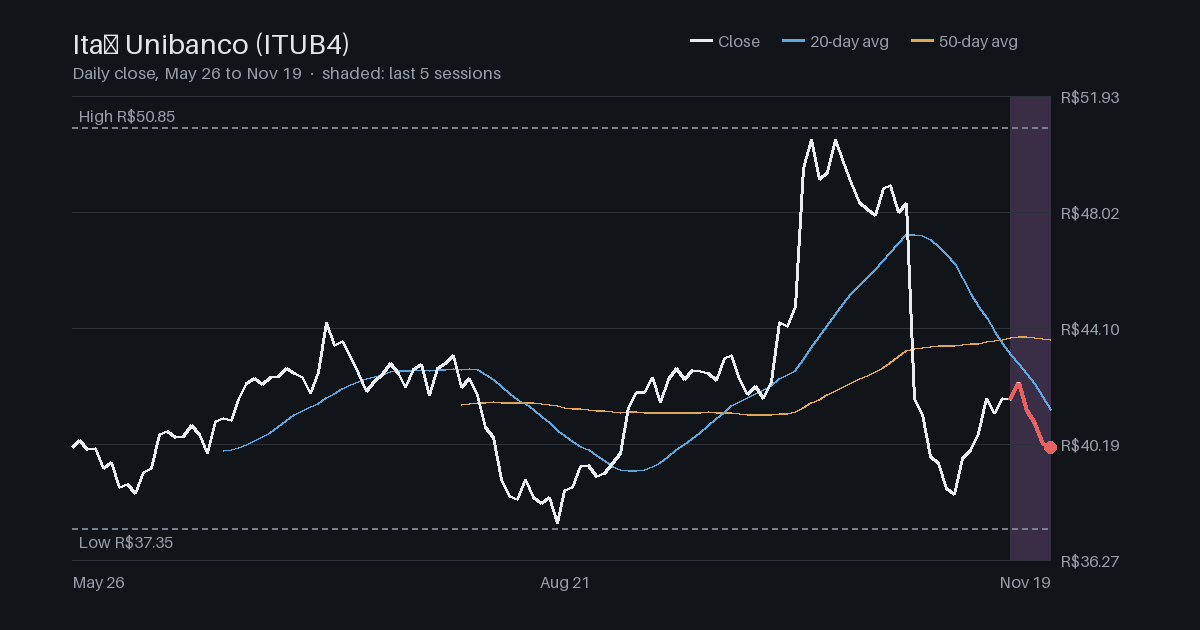
| Last close | R$40.07 | Closing price on Nov 19, 2026. |
|---|---|---|
| 5-session move | -3.9% | Change in the closing price over the last five trading days. |
| 20-day average | R$41.35 | The average closing price of the last 20 trading days. |
| 50-day average | R$43.71 | The average closing price of the last 50 trading days. |
| Period high | R$50.85 | Highest price since May 26, 2026. |
| Period low | R$37.35 | Lowest price since May 26, 2026. |
Related coverage
 Senate Approves PLP 299 Fiscal Adjustment Bill to Calm RatesOn November 18, 2026, Brazil's Senate approved the PLP 299/2026 fiscal adjustment bill by a 69-2 vote, aiming to improve the 2027 primary budget balance.
 US Beverage Processors Squeezed as Global Orange Harvest Drops 7%A Florida Department of Citrus report projects a 7% drop in combined orange harvests in Brazil, the US, and Mexico, raising costs for beverage processors.
 Yield Spread With US Gaps Past 10% as Brazil Futures Hit 14.82%A massive 10% yield gap between U.S. and Brazilian debt is depressing the Real and hurting dollar returns for emerging-market fund investors.