

Agriculture Debt Surge Sparks Push to Replace Banco do Brasil CEO
A 66.5% drop in Banco do Brasil's Q3 2026 profit due to agribusiness defaults has prompted Lula's government to consider replacing CEO Tarciana Medeiros.

Key takeaways
- Banco do Brasil's Q3 2026 adjusted net income fell 66.5% year-over-year to R$ 1.27 billion, per company earnings on November 11, 2026
- The bank's credit costs surged 18.4% to R$ 21.2 billion, driven by R$ 12.2 billion in agricultural default losses, per financial reports on November 11, 2026
- Lula's economic team is considering replacing CEO Tarciana Medeiros with candidates like Alexandre Barreto, per media reports on November 21, 2026
For American investors holding emerging market portfolios or tracking global agricultural credit risk, a sudden financial blow to Latin America's largest farm lender is triggering a political shakeup in Brasilia. State-controlled Banco do Brasil saw its third-quarter adjusted net income collapse by 66.5% year-over-year to R$ 1.27 billion, down from R$ 3.785 billion a year earlier, according to its November 11, 2026 earnings release. The severe profit slump, driven by a wave of agricultural loan defaults, has led the economic team of President Luiz Inácio Lula da Silva to actively discuss replacing the bank’s chief executive officer, Tarciana Medeiros, according to reports on November 21, 2026.
The financial deterioration stems from a dramatic spike in unpaid debts among medium and large grain and livestock producers in Brazil's central-west farm belt. The bank's cost of credit surged 18.4% year-over-year to R$ 21.2 billion in the third quarter of 2026, fueled primarily by R$ 12.2 billion in losses from expected defaults in its agribusiness loan portfolio, as reported in the bank's November 11, 2026 financial disclosures. To cushion the blow, Banco do Brasil slashed its full-year 2026 profit outlook and trimmed shareholder dividend payouts to the regulatory minimum of 25%.
With the state-owned institution serving as the foundational pillar of Brazilian farm lending, the scale of the agribusiness defaults has forced Lula's administration to consider a leadership change. Government officials are actively vetting candidates to succeed Medeiros, who in 2023 became the first woman to lead the 218-year-old bank. Among the leading names under discussion is Alexandre Barreto, the former superintendent of Brazil's antitrust regulator Cade, according to reports published by Money Times on November 21, 2026. While Barreto is reportedly backed by key political figures, including Senate President Davi Alcolumbre, no official announcement has yet been made by the government or the bank.
The emerging crisis highlights broader vulnerabilities within the Brazilian banking sector and agricultural debt risk, which has escalated due to high interest rates and falling commodity prices. As large-scale grain producers struggle to service debts, private analysts have expressed concerns about systemic credit deterioration extending beyond Banco do Brasil to other domestic lenders. A potential change in the state bank's leadership could signal a shift in how Brazil's government manages agricultural debt renegotiations and risk provisions in the coming year.
Looking ahead, global markets will be watching for official cabinet confirmations or regulatory filings from Brasilia regarding the CEO position. The bank's board and the Ministry of Finance must also address whether further provision adjustments are required for the final quarter of the fiscal year.
In your brokerage app
For retail investors holding the iShares MSCI Brazil ETF (EWZ), the performance of major financial institutions is a primary driver of fund performance. Banco do Brasil, which trades on the B3 exchange in Sao Paulo under the ticker BBAS3, represents a major component of the Brazilian banking sector, meaning that rising agricultural debt risk can weigh directly on broader emerging market fund returns.
Analysis · NWX analysis desk
Which Brazil assets this touches
- EWZ, BBAS3, IBOV, USDBRL — Named in this story.
Fundamentals · Banco do Brasil (BBAS3)
Banco do Brasil (BBAS3) trades at 7.4x its yearly earnings and 0.4x its book value. Its return on equity is 6.8%. Its dividend yield is 4.8%. The market values the company at R$81.8 billion. Its financial health score is 48 out of 100 (stable), based on profitability, liquidity, debt and growth. Latest: Q3 2026 results, published Nov 11, 2026.
| Price / earnings (P/E) | 7.4x | How many years of the current yearly profit the share price adds up to. |
|---|---|---|
| Price / book (P/B) | 0.4x | The share price compared with the accounting value of what the company owns, per share. |
| Return on equity (ROE) | 6.8% | Yearly profit for every R$100 that shareholders have put into the company. |
| Net margin | 4.3% | The part of every R$100 in sales that is left as profit. |
| Dividend yield | 4.8% | Cash paid to shareholders over the past year, as a share of today's price. |
| Market value | R$81.8 billion | What the whole company is worth at today's share price. |
Technical picture · iShares MSCI Brazil ETF (EWZ)
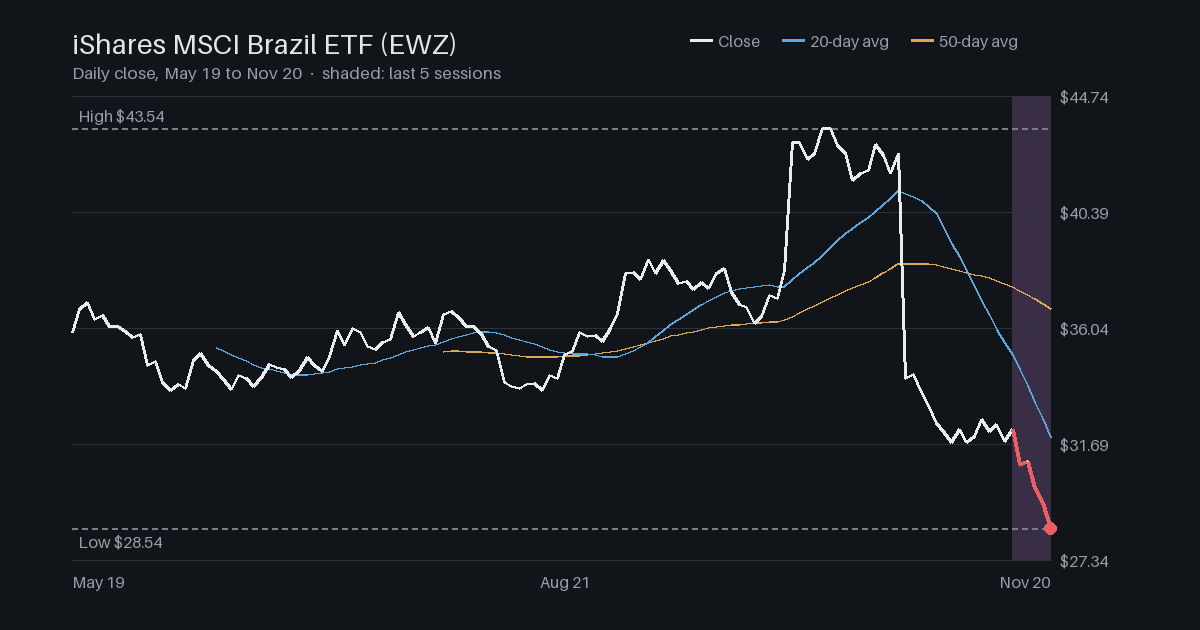
iShares MSCI Brazil ETF (EWZ) closed at $28.54 on Nov 20, 2026, down 11.4% from five sessions earlier. The last close is below its 20-day average of $31.94 and below its 50-day average of $36.77. Since May 19, 2026 it has traded between $28.54 (low, Nov 20, 2026) and $43.54 (high, Oct 9, 2026).
| Last close | $28.54 | Closing price on Nov 20, 2026. |
|---|---|---|
| 5-session move | -11.4% | Change in the closing price over the last five trading days. |
| 20-day average | $31.94 | The average closing price of the last 20 trading days. |
| 50-day average | $36.77 | The average closing price of the last 50 trading days. |
| Period high | $43.54 | Highest price since May 19, 2026. |
| Period low | $28.54 | Lowest price since May 19, 2026. |
Related coverage
 New Brazilian Labor Rules and High Interest Rates Squeeze RetailersBrazil's new 5x2 workweek decree and a high Selic rate squeeze retailers and fintechs, while Lula clashing with markets adds to fiscal caution.
 US Funds Keep 145,816 Net-Long Soybean Contracts, CFTC ReportsSpeculative funds held 145,816 net-long soybean contracts as of November 17, 2026, supporting Brazilian export expectations, according to the CFTC.
 Banco do Brasil Eyes CEO Change After Crop Calamity Squeezes ProfitBanco do Brasil faces a leadership shakeup as bad agricultural loans trigger a 66.5% profit drop and the suspension of 2027 intermediate dividends.