

BofA Eyes Rare Earths, Infrastructure if Spending Cuts Delivered
Bank of America's Brazil leadership says global capital could flow back into critical minerals and infrastructure if the government executes spending cuts.
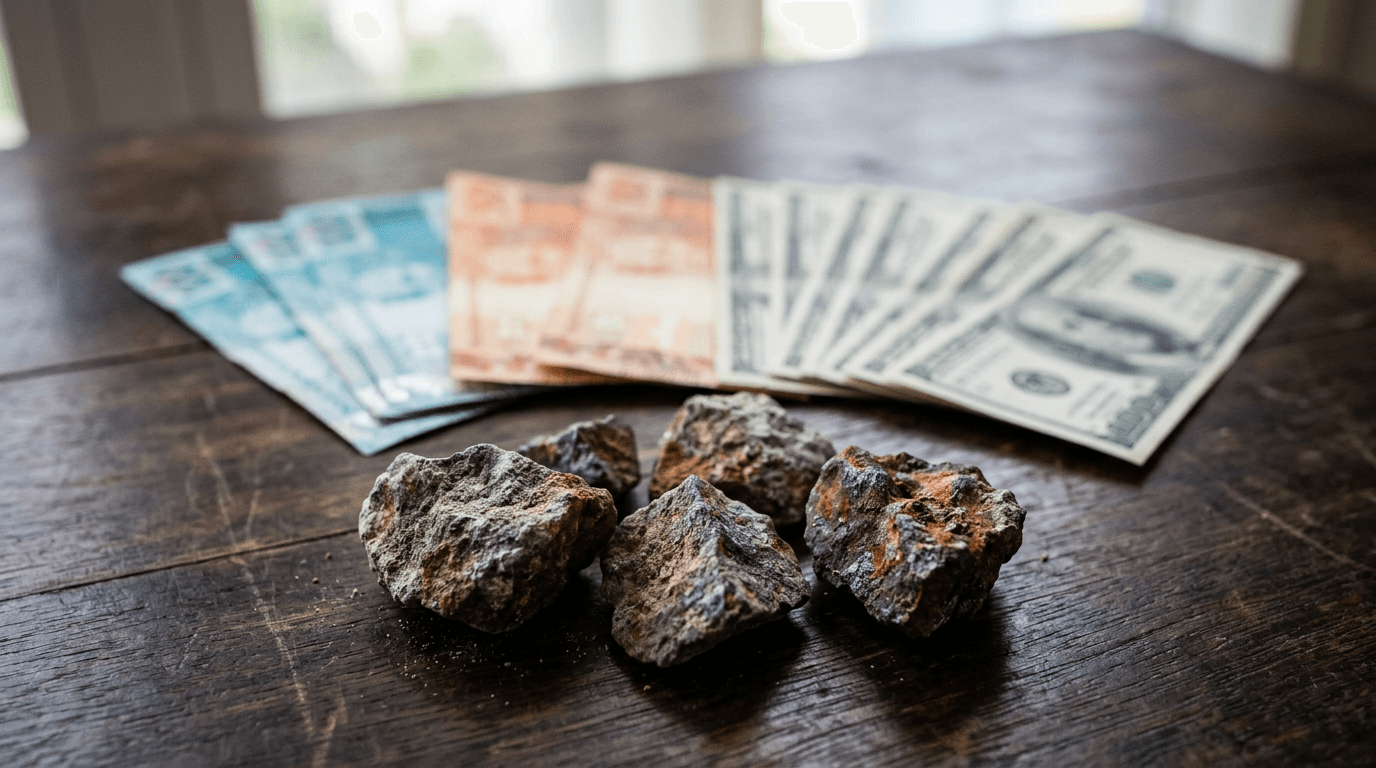
Key takeaways
- Bank of America's Brazil executives stated that the country has a significant path to resume attracting global capital if it delivers on fiscal adjustments, per Bloomberg Línea on November 19, 2026
- BofA highlighted that Brazil's massive reserves in critical minerals and rare earths make it a sector that global investors cannot ignore, per Bloomberg Línea on November 19, 2026
- The bank currently projects the U.S. dollar to reach R$ 5.85 by the end of 2027, with the central bank's Selic rate path under active review, per Bloomberg Línea on November 19, 2026
Global capital has spent much of the year tightly concentrated in U.S. mega-cap technology and artificial intelligence, leaving international diversification on the back burner for most American retail investors. However, as capital demands for AI hardware stretch global resources, Wall Street is searching for the next macro shift in critical raw materials and infrastructure. On November 19, 2026, Bank of America executives stated that global capital is prepared to rotate into these specialized physical assets, provided emerging market governments can successfully clean up their public balance sheets.
In Brazil, this means the return of foreign investment hinges entirely on the federal government executing its long-promised fiscal spending cuts. According to Bruno Saraiva, co-head of investment banking in Brazil and head of equity capital markets for Latin America at Bank of America, the country has a "relevant" chance of attracting international capital once it finishes its fiscal "homework," as reported by Bloomberg Línea on November 19, 2026. While the local stock exchange has maintained positive foreign inflows for the year, BofA executives warned that international investors require concrete public-sector savings before returning in earnest. For global investors watching the region, the latest outlook from brazil bank of america suggests that a credible fiscal package is the single most critical catalyst for the market.
The primary draw for this foreign capital lies in sectors that are highly insulated from routine political noise, particularly critical minerals and logistics. Diogo Aragão, BofA’s head of mergers and acquisitions in Brazil, pointed out on November 19, 2026, that the country’s massive reserves of rare earth elements make it a region that global players simply cannot ignore. With the global tech supply chain hungry for elements crucial to advanced computing and defense, Brazil’s deep deficit in basic transportation infrastructure and its untapped mineral wealth represent high-barrier-to-entry opportunities that continue to attract multinational interest regardless of local market volatility.
To account for this volatile transition, Bank of America has adjusted its macroeconomic forecasts for the local currency. On November 19, 2026, the bank announced it projects the U.S. dollar to reach 5.85 Brazilian reais (R$ 5.85) by the end of 2027. This weaker currency outlook makes Brazilian assets cheaper for dollar-based investors, but it also creates structural headaches. Aragão noted that extreme exchange rate volatility is the main hurdle for foreign corporations, because a depreciating real ultimately reduces the dollar-denominated revenue that these parent companies can report back home. Consequently, the bank's previous projection of eight 0.25-percentage-point cuts to Brazil's Selic interest rate through 2027 is now under active review.
| Metric | Projection (as of Nov 19, 2026) | Previous Outlook |
|---|---|---|
| USD/BRL Exchange Rate | R$ 5.85 (End of 2027) | — |
| Selic Interest Rate Path | Under active review | Eight cuts of 0.25 percentage points |
International asset managers are now focused on whether the Brazilian Congress will pass the final pieces of the government's fiscal containment package. Until these structural spending cuts are signed into law, major sovereign wealth funds and global private equity firms are likely to remain on the sidelines, keeping their capital in high-yielding U.S. dollar-denominated assets. If the fiscal targets are met, the dual engines of rare earths and infrastructure concessions could see a rapid influx of foreign direct investment.
In your brokerage app
For retail investors seeking exposure to this potential critical mineral and infrastructure pivot, the largest vehicle is the iShares MSCI Brazil ETF (NYSE Arca: EWZ), which tracks large- and mid-sized Brazilian equities and is highly sensitive to the USD-BRL exchange rate. On the critical minerals side, Sigma Lithium Corporation (NASDAQ: SGML), a producer of high-grade lithium based in Minas Gerais, offers direct equity exposure to the region’s transition metals sector. However, any investment in these assets remains heavily dependent on the stability of the Brazilian real and the central bank's upcoming decisions regarding the Selic interest rate.
Analysis · NWX analysis desk
Which Brazil assets this touches
- EWZ, USDBRL, DI1 — Named in this story.
- NU, STNE, PAGS — Big swings in U.S. tech stocks tend to spill into Brazil's fintechs listed in New York and into the broad Brazil fund, as global investors change how much risk they hold.
Technical picture · iShares MSCI Brazil ETF (EWZ)
iShares MSCI Brazil ETF (EWZ) closed at $28.54 on Nov 20, 2026, down 11.4% from five sessions earlier. The last close is below its 20-day average of $31.94 and below its 50-day average of $36.77. Since May 19, 2026 it has traded between $28.54 (low, Nov 20, 2026) and $43.54 (high, Oct 9, 2026).
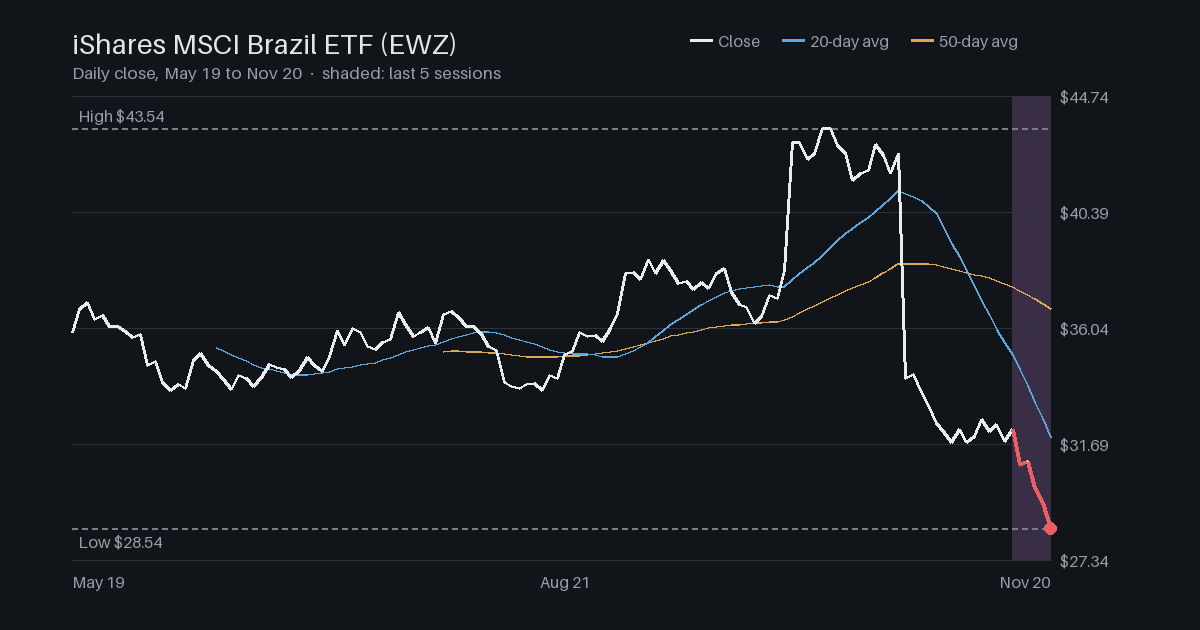
| Last close | $28.54 | Closing price on Nov 20, 2026. |
|---|---|---|
| 5-session move | -11.4% | Change in the closing price over the last five trading days. |
| 20-day average | $31.94 | The average closing price of the last 20 trading days. |
| 50-day average | $36.77 | The average closing price of the last 50 trading days. |
| Period high | $43.54 | Highest price since May 19, 2026. |
| Period low | $28.54 | Lowest price since May 19, 2026. |
Related coverage
 Goldman Sachs Cuts Brazil Stocks to Neutral on Fiscal RisksGoldman Sachs downgraded Brazilian equities to neutral on Nov. 17, 2026, citing a slowing economy, sticky inflation, and fiscal risks.
 Easing Consumer Prices Rose 0.14% in October but Top Brazil's TargetBrazil’s October inflation slowed to 0.14%, but the 12-month trailing rate rose to 4.63%, exceeding the Central Bank's 4.5% target ceiling.
 Itaúsa Sets Nov. 30 Cutoff for Brazil Real 0.02 Dividend PayoutBrazilian holding giant Itaúsa sets a November 30 cutoff for its fourth-quarter dividend, yielding a net R$ 0.02 per share to be paid on January 4, 2027.